
The difference between armoured, armour-plated and reinforced doors comes down to security, structure and use.
Armoured doors are the most common choice and suit homes and offices.
Armour-plated doors offer a higher level of protection and are designed for high-risk settings.
Reinforced doors, on the other hand, are existing doors upgraded with added measures, but with lower performance.
Despite these differences, the three terms are often confused and used as if they meant the same thing.
In this article we explain clearly the difference between armoured, armour-plated and reinforced doors, looking closely at materials, level of security, how they are fitted and price ranges.
We will also see when one solution makes more sense than another, to help you find the option best suited to your protection needs.
Armoured, armour-plated or reinforced door: what really changes
| Feature | Armoured Doors | Armour-plated Doors | Reinforced Doors |
|---|---|---|---|
| Structure | Internal steel + outer panels | Fully steel, multi-layer structure | Existing door with added reinforcements |
| Level of security | Medium-high (resists common break-ins) | Very high (resists advanced attacks) | Low-medium (depends on the base structure) |
| Certifications | EN 1627 (RC1 to RC6) | EN 1143-1 (safe standards) | No full certification |
| Locking systems | Multipoint, security cylinder | Advanced, complex systems | Upgraded locks on existing structure |
| Where they are used | Homes, offices, shops | Banks, vaults, high-risk settings | Homes to be upgraded without replacement |
| Fitting | Requires professional fitting | Complex, specialist fitting | Work on the existing door |
| Price | Medium (from €2,500 + VAT) | High (often made to measure) | Low (targeted work) |
| Advantages | Balance of security and comfort | Maximum protection | Affordable and minimally invasive |
| Limits | Not suited to very high risk | Costly and less attractive | Limited security |
When weighing up a security solution, it is important to understand that armoured, armour-plated and reinforced doors are not the same thing, even though they are often confused.
Armoured doors are designed as genuine security systems.
They have an internal steel structure, multipoint locking systems and cladding panels that also give a good finish.
They are made for everyday use in homes and offices, offering a good balance of security, insulation and convenience.
Armour-plated doors have a sturdier, more complex build.
They are made with fully metal structures, often with several layers and high-strength materials. In some cases they may include specific fillings or advanced protection systems.
For this reason they are used in settings that call for high security, such as vaults, banks or places where valuables are kept.
Reinforced doors, on the other hand, are not built as security doors from the start.
They are existing doors upgraded with added measures, such as more advanced locks, bars or metal plates.
These measures increase resistance to attack, but they do not offer the same structural performance as an armoured door designed for security from the outset.
Understanding these differences helps you weigh up the options available.
We will look in detail at materials, levels of protection, how they are fitted and costs, so you have the full picture and can choose the solution best suited to your needs.
The main differences between armoured, armour-plated and reinforced doors
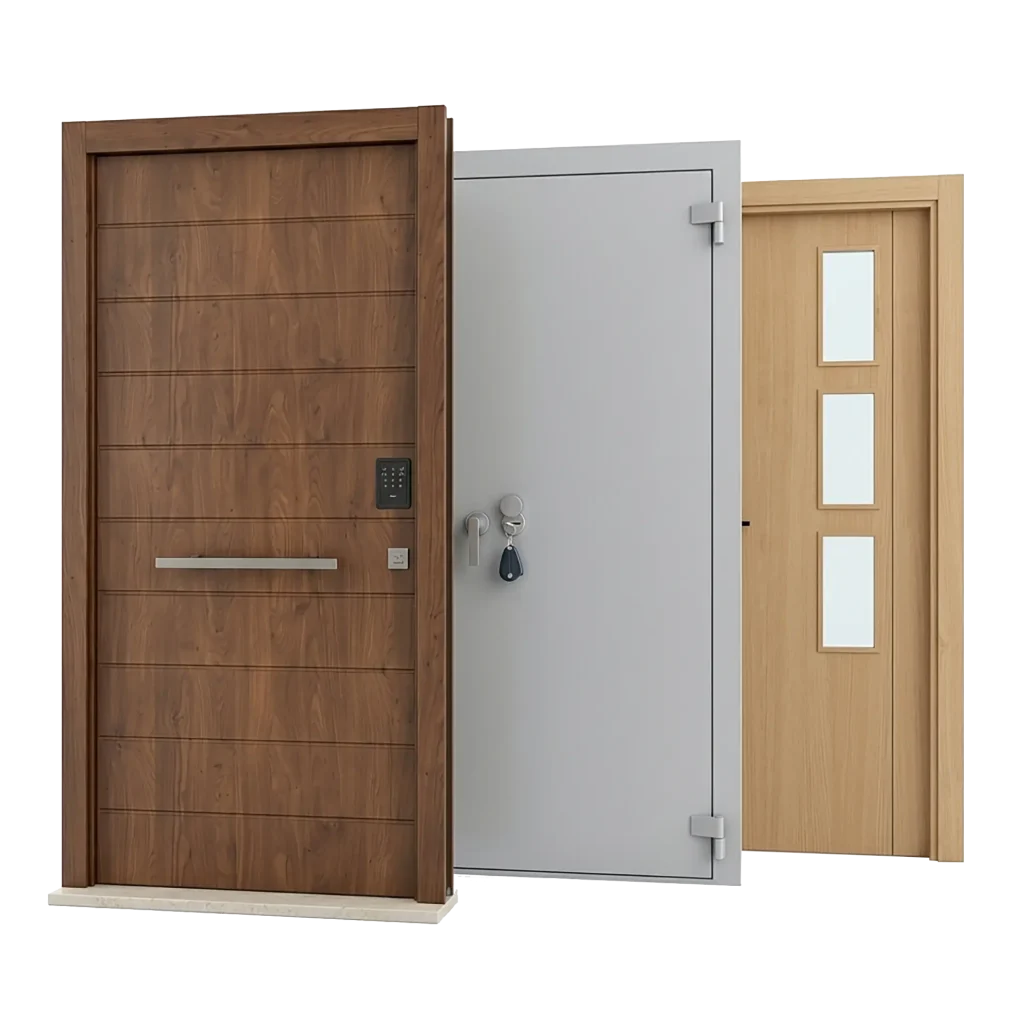
To help you choose, it is worth going into more detail and comparing these three types of door across the points that matter most.
The differences come out above all when you look at how they are built, how much they protect, where they are used and which certifications they meet.
In the next sections we will go through these one by one, to give a clear, concrete comparison of the different solutions.
Materials and structure
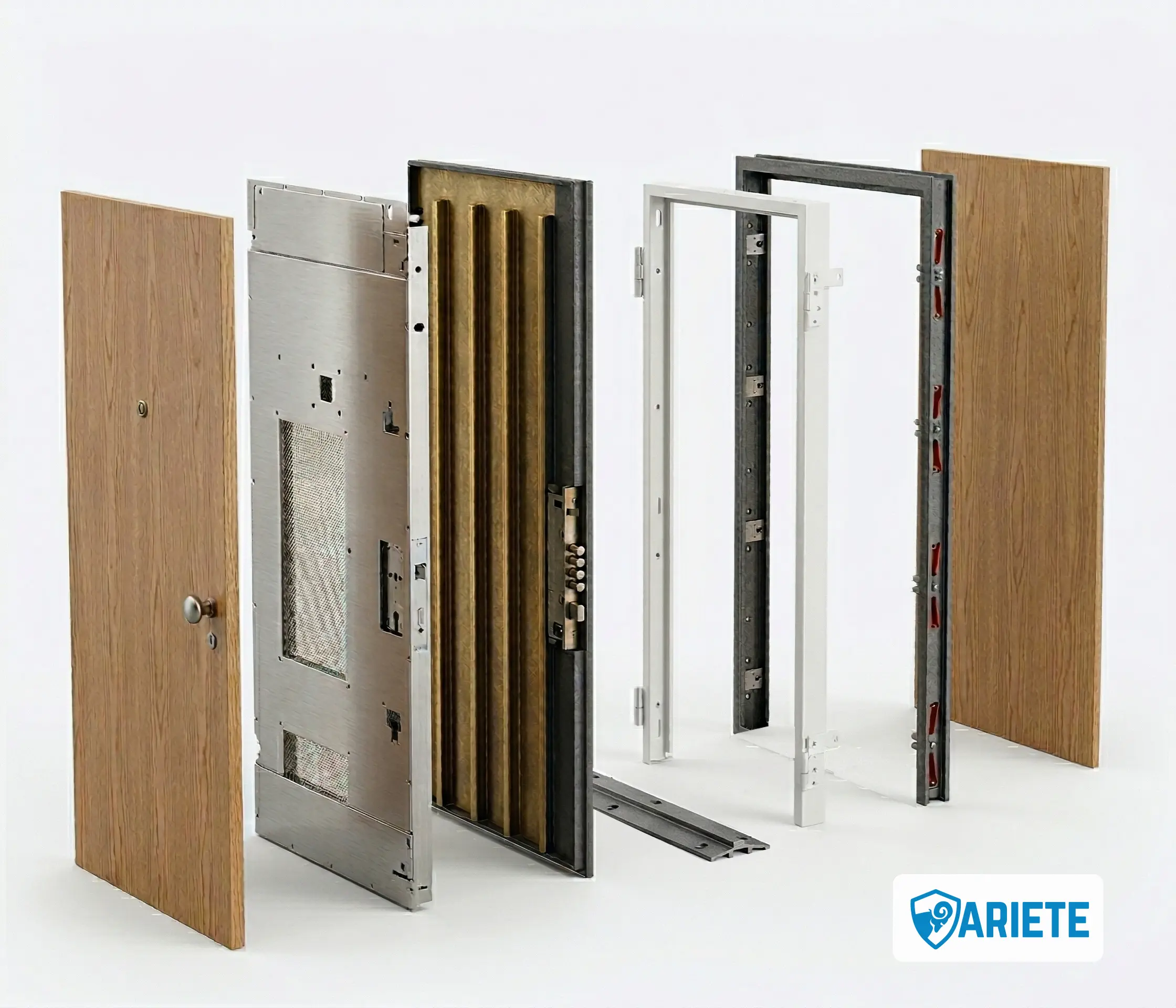
The layered build of an armoured door
The difference between armoured, armour-plated and reinforced doors starts with the internal structure.
It is precisely from here that strength, durability and the ability to defend against forced entry depend.
Armoured doors are designed as complete security systems.
Their structure is made up of a steel frame and subframe, fixed to the masonry, and an internal leaf with one or more steel plates.
Inside there may be vertical reinforcements (omega profiles) that increase the rigidity of the door.
A key element is the multipoint lock, which drives several locking points (side, top and bottom), spreading the force across the whole structure.
Added to this are security cylinders, anti-drill defenders and anti-pull systems. The outer cladding, on the other hand, has an aesthetic and insulating role, but does not directly affect security.
Armour-plated doors are built for higher levels of protection.
The structure is fully metal, with several layers of high-strength steel, often of considerable thickness.
In some cases they may include special materials or technical fillings designed to resist advanced break-in tools.
They are fitted with very complex locking systems, with numerous anchoring points and locks certified for high-security settings.
The frame is particularly sturdy and sized to bear heavy weights, while the whole structure is designed to withstand not only attempted break-ins, but also prolonged, targeted attacks.
Reinforced doors, on the other hand, do not have a structure designed for security.
You start from an existing door, often in wood or lightweight materials, to which reinforcing elements are added.
These include: more advanced locks (triple or quintuple), bars, metal plates or stiffening bars.
These measures improve resistance at the most vulnerable points, such as the lock and hinges, but the overall structure remains the original one.
This means that, under heavy stress, the door can deform or give way more easily than an armoured door designed from the start to withstand attacks.
The difference, then, is not only about materials, but above all about the way these doors are designed: armoured and armour-plated doors are conceived as genuine security systems, whereas reinforced doors are simply an existing door to which elements are added to improve its resistance.
Level of security
The level of security is one of the things that most sets armoured, armour-plated and reinforced doors apart.
Armoured doors are designed to resist the most common attempts at forced entry.
Their effectiveness depends on a set of components that work together: steel structure, multipoint locks, security cylinders and protection systems such as defenders, anti-pull and anti-drill devices.
These elements serve to protect the most vulnerable points of the door, making it harder to force and increasing the time needed to break in.
Armour-plated doors offer a higher level of security.
They are designed not only to slow down an intrusion, but to resist prolonged and more complex attacks, even with professional or power tools.
This is possible thanks to sturdier structures, more advanced locking systems and high-strength materials, which let the door keep its integrity even under prolonged stress.
Reinforced doors improve the resistance of an existing door, but with an important structural limit.
Even if they can be fitted with advanced locks, metal bars or reinforcing plates, their effectiveness always depends on the base structure, which is not designed to resist targeted attacks.
For this reason they can slow down an attempted break-in, but they do not guarantee the same level of protection as a door designed as a complete security system.
When comparing these solutions, it is essential to consider how the whole structure reacts to an attack, not just the presence of single security elements.
Where they are used
Another difference concerns where and when it makes sense to fit these doors.
Armoured doors are the most widely used solution in homes and businesses. They are used in flats, houses, offices and shops, where the entrance needs protecting while keeping comfort and convenience.
Beyond security, they offer thermal and acoustic insulation, ease of use and plenty of scope for customising the look.
Armour-plated doors are designed for settings where security is an absolute priority. They are found in banks, vaults, jewellers, sensitive archives or isolated homes, where the risk of attack is higher.
In these cases you need a door able to resist not only quick attempts, but also organised actions carried out over time.
It should be kept in mind that these are heavier solutions, more complex to fit and less focused on appearance.
Reinforced doors are chosen when you do not want to replace an existing door entirely.
They are common in older properties, second homes or situations where a quick, less invasive solution is wanted.
They can improve basic security, but they remain limited by the original structure, which is the main weak point.
The choice therefore depends on concrete factors such as level of risk, how exposed the entrance is and the value of what you want to protect.
Standards and certifications
To assess these solutions properly, it is important to understand how security is measured.
Armoured doors are classified according to the European standard EN 1627, which assigns a burglar resistance class (from RC1 to RC6).
This classification indicates not only the level of resistance, but also the test conditions, such as the type of tools used and the time needed to force the door during laboratory tests.
Armour-plated doors refer to stricter standards, such as EN 1143-1, also used for safes and high-security systems.
In this case, the tests are more complex and assess resistance to structured, prolonged attacks, carried out with professional tools.
For reinforced doors, on the other hand, there is no full certification of the system.
Even if there may be certified components (such as locks or cylinders), an overall assessment of the door is missing, because the structure is not designed as a security system.
Certifications are therefore essential because they let you compare different products on an objective basis.
Without them, it becomes harder to understand what level of protection you are actually buying.
Armoured, armour-plated or reinforced: which solution to choose?
An entrance that is easy to reach and little overlooked needs higher protection than one in a more controlled setting.
Another decisive factor is the continuity of the structure.
If you want effective protection, it is important that the door, frame and locking system are designed as a single system.
In this sense, doors designed for security from the outset deliver more reliable performance than later interventions on an existing structure.
Then there is the type of intervention to consider.
Replacing the door entirely lets you choose higher-performing, more integrated solutions.
Working on an existing door, on the other hand, can be useful when you are looking for a quick turnaround or want to avoid invasive work, but it brings structural limits worth knowing about.
Finally, it is important to weigh up the balance between performance and cost over time.
A cheaper solution may be adequate in some situations, but it could call for additional work or offer lower protection than a door designed to deliver security on a lasting basis.
An informed choice starts right here: bringing these variables together and understanding which solution really meets your specific needs, rather than going by the name or the perception of the product alone.
A short history of security doors
To really understand why we talk today about armoured, armour-plated and reinforced doors, we need to take a step back.
Up until the 1960s and 1970s, front doors were almost always made of wood and offered very limited protection.
As burglaries increased, people began working on existing doors by adding metal sheets, sturdier locks and more complex locking systems.
This is how the first “reinforced” solutions came about.
Later, instead of modifying existing doors, people began designing doors built for security from the start.
The first armoured doors were mixed structures, with a wooden base and metal reinforcements.
Armour-plated doors, on the other hand, were made entirely of iron and were used in settings that called for higher protection.
Over time, though, the technology changed.
Today, armoured doors too are built with fully steel internal structures, advanced locking systems and certified components.
This has made the distinction between armoured and armour-plated far less clear-cut than in the past.
It is also for this reason that, even today, the two terms are often used as synonyms, even though in technical and commercial terms they continue to indicate different levels of security and performance.
In practice, the evolution of security doors follows the same path: from simple adaptations of existing doors to systems designed to resist ever more sophisticated attempts at forced entry.
How to fit an armoured, armour-plated or reinforced door

When it comes to security doors, the focus tends to fall on materials, locks and certifications.
In fact, there is an equally important aspect: the fitting.
Even the best door, if fitted badly, can lose much of its effectiveness.
This is because security does not depend on the leaf alone, but on how the whole system is fixed to the structure of the building.
For armoured and armour-plated doors, fitting takes place in several stages.
It starts with the subframe, which is inserted into the wall opening and fixed firmly in place, often with anchor straps or plugs fixed to the masonry.
This element is essential because it is the point connecting the door to the home.
Next, the frame is fitted, onto which the door leaf is hung.
All the components must be perfectly aligned, because even small errors can compromise the closing and, over time, create weak points.
An important step is also the sealing between frame and wall, which serves not only for thermal and acoustic insulation, but also contributes to the overall stability of the system.
In some cases technical foams or specific materials are used to avoid play and movement.
Armour-plated doors, being heavier and more structured, call for even more care.
The fitting must take into account the heavy weight, the precision of the internal mechanisms and the distribution of forces across the anchoring points.
For this reason a highly specialist job is almost always needed.
With reinforced doors, the fitting is different.
The whole door is not replaced; instead you work on the existing one. This can include fitting more secure locks, reinforcing bars, metal plates or advanced cylinders.
Here too, however, it is important that every element is fitted correctly, especially at the most sensitive points such as the lock and hinges.
Fitting that is not carried out to a high standard can create obvious problems: difficulty opening and closing, draughts, noise, but above all a real reduction in security, because the door can be forced by acting on the fixing points instead of the structure.
For this reason, more than the product itself, what makes the difference is how it is fitted.
Relying on qualified professionals is not just a practical choice, but a fundamental part of actually getting the level of protection the door was designed for.
Prices: how much the different solutions cost
One of the most concrete aspects of the choice is price, which can vary widely depending on the level of security, the materials and the complexity of the fitting.
Armoured doors have a fairly wide price range.
The cheapest models can start from a few hundred euros, but for reliable, certified solutions the figure easily rises to between €2,500 and €4,000 + VAT or more, especially for high security classes or made-to-measure models.
The fitting also affects the final cost, with jobs that can reach several hundred euros.
Armour-plated doors generally fall into a higher bracket.
Being designed for high-security settings, they cost more, owing to structure, materials and constructional complexity. In practice, these are often custom solutions, so the price can vary considerably depending on the project.
Reinforced doors are instead the most affordable option.
Working on an existing door helps keep costs down, avoiding masonry work and full replacements.
For this reason they are often chosen when you are looking for an improvement in security with a smaller outlay, despite the limits already seen.
In general, the price grows along with the level of protection: the more a door is designed to resist complex attacks, the more it requires materials, technologies and workmanship that affect the final cost.
Conclusion
By this point it should be clear that talking about armoured, armour-plated and reinforced doors is not about choosing between three different names, but between solutions with quite different features and levels of protection.
The choice does not depend on a definition, but on concrete factors: how exposed the entrance is, what you want to protect and what level of security is really needed.
This is the starting point for understanding which solution really makes sense, avoiding both underestimating the risk and choosing oversized products.
In the same way, focusing on the door itself is not enough.
Security is the result of several factors working together: structure, components, quality of materials and the way it is fitted.
Fitting carried out correctly lets the door deliver all its performance, while a rough job can reduce its effectiveness significantly.
Choosing a security door, then, is not a decision to be made on name or price alone, but a broader assessment that takes into account the real setting and use over time.
When all these aspects are considered in the right way, the result is a solution that is solid, reliable and consistent with your needs.
If you are considering fitting a new security door, having a clear idea of the costs is a key step. As we have seen, the price can vary depending on several factors, such as the level of security, the materials and the type of work involved. To help you get your bearings in concrete terms, use the form below to request a quote tailored to your needs.
Frequently asked questions
The difference is about structure and level of security. The armoured door is a system designed to protect homes and businesses. The armour-plated door offers higher protection and is made for high-risk settings (such as bank vaults or jewellers). The reinforced door, on the other hand, is an existing door upgraded with added measures, but with structural limits.
Not exactly. Today the terms are often confused, but in general the armour-plated door refers to a sturdier solution geared towards higher levels of security than a standard armoured door, and is not suited to flats or private settings.
It is a traditional door to which elements such as more secure locks, bars or metal plates are added. It improves resistance, but does not reach the performance of a door designed for security from the start.
No. An armoured door is designed as a complete system, whereas a reinforced door remains an adaptation of an existing structure. This affects its overall resistance to attack.
In most cases, a certified armoured door is the most suitable choice. The level of security should be assessed based on the type of home and how exposed the entrance is.
If you live in a flat within a block of flats, you can choose between an armoured door of class RC3 or RC4. If you live in isolated, higher-risk settings, class RC4 is more suitable.
It is suited to high-risk settings or where there are valuables, such as banks or jewellers.
Armoured doors follow the EN 1627 standard, which defines the burglar resistance classes (RC1 to RC6). For home use, classes RC3 and RC4 are common. Avoid class RC2 as it does not offer a good level of protection.
Yes. They can follow stricter standards, such as EN 1143-1, also used for safes and high-security systems.
Yes. Poor fitting can compromise even a quality door. It is important that the frame and fixings are fitted in a precise, professional way.
An armoured door fitted badly does not deliver the performance it was designed for. So, beyond the product, assess the company you turn to, and check that the fitters specialise in fitting armoured front doors.
