
You are standing outside your front door, rummaging through your bag, and your keys are nowhere to be found.
Have you lost them, left them inside, or had them stolen?
Either way, right now you need to get in.
So let us look at what you can actually do.
There are five DIY methods for opening a door without a key: a plastic card, a lock pick, a wire hanger, a screwdriver and key bumping.
They are all designed for ordinary door locks, and on a modern armoured door they simply do not work.
That is precisely one of the reasons an armoured door earns its name.
When the problem is an armoured door, calling a general locksmith is often not enough: you need a technician who knows that specific system.
When the problem is lost keys, once the door is open you always have to make a decision about the cylinder: recode it, replace it, or change the lock.
In this guide I will explain:
- The four typical situations that leave you standing in front of a door without a key
- The five DIY methods and their real limits
- Why these methods are useless on an Ariete armoured door
- What to do if you are locked out
- What to do once the door is open
Let us go through it point by point.
The 4 reasons you end up in front of a door without a key
Not all key emergencies are the same.
Knowing which of the four scenarios you are in changes the solution and the risk.
Lost keys
The keys are lost and you have no idea where.
They may have dropped in the street, been left behind at the restaurant or slipped under the seat of your car.
The real problem is that whoever finds them can trace your address, if the bunch also held documents or gate remotes.
This is why, once the door is open, you always have to make a decision about the cylinder: recode it, replace it, or change the lock itself.
Keys left in the lock
The key is in the lock on the other side of the door.
Usually someone inside has left it there, and now you cannot insert yours from outside.
On an ordinary lock there is a trick or two: slide a sheet of paper under the door and push the key out of the cylinder from outside so it drops onto the paper.
On an armoured door of class RC3 or higher the trick fails, because the gap under the door is sealed by the threshold and the draught-excluder.
Door accidentally slammed shut
The door closed behind you as you went out without your keys.
Maybe you popped down to take out the rubbish, maybe you nipped round to the neighbour for a moment.
On old, non-armoured doors the latch sometimes does not hold, and a shove or a plastic card is enough.
On an Ariete armoured door this does not happen: the latch stays engaged at all times and the auxiliary bolts hold the leaf even without a key turn.
Stolen keys
You suspect someone has stolen them.
Perhaps your bag was snatched, perhaps you lost a bunch that also carried your address.
This is the most delicate case: whoever has the key now has access to your home, whatever type of lock is fitted.
In this scenario, once you have opened the door, you must block access for whoever holds the original keys: recode the cylinder or replace it.
5 methods to open a door without a key (and their limits)
Let us look at the five DIY methods doing the rounds online.
I will explain how they really work, which type of door they help with and why they are not an option on an armoured door.
A legal note: these methods are only lawful if you are the owner or have the explicit consent of whoever lives in the home.
Opening a door that is not yours is a criminal offence.
The plastic card method
You slide a rigid plastic card between the leaf and the frame, level with the latch.
Pushing the card downwards and turning the handle, the latch draws back and the door opens.
It only works if the door has an exposed spring latch and the auxiliary bolts are not engaged.
Even on an Ariete armoured door the method can work, but only if the door is merely pulled to and not locked with the key.
The real risk is breaking the card, not damaging the latch.
If the door is locked with the auxiliary bolts engaged, the method is useless on any lock.
Hairpin or lock pick: lockpicking
You insert two thin tools into the cylinder: one to apply tension, one to move the pins one by one.
You keep working until the cylinder turns.
It is the classic film technique, but in practice it takes hours of training and a very cheap lock.
Modern euro cylinders have anti-picking pins, lateral rotations and mechanisms that block any attempt.
The patented Ariete cylinder is certified anti-picking for exactly this reason.
The metal wire hanger
You bend a wire hanger into a thin hook and pass it through a gap under the door, trying to catch the handle on the inside.
There is also the variant with a file passed through a transom when there is an opening above the leaf.
In both cases the method only works on light internal doors with a gap underneath and a reachable handle.
On front doors, and on armoured doors in particular, the gap under the door is sealed by the threshold and the inside handle is protected by its plate.
Nothing can be reached from outside.
Screwdriver or Allen key
You use a cross-head screwdriver or a thin Allen key to force the cylinder or the lock.
It is a destructive method: it breaks the cylinder for good and usually damages the frame as well.
On an Ariete armoured door the square defender with chamfered corners fully covers the cylinder and stops any lever tool from getting a grip on it.
Key bumping (the bump key)
You use a bump key: a modified key that, when struck with a hammer, makes all the cylinder pins jump at once.
It is the technique favoured by professional burglars on old doors with an uncertified euro cylinder.
The Ariete cylinder is certified anti-bumping and its hardened-steel pins do not jump under the impact.
This is one of the technical reasons why an Ariete door does not open with the methods you see on YouTube.
Why these methods do not work on an Ariete armoured door
An armoured door is not just a “tougher” door.
It is a security system designed to withstand professional tools, let alone a hairpin or a card.
Let us look at what makes the DIY methods ineffective.
The patented anti-bumping and anti-picking cylinder
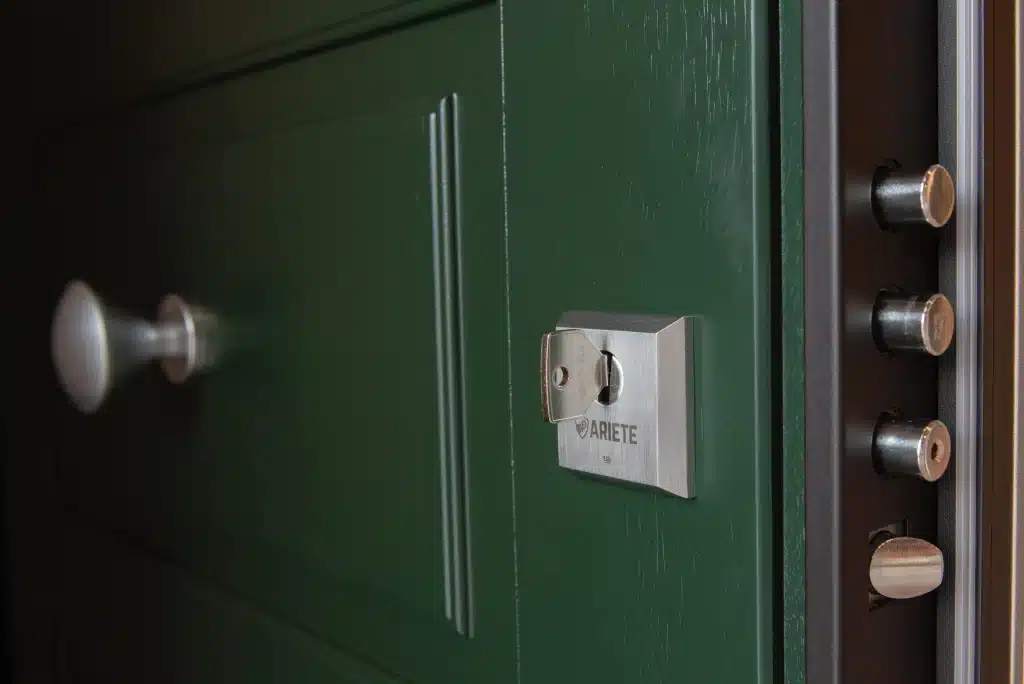
The euro cylinder fitted on Ariete doors is patented and certified against the most common break-in techniques.
Hardened-steel pins, extra security pins and a complex internal geometry: none of these features give way to lock picks or bump keys.
On top of that, the Ariete key is patented and cannot be copied by a hardware shop: no shopping centre can cut a duplicate.
Even someone holding it in their hands cannot reproduce it without our authorisation.
The square defender against the scaffolding-pipe technique
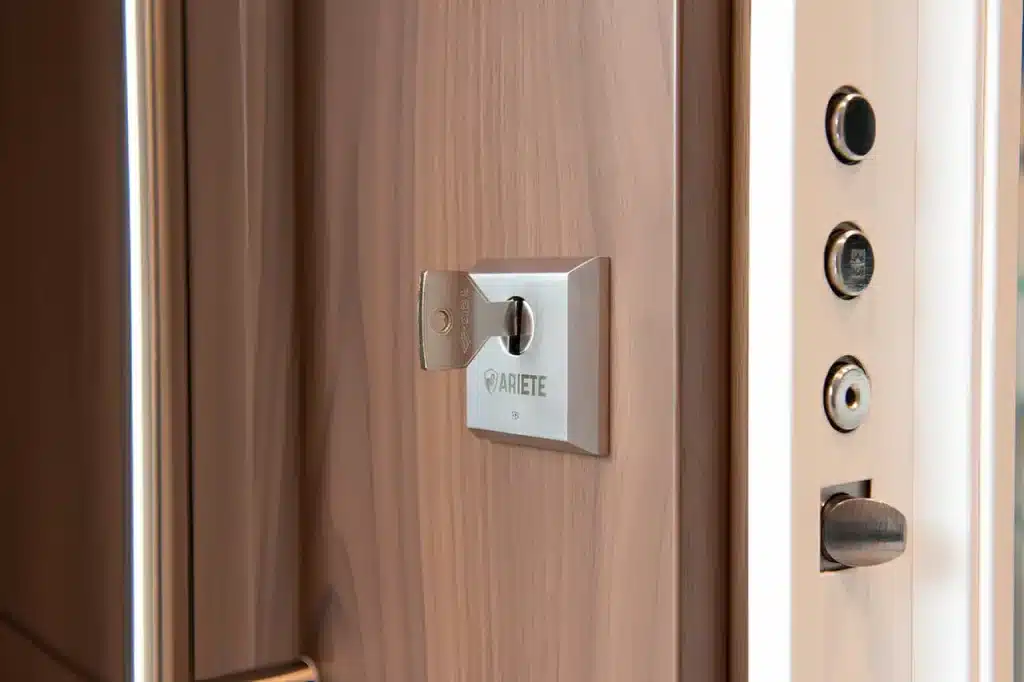
On Ariete doors the cylinder is not left exposed: it is covered by the square defender with chamfered corners, the only one of its kind on the market.
This device blocks the scaffolding-pipe technique, with which burglars grip the cylinder with a clamp and rip it out of the door.
The square defender offers no mechanical purchase whatsoever: a clamp slips off, a scaffolding pipe cannot close around it.
The anti-pull protection is a function of the defender, not of the cylinder on its own.
What to do if you are locked out
If you are standing in front of a closed door, with or without your keys, there are three sensible routes.
One of them is far cheaper than the others.
First option: the fire brigade (in Italy, the number is 115). If there is a genuine emergency (a child or an elderly person inside, gas left on, animals trapped), the fire brigade attends free of charge and opens the door. It also applies when the emergency is only “yours” but real, such as being locked out at night in the cold: they assess each case, and often turn out anyway.
Second option: a private emergency callout (a locksmith). It always works, but it is expensive, especially at night and on public holidays when rates can double or triple. If the situation allows, it is better to call the fire brigade first or wait until the next day.
Third option: wait. If you have a relative or a neighbour keeping a spare set, that is your answer. If your home is a second home and there is no urgency, it is better to come back tomorrow with the key.
A point to make clear about Ariete: we do not do emergency lock opening, because it is not our trade. Ariete sells and fits armoured doors. If after opening the door it is damaged and needs replacing, or if losing your keys leads you to consider upgrading the cylinder or the whole door, then we help you choose the right system.
Want to know whether it makes sense to replace your current door?
Fill in the form below with a few details about the door you have today and about your home.
We will reply with a concrete assessment of what is worth doing.
What to do once you have opened the door
You are back inside and the immediate problem is solved.
Now, though, you have to decide what to do about the cylinder or the door.
The options depend on the reason you found yourself without keys.
Lost or stolen keys: Ariete’s 5+1+1 system
If the keys are lost or stolen, your original keys are out there and their access has to be blocked.
On standard armoured doors the only route is to replace the cylinder: call a technician, buy a new cylinder, pay for the fitting, sort out the new copies.
On Ariete doors there is the 5+1+1 system: five working keys, one maker’s key, one emergency key.
The emergency key lets you recode the cylinder on your own, without calling anyone, up to 2 times in the life of the door.
The system makes the difference in three situations.
Losing the bunch: you recode and the old keys stop opening the door.
Stolen keys: you recode at once and whoever has them cannot get in.
Short lets and guest turnover: you recode every time the guests change.
Only after the two available recodes do you have to physically replace the cylinder.
For most homes this is something that happens once in twenty years.
When it is worth replacing the whole door
There is one case where it pays to look beyond the cylinder: when the door is old.
If you have a door with a double-bit lock, the door is very likely 25 to 30 years old or more.
A misaligned frame, hardened seals, lost insulation, deteriorated panels: spending on the cylinder on a door like that is almost always a waste, because the door will need replacing within a few years.
In this case the rational choice is to consider full replacement straight away.
You will find more detail in our guide to armoured door locks.
What is more, a new door qualifies for the Italian Renovation Bonus and, where there is thermal efficiency, for the Italian Ecobonus as well.
How to avoid being left without your keys
Prevention is the sum of a few concrete choices that take the problem away at the root.
Reliable spare keys: a copy at the home of a trusted relative or with a neighbour you get on well with. Never give the keys to the caretaker unless there is well-established trust.
No keys in the bag with your documents: if your bag is stolen, the thief has both the keys and your address.
Smart locks and biometrics: on Ariete armoured doors in the Futura range the physical key becomes secondary, and the door opens with an app, a badge, a numeric code or a fingerprint.
Key safes: these should be avoided. The little numeric-code boxes fitted near the door are very risky: you are delegating the security of your entire home to a small box a few centimetres across that is easily forced. They shift the problem, they do not solve it: whoever finds the box forces the box and ends up holding the keys.
Conclusions
Opening a door without a key is never a simple situation.
The real complication is working out what happened, why, and how to stop it happening again.
On an ordinary door the DIY methods sometimes work, but they risk destroying the lock.
On a modern armoured door those methods are ineffective, and that is the proof your door is doing its job.
When you find yourself in front of a door without a key, the right move is to understand first what you are dealing with.
If you have an old door, it is worth carrying out a full assessment before spending money on the lock alone.
If you have an Ariete door, the 5+1+1 system lets you handle losses and thefts without calling a technician every time.
If you are locked out right now, call the fire brigade first (in Italy, the number is 115): they open the door free of charge in a genuine emergency.
If you do not know what you have and want to get a clearer picture, request an assessment of your current door from our consultants.
Frequently asked questions
It depends on the type of door and on why you do not have the key. On a light internal door with an exposed latch a rigid plastic card can open it if the auxiliary bolts are not engaged. On an ordinary front door the DIY methods (wire hanger, lock pick, card) rarely work. On a modern armoured door no DIY method works: you need the fire brigade (115 in Italy), free in a genuine emergency, or a paid private callout, with high rates at night or on public holidays.
First get into the home, calling the fire brigade if it is urgent or a private callout otherwise. Then block access for whoever found the keys. On standard armoured doors you replace the cylinder. On Ariete doors you use the emergency key of the 5+1+1 system: you recode the cylinder on your own, without technicians, up to two times in the life of the door. The lost keys stop working immediately.
Lockpicking with a hairpin is a technique that takes hours of practice and only works on very cheap locks with standard pins. You use two tools: one to apply tension to the cylinder, one to move the pins one by one until the cylinder turns. Modern euro cylinders and all patented Ariete cylinders have anti-picking pins, lateral rotations and mechanisms that block it. On a good-class armoured door a hairpin is useless.
If the door is only pulled to, with no auxiliary bolts engaged, you can try a rigid plastic card between leaf and frame, at the risk of breaking the card. If the door is locked from inside, nothing DIY works on an armoured door. On a traditional door you can try the sheet of paper under the door to drop the key that is in the lock on the inside. Either way it is best to call the fire brigade (115 in Italy) if it is urgent, otherwise a paid private callout.
Only if you are the rightful owner or have the explicit consent of whoever lives in the home. Opening a door that is not yours is unlawful entry even if you steal nothing. When you call a locksmith, they will always ask you for an identity document and proof of residence before going ahead.
Yes, even on armoured doors, but only when the latch is not held by the auxiliary bolts, that is when the door is merely pulled to and not locked with the key. The real risk is breaking the card, not damaging the latch. If the door is locked with the auxiliary bolts engaged, the method does not work on any type of door.
The cylinder is sold with five working keys, one maker’s key and one emergency key. When you lose your keys you insert the emergency key into the cylinder and all the previous working keys stop working. You do it on your own, without technicians, and you can repeat it up to two times. Only after the two available recodes do you have to physically replace the cylinder.
Do not force it with other keys, because you would push the fragment in deeper. There are specific techniques for extracting the broken part without damaging the cylinder. You will find the detailed steps in our guide on a broken key in the lock.
Yes, from inside you just turn the knob or the handle: opening is always guaranteed for safety reasons in an emergency, such as a fire or poisoning. The only issue is opening from outside when you do not have the keys on you.
When the door is more than 20 to 25 years old, with a misaligned frame, lost insulation or an original double-bit lock. Investing in the lock of an old door is almost always a waste: it is better to put the spend towards a new RC4 door, with access to the Italian Renovation Bonus.
