
Are you looking for more information about the double-bit lock?
Do you need to replace it and want to know the price, the differences with the euro cylinder or how to protect it?
You have come to the right place.
If you do not know me, let me introduce myself: my name is Mauro Semonella, I am the owner of Ariete Security Doors and an expert in security doors and locks, and in this article I will tell you everything there is to know about the double-bit lock.
If you read the article right to the end, you will discover everything you need to know about this type of lock.
Ready? Let’s begin!
Everything you need to know about the double-bit lock
When the time comes to buy or replace the armoured door of your home, the sheer size of the offer on the market could genuinely dishearten and discourage you, but in reality the steps to take are very few.
So, take heart!
You simply need to grasp the basic concepts to start from in order to identify the product that is right for you: one that can guarantee protection, security, acoustic and thermal insulation and, why not, respect for the aesthetic standards of your home too.
The qualities you should look for in your security door – and of course in the armoured door lock you will need to fit – are solidity, strength and durability, without ever giving up on demanding the right level of expertise from the people we turn to.
So let’s first try to understand whether double-bit locks are secure and the differences between the two main types of lock.
Double-bit lock or euro cylinder?
The lock is the “beating heart” of the armoured door, so let’s pay particular attention to its features and qualities.
The first step towards choosing the right lock is to understand the difference between the double-bit lock and the euro cylinder.
Double-bit lock
The double-bit lock was the first lock designed for the armoured door.
The evolution of technology has, however, now turned it into a fragile and vulnerable tool.
The double-bit lock is a mechanism made up of a sort of carriage to which the locking pistons are connected.
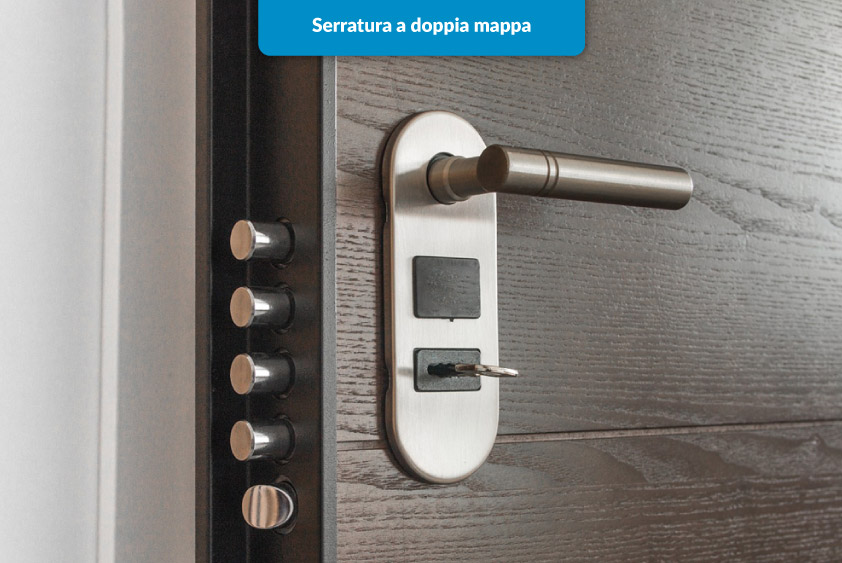
The key sets the pistons in motion, hooks and pushes the carriage: this works only if there is a perfect match between the cuts of the key and the coding of the plates of the levers, known as gorges.
The gorges must therefore prevent any foreign keys from operating the lock.
Are double-bit locks secure?
No. The fragility and vulnerability of the double-bit lock lies in its weak resistance to break-in attempts: the keyhole is in fact wide enough to allow burglars to insert break-in tools into the slot, such as the so-called “pick or skeleton key” (commonly known as the Bulgarian key).
The Bulgarian key is a type of pick used to carry out burglaries without leaving any trace: this tool in fact allows criminals to get into a home without forced entry, because it can open doors by replicating the original key.
What is more, burglary victims are not reimbursed by insurance companies because the doors and frames appear intact, having not technically been forced.
The Bulgarian pick is effective on first-generation double-bit locks operated by long-shaft keys.
With this type of key, the pick manages to insert itself as if it had the exact coding, aligning the shaped plates in the position that releases the locking pin (known as the mentonnet): the key then turns and the bolts come out.
So, if the lock is old, the bolt model is very common or we have never fitted a euro cylinder, it would be best to start considering the option of conversion.
Euro cylinder lock
The cylinder lock is a mechanism made up of a device housing a barrel into which the key is inserted: the key turns the barrel, the barrel sets the cam in motion, and the cam in turn starts the internal mechanisms of the lock.
The euro cylinder is a decidedly more secure lock than the double-bit one because it has a narrower opening that makes inserting break-in tools more difficult; it has anti-snap and anti-drill reinforcements and therefore offers more solidity and strength; its keys are hard to duplicate, because they require certification proving ownership and can only be obtained from authorised centres.
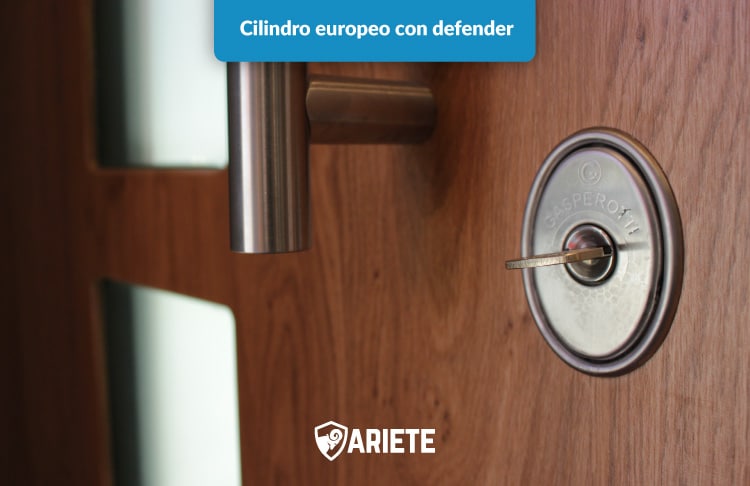
The market offers a wide choice of sizes and cylinder models that can be combined with other security systems on the same door.
If we decide in favour of the cylinder, reading the “eight certification parameters” set out in the UNI EN 1303:2005 standard can help us, as it is very thorough on how the cylinder works and on its main qualities (anti-drill, anti-picking and anti-bumping certifications).
What is the difference between the double-bit lock and the euro cylinder?
In short, the essential difference between the double-bit lock and the cylinder lock lies in their structure: the double-bit lock is generally made of a single element and so it is bought, fitted and, if necessary, replaced as one unit.
In most cases it therefore does not enjoy the interchangeability that is instead typical of the euro cylinder.
How to protect the double-bit lock
We have already pointed out how the fragility and vulnerability of the double-bit lock come from its weak resistance to break-in attempts, because the slot is wide enough to let criminals insert break-in tools inside.
Another weak point lies in the way it works, which involves considerable mechanical play due to the sliding of the gorges.
This “play” in fact allows the burglar to manipulate the lock with a tool called a feeler hook or Hobbs pick; over time the mechanical play relentlessly increases, making the lock less and less secure and more vulnerable.
So how can you make it more secure?
A good way to improve the security of the double-bit lock is to protect the keyhole with a magnetic defender that keeps access to the slot sealed: only by bringing a magnetic key close does the defender open and free up access.
The defender is a hardened-steel block that prevents, or at least makes far more difficult, any tampering with the lock.
Which are the best double-bit locks
When talking about the Bulgarian pick we mentioned that the best double-bit locks are the latest-generation ones.
Among the many locks on the market, those made by Cisa, Mottura and Securemme stand out for quality and value.
All the companies mentioned above offer a wide choice of models that easily suit every security and fitting requirement.
The double-bit locks are generally interchangeable with the more modern cylinder versions, even though replacing them is not always worthwhile from a cost point of view.
For some old double-bit models, moreover, it can be hard to find the matching cylinder lock, unless the structure of the door itself is altered.
Mottura, Cisa and Securemme have updated their latest-generation double-bit lock by modifying the gorges so as to make the burglar’s job harder.
The best double-bit locks are those that, on top of this anti-decoding innovation, feature a reinforcement on the gorges or a special steel ball to thwart break-in attempts by drilling.
Double-bit locks: prices
The cost of changing the entire lock of an armoured door depends on the brand and model.
The outlay is in any case somewhere between a minimum of €350-500 and a maximum of €800 for latest-generation locks.
The brand and model of the lock are usually marked on the key, so with this information it is possible to estimate a price more precisely.
For the replacement of a double-bit lock you should allow for an outlay ranging between €80 and €200.
The price of a good euro cylinder ranges from €200 to a maximum of around €400 for mechanical ones, and around €700 for electronic ones.
As for the time needed to replace a double-bit lock on an armoured door, replacing the cylinder alone takes anywhere between 5 and 25 minutes; replacing the whole lock could require up to 2-3 hours for a non-armoured door and 4-8 hours for an armoured one.
Replacing a double-bit lock
We have clarified the main differences between the two types of lock, so let’s now focus on those concerning the possible replacement of the two mechanisms.
There is in fact a difference between changing the cylinder and changing the entire lock, and it is important not to confuse the two operations: perhaps we think we need to “change the lock” but in reality we only need to work on the cylinder.
If we replace the cylinder, we only need to remove a few parts, take out the old or damaged cylinder and fit the new one: it is a decidedly simple and quick operation.
Changing the entire lock, on the other hand, is a little more complicated and demanding because you need to take the door off its hinges and remove the wooden panels, swap in the new lock, set up the new cylinder and perhaps fit a defender.
In any case, to work out the type of job our door needs, we could use the following criterion:
- if we want to convert the double-bit lock into a cylinder lock, we should consider replacing the entire lock;
- if the key does not go in or does not turn properly and we have a cylinder lock, we should consider replacing the cylinder.
Changing the lock from a double-bit one to a euro cylinder increases the security level of our home: in this way the double-bit lock is renewed with the same lock in its euro cylinder version.
A useful tip is to choose a euro cylinder with a flat key, with an ownership card to control duplication, and a good defender to further protect the cylinder.
Double-bit key stuck in the lock
If at some point the key does not turn inside the lock, it means that our armoured door is jammed.
The first thing to do is to avoid forcing the key to turn.
In doing so, in fact, we could help to bend the key or even break it.
As a general rule, if the double-bit lock jams, there could be essentially three reasons; let’s look at them together.
The lock is old
The wear of the gorges could cause the turn (that is, the click) to skip, with the key turning only half a turn, failing to push the carriage, and the carriage in turn failing to move the pistons.
This means that the alignment of the gorges no longer matches the original mapping of the key.
Poor maintenance
In this case the jamming comes from locks that have never been lubricated or that have been treated with products that are too viscous and have trapped dust, preventing the gorges from sliding smoothly.
In this case, take a look at my video on how to lubricate a lock.
The gorges are worn on one side only
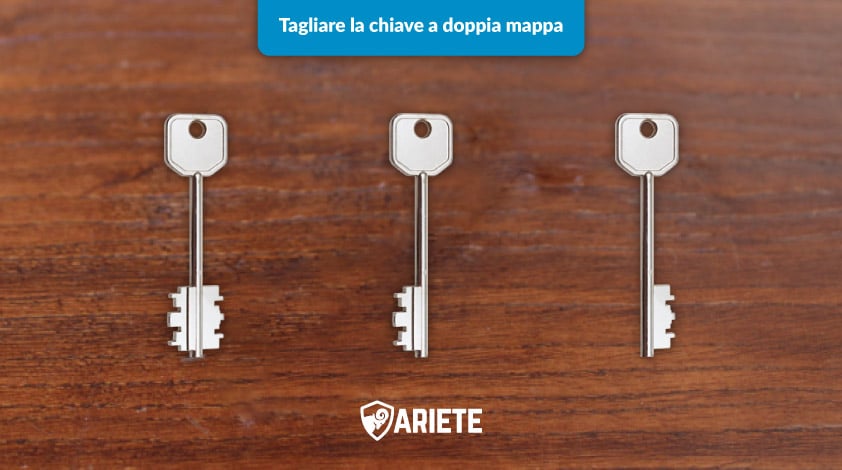
To manage to open the door, you would need to file down the teeth of the double-bit key on one side.
Unfortunately there is no way to tell which is the right side to file, so, if you have more than one key, you need to make two attempts:
- file one side on a first key, try inserting it and opening the door
- if the door does not open, file the other side on a second key.
Conclusions
In conclusion, when the time comes to buy or replace the armoured door of our home, if we want to reach a good level of security, we must choose a lock that mainly guarantees security and durability.
We have seen that the market offers a very wide choice of brands and models that at first glance might dishearten us; we have also learned not to let ourselves be discouraged and to focus on the fundamental features of the lock in order to work out which one best meets our needs.
A final tip is to pay particular attention to the discounts applied to online purchases, as they could turn out to be mere “bait“.
The choice of the most suitable lock for our home can also come about through the “hands-on testing” of an everyday gesture such as, precisely, opening and closing an entrance door made available for visitors to try.
If you need to replace your armoured door, get a free quote.
Warm regards,
Mauro
