
Is the key to your armoured door no longer turning as smoothly as it once did? Is your armoured door lock stiff to open?
If you don’t know me yet, let me introduce myself: my name is Mauro from Ariete Security Doors, an expert in locks and security doors, and in this article I’ll explain how to lubricate your stiff lock.
We’ll look at the causes and their solutions, and I’ll reveal the two specific products that solve the problem in just a few seconds.
Ready? Let’s get started!
Stiff lock? Here’s how to lubricate your armoured door
If your lock is stiff to open and the key doesn’t turn properly, don’t worry: in most cases this is a perfectly normal thing.
Over time, in fact, it’s common for the lock to seize up and for the key to struggle to turn as easily as it once did.
The most frequent cause? A dirty key!
You should know that keys for European cylinder locks have tiny holes that can become clogged over time because of dust.
The solution, then, is to clean the key by lubricating the lock. Here’s how to do it.
How do you lubricate a cylinder lock?
In the past I’ve come across comments on blogs and websites recommending that you lubricate the lock using oil.
Well, you should know there’s nothing more wrong than that!
Oil, in fact, attracts dust and gums up the key, which will then struggle even more to turn.
So what’s the solution?
You need to lubricate your European cylinder using one of these two products:
- WD40
- Powdered graphite.
If you’re not sure what I’m talking about, don’t worry, I’ll explain in just a moment.
Let’s start with the first one.
Method 1: Lubricating the lock using WD40
Time needed: 10 minutes.
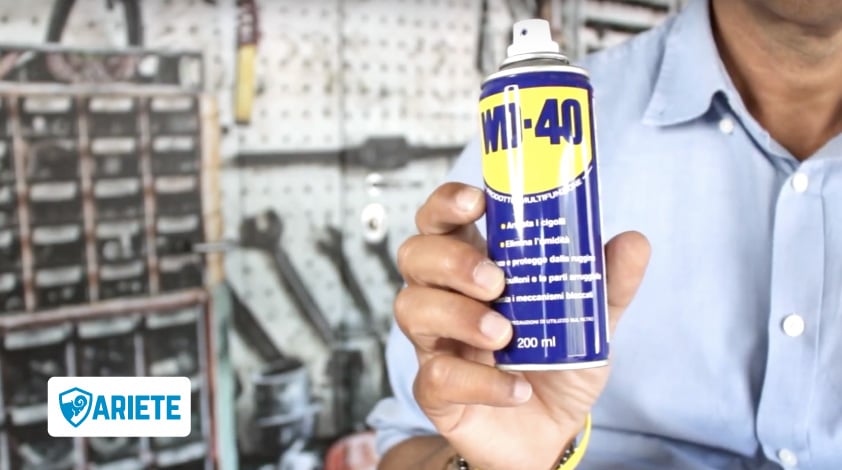
WD40 is among the best lubricants for security locks that I’ve tried in over 30 years of work.
It’s a universal product, used to lubricate practically anything.
To use it correctly, follow these simple steps:
- Get hold of some WD40
Buy a can of WD40.
You can find this product for just a few euros at any hardware shop or on Amazon. - Spray the WD40 into the keyhole
After fitting the thin nozzle onto the WD40, spray a small amount of lock lubricant inside the cylinder lock.
Don’t use too much, please, because if it leaks out of the lock you could stain the door panel.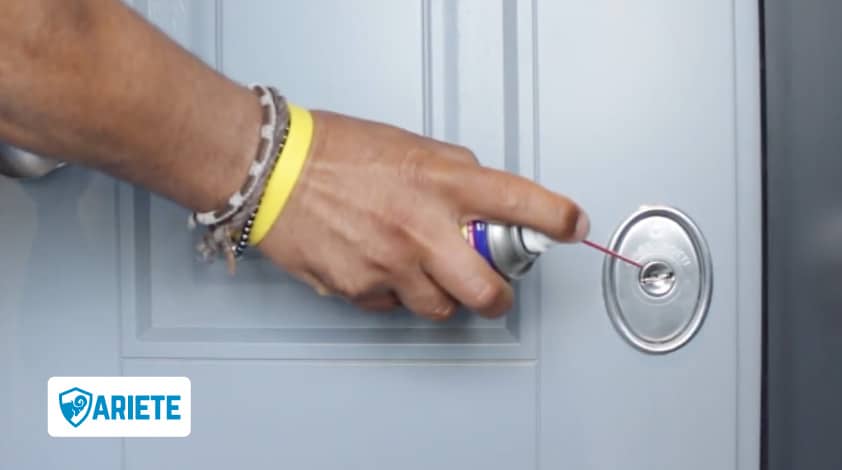
- Spray the lubricant onto the key
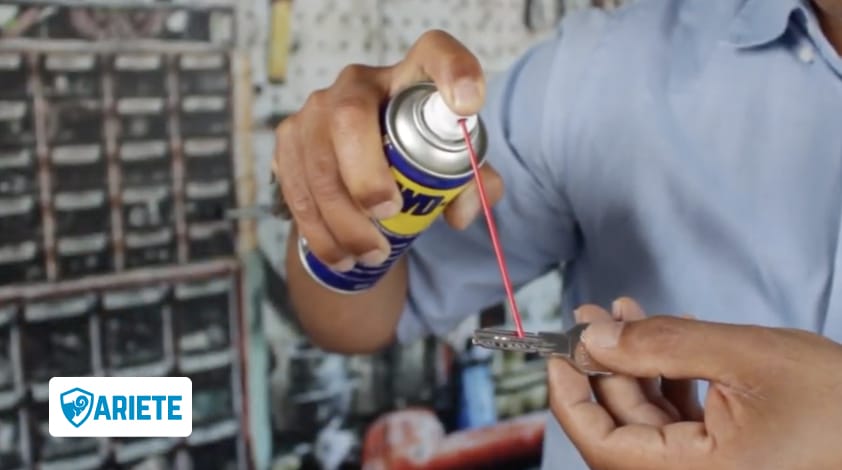
Now spray a small amount of WD40 onto the key, being careful not to overdo it.
- Insert and remove the key
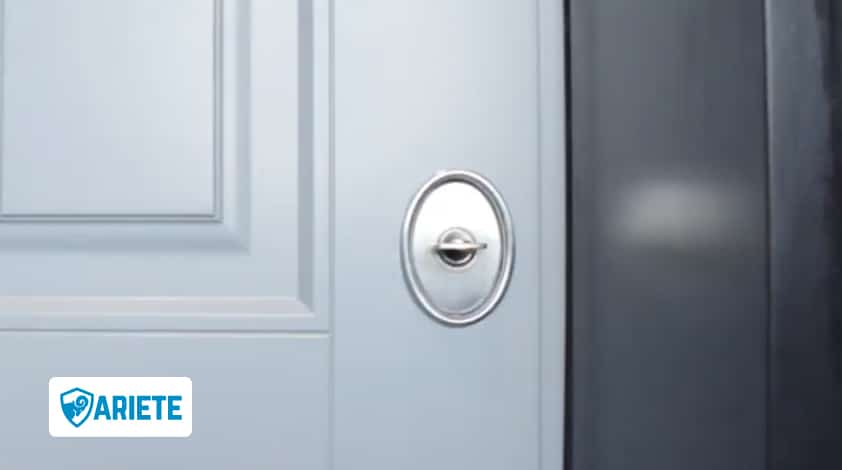
At this point, insert and remove the key in the lock two or three times to spread the armoured door lock lubricant right inside the lock.
- Repeat the process
If the key doesn’t go in properly, spray a little more WD40 into the lock and try inserting and removing the key again.
Method 2: Lubricating with powdered graphite
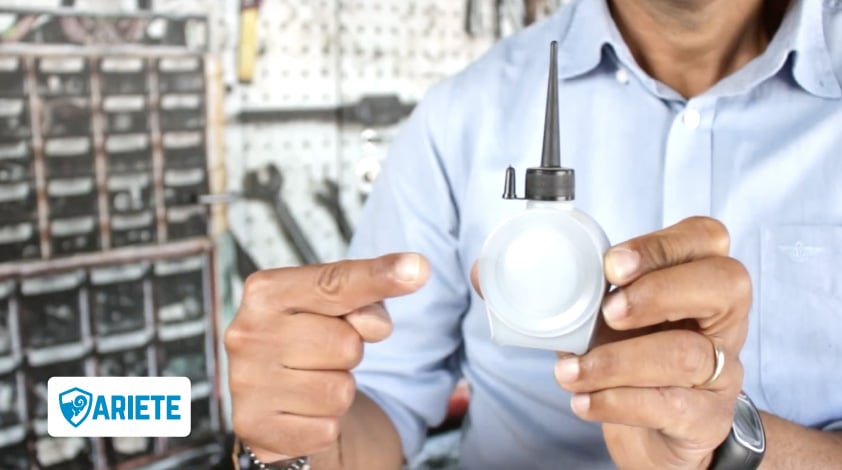
An alternative solution is graphite powder.
Graphite is the material that pencil leads are made of, and it’s one of the products most widely used in the past to lubricate locks.
If you go to an “old-school” hardware shop, they’ll undoubtedly recommend this product.
It’s ideal because the powder clings to the metal, lubricating without leaving any greasy residue (so it doesn’t pick up dust or other debris) and without damaging the internal cylinders of the locks.
How do you use graphite powder?
To lubricate the locks, follow these simple steps:
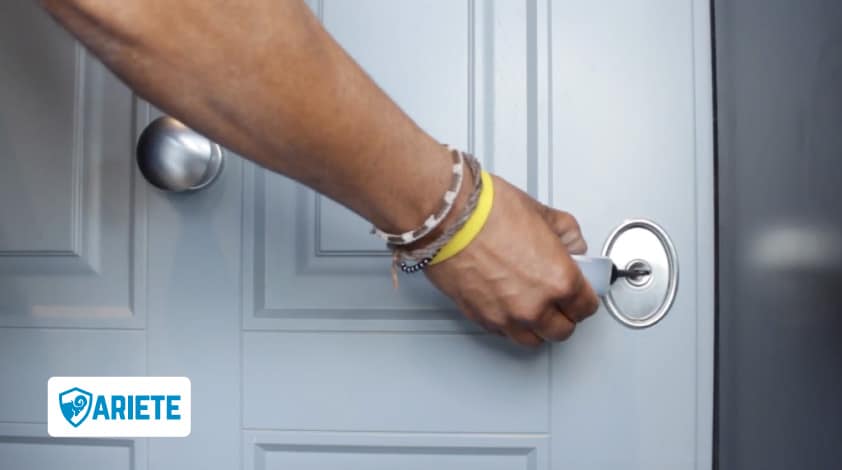
- Insert the tip of the powdered graphite tube into the lock.
- Squeeze the tube a couple of times (don’t use too much, even small amounts will be effective for a long time)
- Insert and remove the key in the lock two or three times (this way you can tell whether the graphite has worked properly)
- If the key still goes in with difficulty, add a little more graphite
- Try again.
Where do you buy graphite powder?
Just like WD40, powdered graphite can be bought from any hardware shop or on Amazon.
It’s usually sold in small containers fitted with a pointed nozzle, or in tubes that fit very well into the keyhole; a tube generally costs from €7 to €20 depending on the size.
Alternative method: Using the tip of a pencil
If you don’t have graphite powder or WD40 to hand, you can try taking a pencil and rubbing the tip directly onto the key.
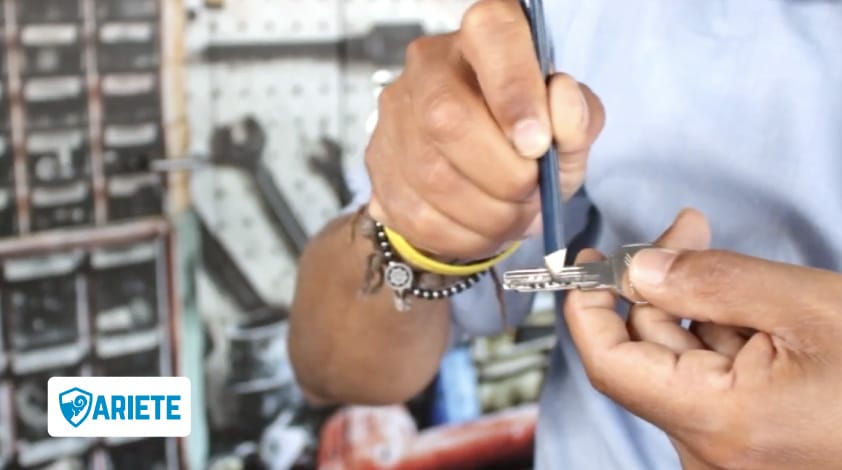
It’s not a guaranteed fix, but in most cases it works, as you can see from the comment this user left under my YouTube video.

Conclusions
Right, we’ve reached the end of this article on how to lubricate the cylinder lock of an armoured door, through which I hope I’ve helped you solve your problem.
If the key still doesn’t turn properly, or if you have a different problem from the ones I’ve talked about in this post, read my article on the armoured door lock or leave a comment.
Now I’ll hand over to you: did you manage to solve your problem? How did you do it?
Share your experience with the Ariete Security Doors community.
Warm regards,
Mauro

7 Responses
Ho strofinato leggermente la chiave con un po di oĺio e pare che vada meglio ma leggendo il tuo consiglio risulta sbagliato e quindi come posso rimediare? Posso spruzzare il wd40? Grazie resto in attesa di una vs risposta
Si Danny, attendi qualche giorno e poi lubrifica con del WD40.
Un caro saluto,
Mauro
Potrebbe essere valido, miscelare la grafite con olio antiattrito?
No, Pietro.
L’olio impasterebbe la polvere di grafite e potrebbe peggiorare la situazione.
Ti consiglio di utilizzare o la grafite in polvere o il WD40.
Un caro saluto,
Mauro
Va bene anche il WD40 al silicone?
Il wd 40 è uno sbloccate, non un lubrificante. È un olio che si secca ed evapora, in officina lo usiamo per sgrassare le lamiere, quindi…..
Ho risolto anch’io con la matita grazieee. È proprio vero non si finisce mai di impare!!!