
The scaffolding pipe attack is a break-in technique that uses a round metal pipe as a lever to tear off the defender protecting the cylinder of an armoured door.
The name comes from the building trade: the “Innocenti pipe” is the round tube used in scaffolding and site platforms, patented in Italy by Ferdinando Innocenti, whose history you can read on the dedicated Wikipedia entry. It is the very same pipe that, when misused, became one of the best-known tools for forcing round defenders.
The important thing to know is that this technique works only on some armoured front doors: those fitted with an old-style defender, round in shape and protruding. On modern defenders of a suitable shape, it loses most of its effectiveness.
How the scaffolding pipe attack works
The principle is purely mechanical, and it is worth understanding in order to choose the right protection.
The defender is the plate that covers and protects the lock cylinder. When it is round and protruding, the pipe can slip over it like a glove and get a grip on its outline.
At that point, using the pipe as a lever, the burglar applies force and sharp tugs to the defender to try to snap it off or pull it out together with the cylinder. Once the defender is gone, the cylinder is left exposed and open to attack.
So everything comes down to a single point: the ability to get a grip. If the pipe finds nothing to hold on to, the technique never even gets started.
In the video below Mauro Semonella, the owner of Ariete, shows live how a calibrated pipe similar to the Innocenti pipe can lever on a round defender.
This second clip from the Italian State Police, also featured on the Ariete channel, documents a real case of forced entry carried out with the scaffolding pipe on a round defender.
How to protect against the scaffolding pipe attack
The defence is simple in principle: give the pipe nothing to lever against.
Defenders of a non-circular shape are the most effective answer. A defender that is conical, spherical, oval or square with rounded corners offers no regular profile for the pipe to slip over and latch on to.
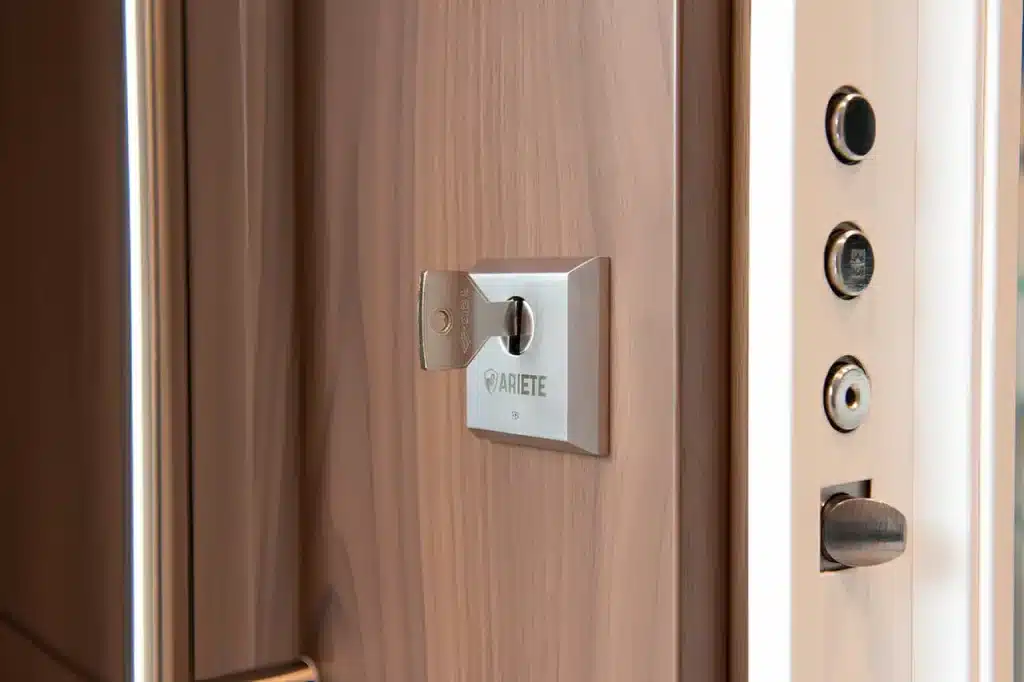
It also helps to have a containment frame (the so-called collar) that some defenders carry around their base: it keeps the defender anchored and stops it being pulled out. In the same way, a cylinder with reduced protrusion beyond the plate gives tools less to grip.
It is worth remembering that the defender is just one of the elements contributing to the overall strength of a door, alongside the lock, the anchor points and the door’s resistance class. If you want the full picture, the entry on burglar resistance classes is useful, as is the deeper look at the Bulgarian key, another technique that targets the cylinder.
The Ariete square defender against the scaffolding pipe attack
Ariete armoured doors are fitted with a square defender with rounded corners, a solution that is unique on the market today.
Precisely because its shape is not circular, it gives the scaffolding pipe no round profile to grip: with nothing to hold on to, the lever cannot work and the attempt is stopped before it begins. It is the most direct way to neutralise the technique, acting on the geometry rather than on the hardness of the metal alone.
You can find the full explanation in the article on the armoured door defender. If you are thinking of replacing your front door with a safer one, at Ariete we design and install it complete, from the defender to the fitting.
Frequently asked questions
No. The technique works mainly on doors with a round, protruding defender, typical of older models. A defender with a non-circular shape, or one protected by a containment frame, takes away the pipe’s grip and makes the attack ineffective.
Look at its shape. A defender that is conical, spherical, oval or square with rounded corners is designed to give the pipe nothing to grip; a round, protruding one is the most exposed. If you are in any doubt, it is a good reason to have the whole front door assessed.
Yes, against this specific technique. The non-circular shape stops the pipe from slipping over it and levering, whereas a round profile is exactly what the technique relies on. The square defender with rounded corners was created to close this vulnerability.