
Burglar resistance classes tell you how well an armoured door can withstand attempts to break in.
They are divided into six levels, from RC1, the weakest, to RC6, the most secure.
Doors in RC1 and RC2 offer minimal protection, suitable only for utility rooms or storage spaces.
The RC3 and RC4 are the ideal choice for homes: RC3 for secure residential settings or blocks of flats, RC4 for detached houses or isolated areas.
Doors in RC5 and RC6 guarantee the highest level of security, designed for banks, jewellers or military buildings.
Each class is tested according to the tools used and the resistance time, which can reach up to 20 minutes.
In this article we will look together at the 6 burglar resistance classes for armoured doors, which one to choose depending on where you live and the level of protection you want, and what to know so you do not get caught out.
Let us find out together in the article.
The 6 security classes of armoured doors, explained simply
The moment an unauthorised person, usually an intruder, tries to force any locking or security system, you have a case of forced entry: when it comes to armoured doors, burglar resistance classes (or security classes) are used specifically to indicate (and quantify) in an objective way how well those doors can withstand the different types of break-in attempts.
Burglar-resistant doors are all different from one another, not only in their look and design, but also and above all in the type and the level of security they can offer against burglars’ attacks.
But how can you actually classify the burglar resistance of armoured doors in an effective and objective way?
To do this in a consistent way, the EC (European Community) stepped in, setting out precise standards that define the real characteristics a product must have.
These characteristics divide armoured doors into 6 burglar resistance classes and so create the body of rules known today as UNI EN 1627-1628-1629-1630.
But what do the security levels of modern armoured doors actually involve? What are they for?
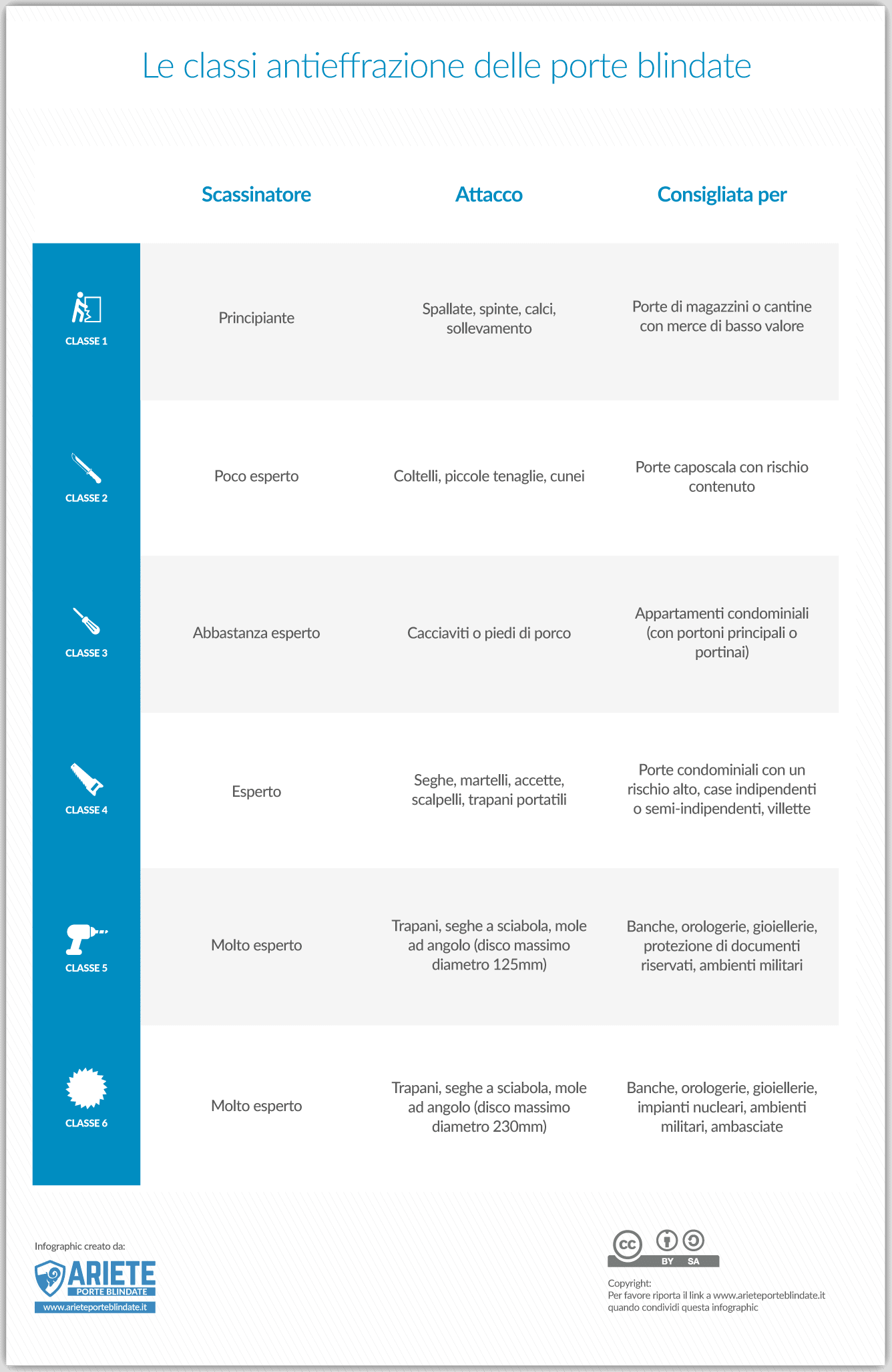
There are six classes, but defining them was no simple matter, since this is a very complex field tied to parameters that are very hard to classify objectively: it is in fact a question of determining the degrees of cunning, speed, strength and violence of the intruder about to attack you, and these are all variables that are hard to predict.
That is why the “UNI ENV1627” standard sets out to define the resistance of an armoured door against possible break-in attempts with six security levels, set on the basis of tests that aim to simulate the real attack attempts of a burglar.
Armoured doors RC1
Since the six security levels of an entrance door become more effective as the number rises, a RC1 rating naturally means a truly minimal level of burglar resistance.
An armoured door rated in RC1 is therefore the weakest and can only withstand opportunist burglars or beginners.
In any case, class one armoured doors can only stop people who try to force your door using physical force alone, such as with shoulder barges, kicks, pushes, lifts or attempts to wrench it open.
The first resistance class (RC1) therefore defines the resistance that the armoured door offers to a burglar’s physical efforts alone, with no tools of any kind, who will manage to open it in an estimated time of three minutes.
That is why doors in RC1 are armoured doors suited only to be placed as the landing door of cellars or storerooms holding goods of low economic (or sentimental) value.
Resistance time: not tested
Armoured doors RC2
As the security classes go up, the level of force the intruder brings also rises progressively, along with the type of tools they use, and the time they take to reach their goal.
Moving up to the RC2 armoured door you are buying a unit that can also withstand an occasional burglar, usually not very experienced.
This type of burglar uses widespread, everyday tools to force the door, such as knives, small pliers, wedges and so on.
RC2 armoured doors are recommended for installation as a landing door in places with limited risk, such as offices but also industrial buildings.
Resistance time: 3 minutes
Armoured doors RC3
With the intermediate burglar resistance class for armoured doors you will start to enjoy a higher level of security, giving any burglar who targets your property more work to do: the RC3 armoured door in fact also withstands the experienced burglar, the one who also uses more aggressive tools such as crowbars and screwdrivers.
In this case you can use your RC3 burglar-resistant door still as a landing door, but it can also be used in settings with a medium risk, such as in flats in blocks that also have main entrance doors or porters, in short in places where the demand for security is not particularly high.
Resistance time: 5 minutes
Armoured doors RC4
A RC4 armoured door can repel the attacks of experienced burglars who, in addition to the tools mentioned above, use saws, hammers, hatchets, chisels and portable cordless drills.
It is therefore the type of armoured door entirely suited to the effective protection of detached or semi-detached houses, villas, or flats in blocks with a high risk.
Resistance time: 10 minutes
Armoured doors RC5
A RC5 armoured door has a remarkable level of security.
It can in fact withstand attacks by very experienced burglars who also use serious tools such as drills, reciprocating saws and even angle grinders, with a disc up to 12.5 centimetres in diameter.
It is perfectly suited to the highest protection of banks, watchmakers, jewellers, military settings, embassies and also for the protection of confidential documents.
Resistance time: 15 minutes
Armoured doors RC6
The level of security of armoured doors in RC6 is the highest of all.
The RC6 armoured door withstands even the attacks of professional burglars who use drills, reciprocating saws and angle grinders, with a disc up to 23 centimetres in diameter.
The RC6 level assumes that the burglar manages to achieve their aim within a time limit of twenty minutes.
RC6 security armoured doors are suited to banks, watchmakers, nuclear plants, to the protection of places where various confidential documents are carefully kept, military settings and embassies.
Resistance time: 20 minutes
Security class of armoured doors: the table
| Class | Tools | Resistance time |
| 1 | Effective only against those who use physical force to break the door open | not tested |
| 2 | Designed to withstand break-in attempts with simple tools such as screwdrivers, pliers and so on | 3 minutes |
| 3 | Designed to withstand break-in attempts with more elaborate tools such as hammers, chisels and crowbars. | 5 minutes |
| 4 | Designed to protect the door from an experienced burglar using tools such as saws, hatchets, chisels and cordless drills | 10 minutes |
| 5 | Designed to protect against reciprocating saws, electric drills and circular saws (with a diameter up to 125 mm) | 15 minutes |
| 6 | Designed to protect against high-power electric tools such as reciprocating saws, electric drills and circular saws with a disc up to 230mm in diameter | 20 minutes |
Armoured door class: the security of the best entrance doors
On doors of RC4 or RC5, already almost at the top of security against attacks by fairly experienced intruders, you can also fit tubular subframes and latest-generation euro cylinder locks.
On the best doors the meeting point between the locks and the strike plate is adjustable, so it does not suffer from unpleasant misalignments caused by temperature changes or during maintenance.
Ask too for the best anti-pipe defenders (or anti-wrench) currently on the market: you can also request systems fitted with the most modern electronic cylinders operated by a reader, but also by electronic key, or even by smartphone and tablet.
Frequently asked questions
To establish in the best possible way which class an armoured door belongs to, the door is put through 3 types of test, all based on the European standards in force:
– resistance to static loads;
– resistance to dynamic loads;
– resistance to manual attacks.
To carry out all the various security tests, certain machines are used that can perform every kind of very realistic simulation of the various possible break-in attempts.
It is precisely on the basis of the results obtained that the resistance class of the armoured door is established and that it is placed in the relevant security class.
Naturally, to choose the best burglar-resistant armoured door you can rely on all the information you manage to find, but among the various criteria for making your choice you will of course also need to consider the budget you have available.
To work out what your maximum budget will be, bear in mind that putting a price on a good-quality armoured door is like trying to put a value on security and on your privacy, and that is difficult.
An armoured door in the best burglar resistance classes is a genuine investment, because it is a precious asset: depending on your needs, choose the most secure armoured door you can afford.
Naturally, the level of security you choose affects the final price of a quality armoured door a great deal, since it determines its degree of burglar resistance.
Bear in mind that, depending on your budget, you can choose a door in RC3 or RC4 for private homes that are not too isolated: weigh up all the general security guidance carefully, and then tailor and personalise it to your specific protection needs.
Also, do not forget to check that the burglar resistance certification is present, the only assurance that your purchase is really the one best suited to your needs.
Generally, if you live in a flat inside an occupied block of flats, you can choose between a RC3 or RC4 armoured door.
If you live in a detached house or a villa, it is advisable to opt for an entrance door in RC4.
Guarantee marks and protection standards for armoured doors
In addition to the six burglar resistance quality classes we have looked at together, your new armoured door will also be certified with guarantee marks: each of these aims to certify a particular feature of your future armoured door and assures you of its level of security and its thermal and acoustic insulation.
Let us look together at the marks to know in order to make an excellent, informed purchase:
- CE marking – governed by the “EN 14351-1” standard, it is also compulsory;
- Italian Legislative Decree “192/2005” – parameters for energy efficiency and those for thermal and acoustic insulation;
- “UNI ENV 1627” standard – the characteristics of the six burglar resistance classes;
- “UNI EN 1303:05” standard – requirements for the resistance and durability of cylinders against the attacks made on them;
- “UNI EN 12209” standard – security for locks;
- SCCQ (“Certified and controlled security and quality”) – the quality of an armoured door across 5 levels (made in Italy, at least RC3, acoustic protection of at least 32 decibels, contains no harmful substances, factory production checked periodically by an external Notified Body);
- Icim – the highest effectiveness in preventing unauthorised duplication of the key
Armoured door classes: some final advice
When it comes to protecting yourself and your family (and your belongings too) security must come first.
As we have seen, the RC1 and RC2 of armoured doors are the lowest, and this is in fact why they are both generally found on many building sites.
The RC5 and RC6 represent instead the top of security and are therefore used in places with high protection standards, such as jewellers and even nuclear power plants.
That is why RC3 and RC4 are the must when it comes to residential installation.
It must never be forgotten that the same class includes several types of door, which affect the model, and the break-in factor, the lock, the type of cylinder and also the defender, that is the protection of the cylinder itself.
One last piece of safety advice: it is essential that, when choosing, you also ask your retailer about the type of masonry into which your new armoured door will be installed.
It is in fact enough for the door to be fitted into the wall incorrectly for burglars to be able to break in very easily despite its security class.
Conclusions
We have reached the end of this long article on the security classification of armoured doors, in which we have discovered what the six classes are and which one to choose depending on where you live.
If you want to replace your armoured door, get a free quote.
Need more information? Read my article on armoured door prices.
Warm regards,
Mauro
