
The auxiliary bolt of an armoured door is a mechanical component connected to the lock that serves to increase the door’s locking points.
When you turn the key, the movement of the lock is transmitted to the auxiliary bolt through dedicated internal rods, pushing out extra bolts that secure the door into the frame.
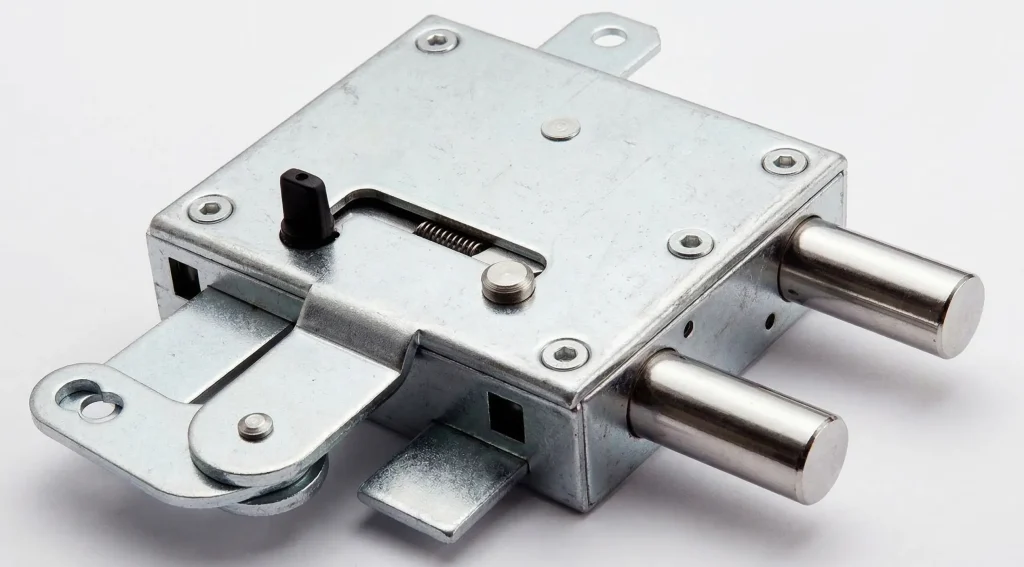
Thanks to this system, the armoured door does not lock only at the sides but can also anchor itself into the top and bottom of the frame, spreading the security points more evenly along the whole height of the door. The result is a more stable structure that is far more resistant to break-in attempts.
The auxiliary bolt is therefore one of the elements that contribute to the multi-point locking system typical of modern armoured doors, working together with the main lock and the other security deadbolts.
What the auxiliary bolt is for on armoured doors
The auxiliary bolt’s job is to increase the points where the armoured door anchors into the frame, improving the overall security of the locking system. Without auxiliary bolts, the door would lock only at the points driven directly by the main lock. With the auxiliary bolt, instead, the locking action is extended to the top and bottom of the door as well.
When the lock is operated, the movement is transmitted through internal rods that activate the auxiliary bolt. This mechanism pushes out extra bolts or deadbolts that engage with the frame, creating a more stable and resistant multi-point lock.
The result is an armoured door that spreads the locking force along its whole height, making it far harder to bend the leaf, force it with a lever or attempt to lift it off its hinges.
For this reason the auxiliary bolt is considered one of the key components in the security systems of modern armoured doors.
How the auxiliary bolt works on armoured doors
The way the auxiliary bolt works is closely linked to the main lock of the armoured door.
When you turn the key or operate the locking system, the lock sets in motion a system of internal metal rods that run vertically inside the door.
These rods transmit the movement to the auxiliary bolts, generally positioned at the top and bottom of the leaf.
In turn, the auxiliary bolts push out one or more bolts that engage with the dedicated housings in the door frame.
In this way the armoured door does not lock only at the sides, but is fixed to the frame at several points: along the sides, at the top and at the bottom.
This multi-point locking system increases the stability of the door and improves resistance to break-in attempts.
The auxiliary bolt therefore works completely automatically together with the lock: every time the door is locked with the key, all the locking points engage at the same time.
Where the auxiliary bolt is located in the armoured door
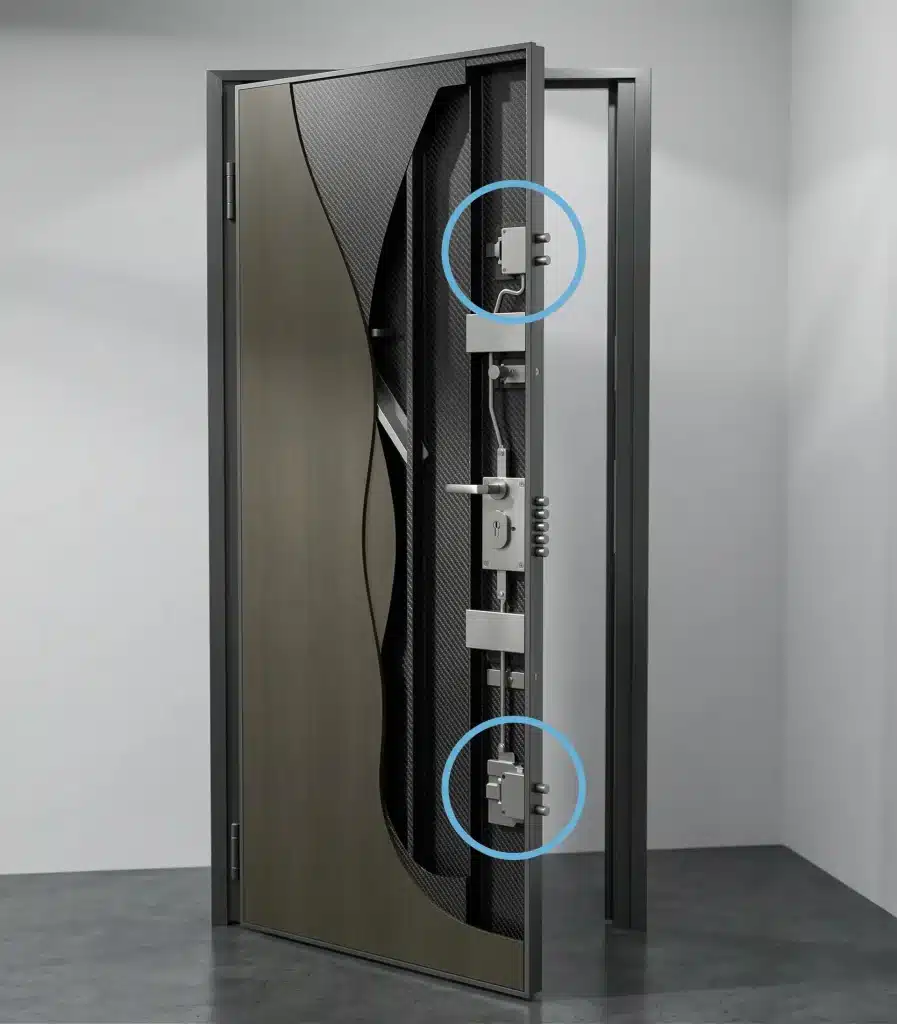
The auxiliary bolt is fitted inside the structure of the armoured door, generally at the top and bottom of the leaf.
It is therefore not visible from the outside, because it is part of the internal locking system connected to the lock.
Inside the door there are vertical metal rods that run from the main lock up to the auxiliary bolts. When the lock is operated, these rods transmit the movement to the auxiliary bolts, which push the bolts out towards the frame.
In most modern armoured doors there are two auxiliary bolts: one at the top and one at the bottom of the door. In this way the door does not lock only at the sides, but also upwards and downwards, increasing the stability and security of the whole system.
This positioning lets the door spread the forces more evenly during break-in attempts, making it far harder to bend the leaf or lift it off its hinges.
Types of auxiliary bolt for armoured doors
Not all auxiliary bolts for armoured doors are the same. There are in fact several types, which vary according to the lock system, the number of bolts and the door’s configuration.
One of the most common variants is the single-bolt auxiliary bolt, which activates a single extra locking point. This type is often used on armoured doors with simpler locking systems or as a complement to the main lock.
Another widespread solution is the double-bolt auxiliary bolt, designed to push out two deadbolts at the same time. This gives a sturdier lock and spreads the anchoring points more evenly along the door frame.
Then there are the auxiliary bolts connected to multi-point locks, very common on modern armoured doors. In these systems the auxiliary bolt works together with the vertical rods that link the central lock to the upper and lower locking points of the door.
Finally, in some special configurations there may be auxiliary bolts with specific features, such as handed or reversible models or ones designed for triple locks, which let you adapt the locking system to the structure of the armoured door and the level of security required.
Conclusion
The auxiliary bolt is a component of the armoured door’s locking system connected to the main lock.
Its job is to activate extra locking points, generally at the top and bottom of the door, increasing the stability of the leaf and security against break-in attempts.