
Is your armoured door not closing properly?
Is it catching on the floor, or is the key hard to turn?
Hello, I’m Mauro from Ariete Security Doors and today I’ll show you how to adjust your armoured door.
In this article we’ll discover together that all you need is a simple Allen key to adjust the armoured door, and that the job is easier than you think!
Read it right to the end, results guaranteed!
How to adjust an armoured door that won’t close properly
Over time it can happen that your armoured door drops and that, when you open or close it, the leaf scrapes on the floor.
You can also tell that your door has dropped when, turning the key, you struggle to close it.
This is because the bolts of the lock don’t slot perfectly into the holes in the frame, causing friction.
Don’t worry, it’s perfectly normal.
How can you tell that this is exactly the problem?
Try turning the key with the door open; if the key turns perfectly, it means that, as the door closes, the bolts aren’t slotting into the holes properly.
Now I’ll explain how to solve this problem.
How to adjust the hinges of an armoured door
Time needed: 15 minutes.
All the hinges of armoured doors have an Allen screw inside.
If you tighten it with the Allen key (also known as a hex key) of the right size, the door rises, while if you loosen it the door drops.
To adjust your armoured door you simply follow these 4 easy steps.
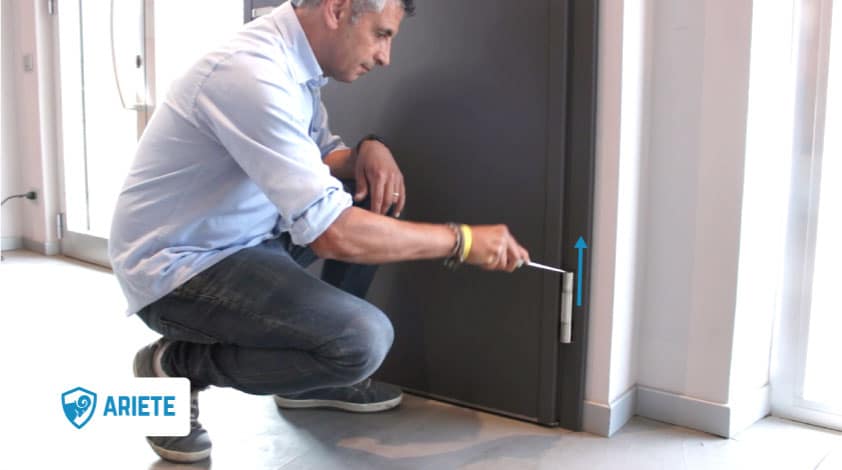
- Remove the hinge cap
Get a flat-head screwdriver (or any sharp object, such as a knife) and remove the hinge cap.
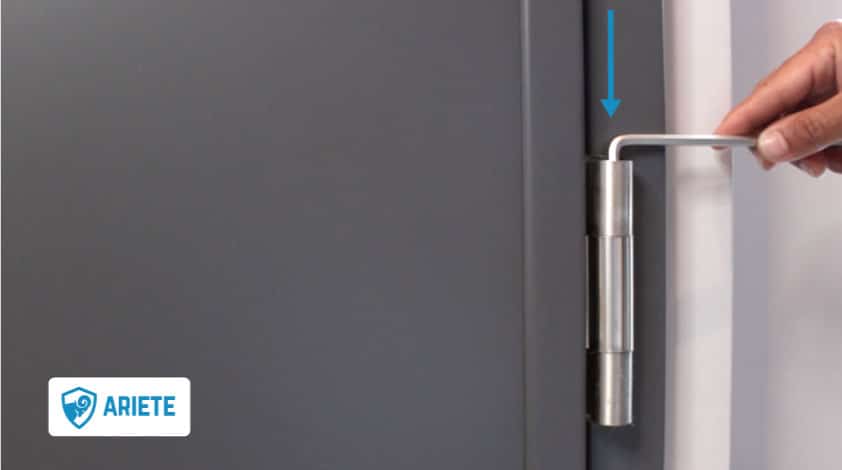
- Insert the Allen key into the hinge
Once you’ve found the Allen key of the correct size, insert it into the hinge of the armoured door.
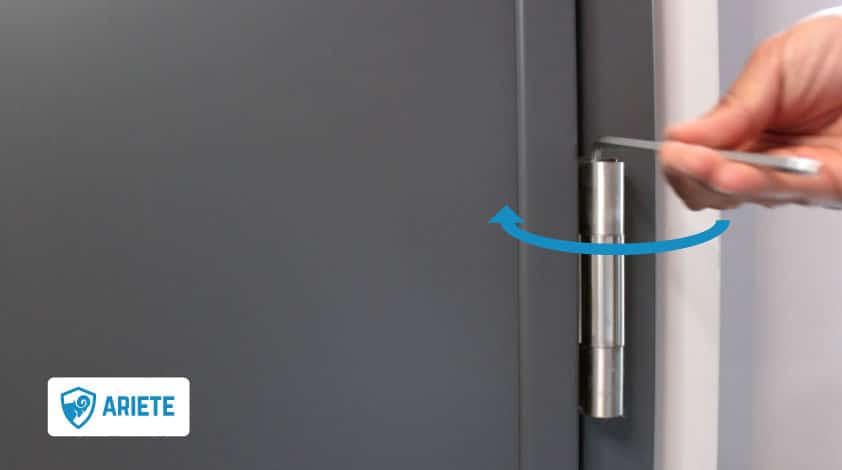
- Turn the Allen key clockwise
Turn the Allen key clockwise (to raise the armoured door) until you feel it pull, that is, when it becomes stiff.
- Repeat on the top hinge
Do the same on the upper Allen screw, the one at the top.
Here too, turn until the screw becomes stiff.
Be careful to apply the same adjustment to all the hinges.
This is how you’ve raised your armoured door in just a few seconds.
How to lower an armoured door
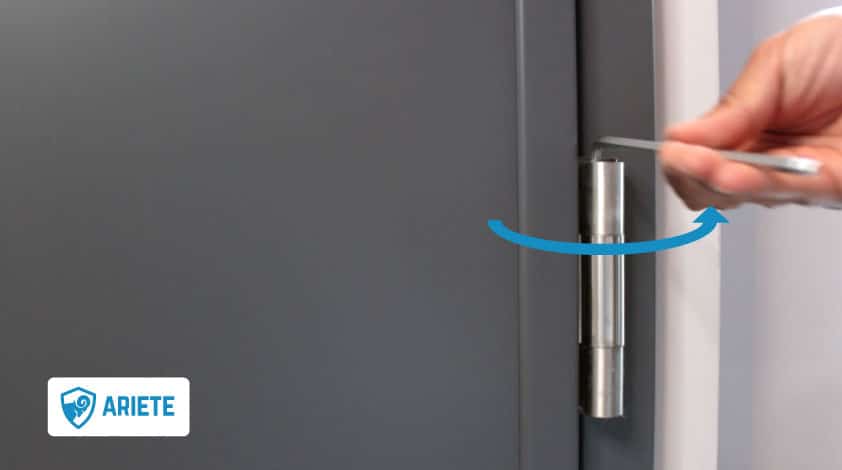
And if instead you wanted to lower the armoured door, what do you do?
Don’t worry, the procedure is exactly the same.
You simply repeat the whole operation, but turning the Allen key anticlockwise.
You’ll see that you can lower the door in just a few seconds.
Adjusting the draught excluder on an armoured door
The draught-excluder bar is a mechanism fitted with a rubber seal that closes the gap between the door and the floor below.
It works completely automatically: once the door is closed, the draught excluder drops down automatically and rests on the floor.
Ariete armoured doors, for example, are fitted with a draught-excluder blade with 5 air chambers, which guarantees maximum protection against the infiltration of air, light and dust.
How do you adjust the draught excluder?
On the back of the door, at the bottom, a kind of small piston sticks out, usually made of metal or plastic.
Once you’ve spotted the piston, you’re ready to start the adjustment.
Get hold of an Allen key
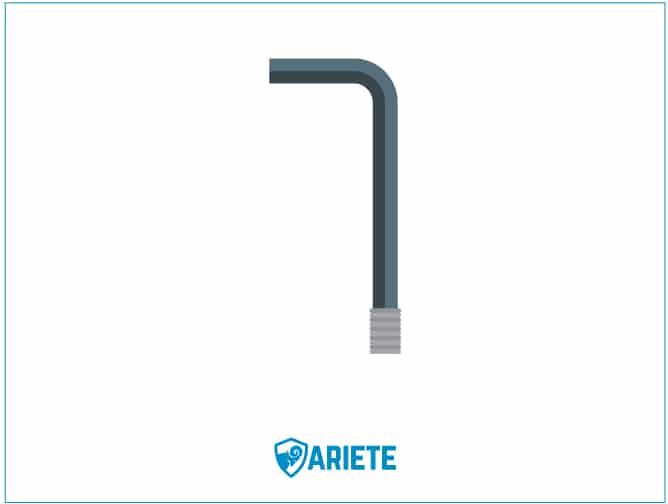
Get hold of an Allen key of the right size (it’s usually a 3mm one, but some doors may need Allen keys of different sizes).
Insert the Allen key into the hole
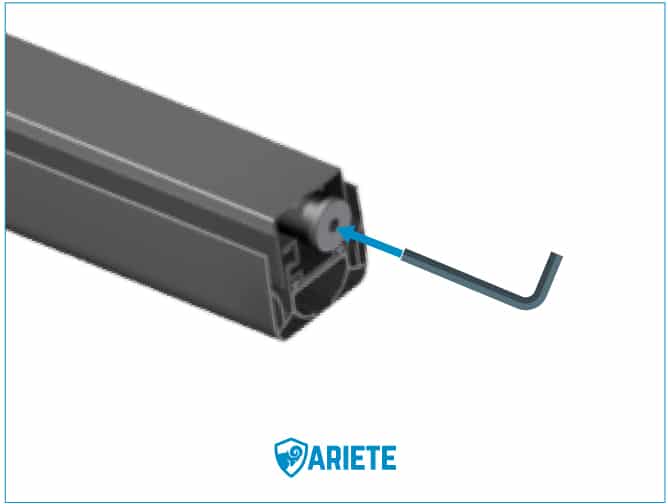
Once you’ve located the small hole and worked out the matching size, insert the Allen key inside it.
Turn the piston
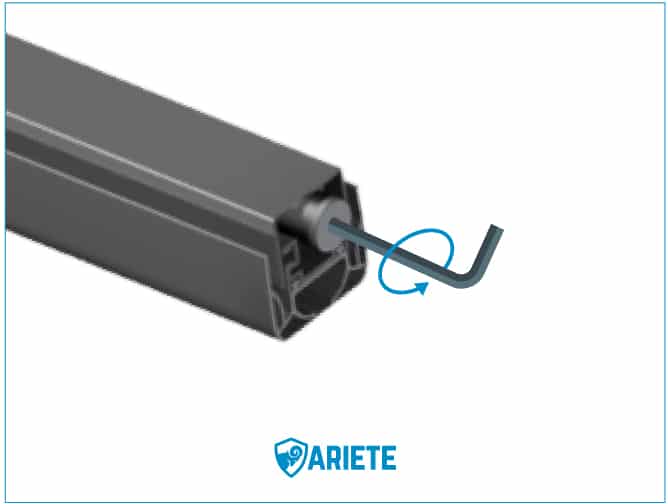
Turn the piston half a turn at a time, anticlockwise.
Close the door
Close the leaf while keeping the handle pushed down and check whether the draught-excluder blade meets resistance and whether it rests firmly enough on the floor.
Repeat the operation
If the draught-excluder bar doesn’t rest on the floor, repeat the operation by turning another half turn, until you reach the height you want.
Conclusion
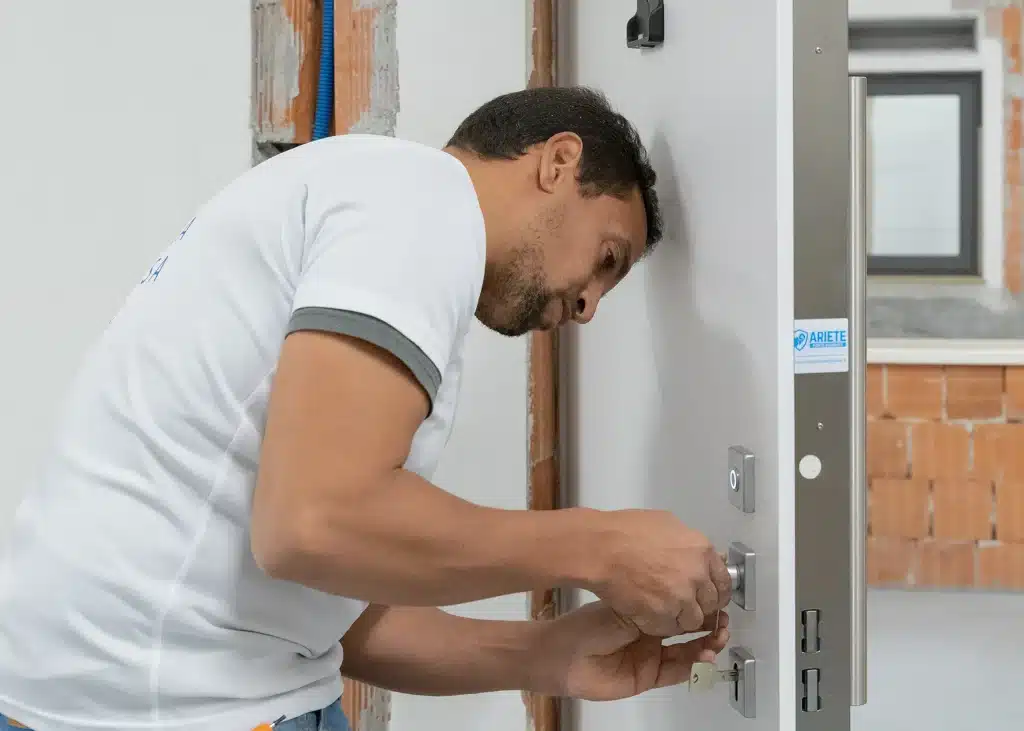
There you go! Thanks to these simple adjustment operations, your armoured door is working properly again.
With this video I hope I’ve solved your problem of an armoured door that needs adjusting.
Did you manage to raise your armoured door? Or to lower it? Or to adjust the draught-excluder blade?
If not, leave a comment below explaining your specific problem (try to be as detailed as possible so you help me understand the problem clearly) and I’ll do my best to help you.
And if this article has been useful to you, subscribe to our YouTube channel where you’ll find more video tutorials on how to adjust an armoured door.
All the best,
Mauro

31 Responses
Grazie per i consigli, il mio problema è che il corpo che scorre all’ interno del buco del pavimento sembra fuori asse, come non combaciasse più col foto. È sempre un problema di registrazione?
Ciao Enzo,
I possibili problemi sono due:
1) Il perno inferiore è spostato di pochissimo -> devi registrare la porta seguendo le istruzioni che trovi in questo articolo
2) Il perno inferiore non lavora più correttamente -> in questo caso devi chiamare un tecnico.
Un caro saluto
Mauro
Ciao. Le mie cerniere non hanno alcun tappo per accedere alla brugola. Come posso fare? Grazie
Ciao Luca,
Guarda nella parte inferiore della cerniera se c’è un foro con la brugola.
Se non c’è nessuna regolazione devi rimuovere la porta e inserire delle rondelle per alzare l’anta.
In quest’ultimo caso ti consiglio di rivolgerti a un tecnico.
Un caro saluto,
Mauro
Ciao, il mio problema invece è quando il portoncino è chiuso, dal lato della serratura, la parte alta chiude perfettamente mentre la parte bassa del portoncino tra il montante e la guarnizione ha una luce di almeno 1cm.
Come posso regolarla
Grazir
Ciao Francesco,
Significa che la porta è montata fuori piombo, ossia la parte alta non è in asse con la parte bassa.
Puoi provare a svitare le viti che trovi sul telaio e avvicinare il telaio all’anta solo nella parte bassa fino a fare pressione con la guarnizione.
Per risolvere completamente la situazione dovresti smurare il telaio e far rimontare la porta a piombo.
Un caro saluto,
Mauro
Salve la mia porta blindata rimane un pochino aperta nella parte bassa non facendo pressione sull’antispiffero come devo fare per regolarla e portarla in pressione solo in basso grazie.
Ciao Michele,
Puoi agire in due modi:
1) Abbassa leggermente la porta regolando le cerniere (guarda il video presente in questo articolo)
2) Regola il paraspiffero (svitando una vite che si trova sul lato della porta, questa fa pressione sul telaio e fa scendere il paraspiffero).
Un caro saluto,
Mauro
Buongiorno Mauro, ho appena preso un appartamento in affitto e la porta blindata era completamente fuori asse, al punto da non chiudere nemmeno tutte le mandate.
Sono riuscito a regolarla quasi completamente, ma sembra che le cerniere siano bloccate: quando cercodi abbassarla, restano lente e la porta non si smuove, anche se c’è ampio spazio per la correzione.
Come posso procedere?
Grazie!
Ciao Stefano,
I casi sono due:
1) Le cerniere sono bloccate (spruzza del WD40 e aspetta un’oretta)
2) Le cerniere sono arrivate a termine di regolazione, e anche se ti sembra che ci sia spazio per la regolazione, in realtà non ce n’è.
Una piccola precisazione: attenzione perchè le cerniere vanno svitate entrambe.
Un caro saluto,
Mauro
Buongiorno Mauro,il mio problema della porta blindata Alias è che dalla parte che si trova all’interno della casa, la maniglia non è piu attaccata alla rondella..
Mi farebbe piaciuto allegare la foto,ma non vi è la possibilità.
Ciao Ramona
Ecco la soluzione:
1) Con una brugola da 3 devi liberare la maniglia dal perno
2) Inserisci il perno dentro alla porta e stringilo forte con una pinza
3) Inserisci nuovamente la maniglia stringendola con la brugola
Un caro saluto,
Mauro
Ciao,
il mio problema è che la porta Dierre installata dal tecnico, quando “sbatte” o anche se viene chiusa senza essere accompagnata con estrema dolcezza, la porta invece che chiudersi, si riapre immediatamente.
A cosa potrebbe essere docuto questo problema?
Ciao Michele,
Si tratta di un problema di montaggio.
Le cerniere fanno molla perchè la porta non è montata a piombo (in asse).
Per risolvere il problema bisognerebbe smontare il telaio e rimontarlo esattamente in asse.
Un caro saluto,
Mauro
Buongiorno Mauro, il mio problema è che la chiusura a scrocco è diventata estremamente difficoltosa. Il perno smussato batte perfettamente in linea ma non mi è chiaro se devo stringere o allargare la fessura tra la porta e laparte fissa. Grazie
Ciao Franco,
Prova ad allargare la fessura, perchè molto probabilmente la porta è ceduta perciò si è avvicinata alla parte fissa.
Un caro saluto,
Mauro
Buongiorno il mio vecchio portoncino blindato non si chiude più senza la chiave. Cioè basta una spinta per aprirlo. Può aiutarmi? Grazie mara
Buongiorno Mara,
Se basta una spinta per aprirlo significa che la serratura è fuori uso.
Ti consiglio di cambiare l’intera porta.
Un caro saluto,
Mauro
ho montato un nuovo portoncino blindato. Tutto funziona perfettamente, L’unico incoveniente è che l portoncino, se lasciato aperto, tende a chiudersi; non rimane aperto. Come posso procedere per ovviare? Grazie
Ciao Alessio,
Sicuramente durante il montaggio non hanno controllato il piombo e la bolla ed è per questo motivo che il portoncino blindato si chiude da solo.
Per risolvere definitivamente bisognerebbe smontare il portone d’ingresso e metterlo a piombo.
Un caro saluto,
Mauro
Salve ho un problema sulla mia porta ho montato la serratura nuova cm quella vekkia nessuna modifica faccio la prima mandata la seconda nn va del tutta si ferma e lo scrocco nn entra nel buco.la causa può essere la regolazione delle cerniere? Attendo notizie grazie mille
Molto probabilmente si, Emanuele.
Prova a ruotare la chiave a porta aperta. Se ruota senza problemi, significa che devi agire sulle cerniere come ho indicato in questo articolo.
Un caro saluto,
Mauro
Salve ho una porta tesio start 2, il mio problema che quando accostò la porta per chiuderla lo scoccco fatica ad entrare devo sbatterla forte. Come posso regolare tale problema non essendo un problema di centratura e piombo porta grazie
Ciao Angelo,
Lubrifica per bene lo scrocco utilizzando del lubrificante WD40.
Un caro saluto,
Mauro
Buongiorno. Io ho il problema che la porta striscia sul pavimento. Ho serioso il tuo video ma le serrature della mia porta non hsmmo viti superiori come fai vedere tu ma laterali.
Ho provato s stringerle una nessun risultato.
Ciao Marina,
Le viti laterali non servono per alzare la porta, ma solo per regolarne l’asse.
Hai controllato nella parte inferiore della cerniera? Generalmente le viti sono o sopra o sotto (spesso sotto ad un tappino di gomma).
Un caro saluto,
Mauro
Buonasera, volevo chiederle
La mia porta blindata quando è aperta le mandate girano bene. Quando la chiudo la seconda è terza manata per chiuderle devo spingere verso l’esterno perché la chiave fa veramente fatica. La cosa strana che quando fa caldo e il sole picchia sulla porta il problema sembra molto meno. Può dirmi quale può essere il problema.
Grazie mille.
Ciao Daniele,
Sembra proprio il problema di cui ti ho parlato nell’articolo qui sopra.
Prova ad alzare la porta agendo sulle cerniere laterali (trovi tutte le info in questo video).
Fammi sapere se riesci a risolvere il problema.
Un caro saluto,
Mauro
Buongiorno,
poiché devo montare un pavimento tipo parquet dello spessore di 6mm (da posare sopra il pavimento esistente) ho necessità di alzare, di conseguenza, la porta blindata. Pertanto, agendo sulle cerniere tramite la chiave a brugola, di quanto max si può alzare la porta mod.Dierre?
Grazie
Ciao Pasquale,
L’operazione più corretta sarebbe quella di alzare non solo la porta ma anche il suo telaio.
Questo perchè, se alzi solo la porta agendo sulle cerniere, i perni non entrano più bene all’interno dei fori presenti nel telaio.
Per effettuare questa operazione, dovresti svitare le viti presenti nel telaio, e inserire dei piccoli spessori sotto allo stesso. In questo moto potrai recuperare 3-4mm.
Solo a quel punto puoi agire anche sulle cerniere.
Un caro saluto,
Mauro
ho trovato molto chiare ed interessanti le risposte date da Danilo