
You are about to replace your front door.
You have been offered an armoured door in class RC3 and one in class RC4, and the difference is real and you can feel it: is the extra cost really worth it?
So let us look at what actually changes.
Class RC3 resists hand tools (screwdrivers, levers, crowbars) for at least 5 minutes.
Class RC4 resists power tools too (drills, jigsaws) for at least 10 minutes.
In plain terms: class RC3 sees off the opportunist burglar, class RC4 stops even the organised burglar.
And here is the important thing that almost nobody tells you clearly.
For 95% of Italian homes the sensible choice is class RC4.
Class RC3 only makes sense in a few specific scenarios: flats on the upper floors of blocks with controlled access, low-risk areas, cases where the door is already part of a wider security system.
In this guide I explain:
- What the EN 1627 burglar resistance classes really are and what each class resists in concrete numbers
- The build differences that make class RC4 what it is (steel sheets, locking points, anchorings)
- The 4 contexts where class RC3 is enough and the 6 where you need class RC4
- Why class RC5 and RC6 doors are almost never worth it for a private home
- The factor that often matters more than the class itself: who fits the door for you
Let us go through it point by point.
What the burglar resistance classes mean (EN 1627)
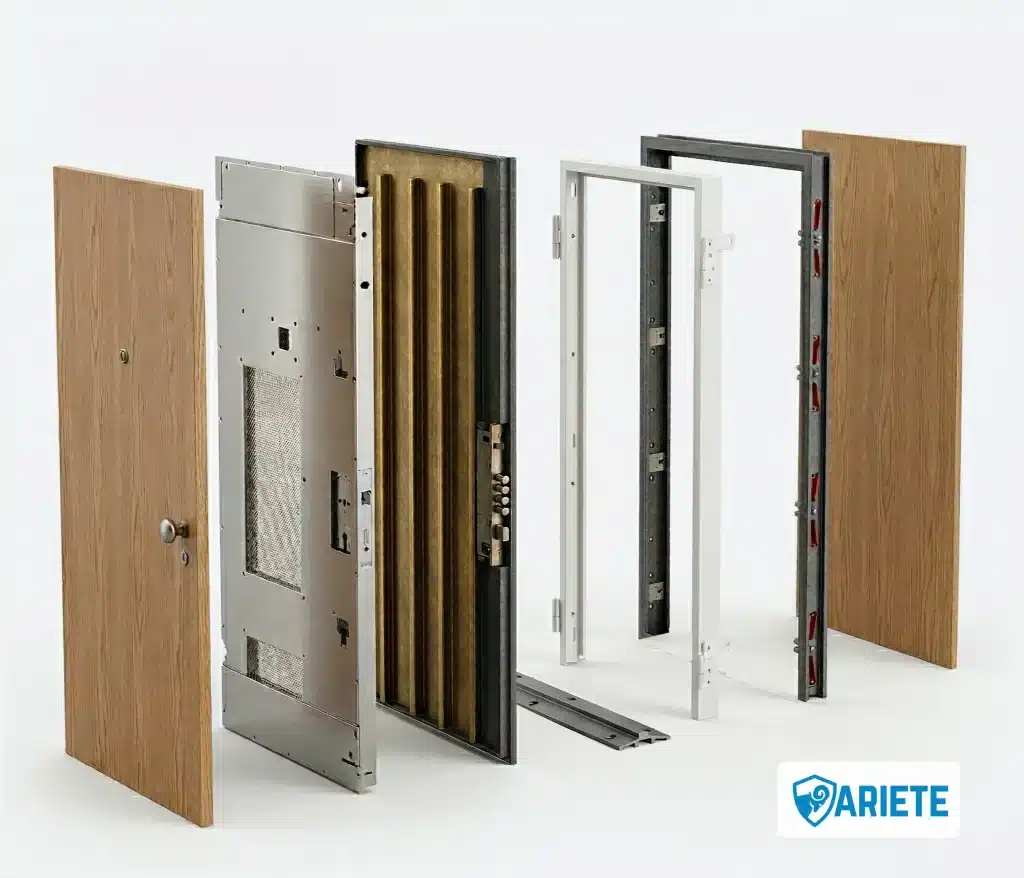
The burglar resistance classes are the result of laboratory tests set out by the European standard EN 1627, which certifies how much resistance a door offers against break-in attempts.
There are 6 classes, from RC1 to RC6 (“RC” stands for Resistance Class).
The 6 classes of the standard
To give the full picture, here is what each class resists.
Class 1 (RC1): resistance against minimal vandalism (kicks, shoulder charges). It is unsuitable for front doors: it is used for cellars or utility rooms.
Class 2 (RC2): resistance to simple tools (screwdriver, pliers, wedges) for at least 3 minutes. It is the lower limit for being considered “armoured”.
Class 3 (RC3): resistance to more aggressive hand tools (levers, crowbars, hammers) for at least 5 minutes.
Class 4 (RC4): resistance to power tools (drills, jigsaws, portable angle grinders) for at least 10 minutes.
Class 5 (RC5): resistance to high-power professional power tools for at least 15 minutes. It is used in sensitive commercial settings.
Class 6 (RC6): resistance to heavy professional power tools for at least 20 minutes. It is the level of bank vaults, jewellers and institutional buildings.
For a private home, the real choice is therefore between an armoured door in class RC3 or class RC4.
How an armoured door is certified
A door is not simply “declared” class RC4: it must pass certified tests in an accredited laboratory.
In Italy one of the main reference bodies is the Istituto Giordano.
The test involves three trials.
Static test: an increasing load is applied to the locking points and the hinges until the door gives way. Class RC3 must resist around 600 kN, class RC4 around 1,000 kN (1 kN is roughly 100 kg of force).
Dynamic test: simulated blows are delivered with standardised tools, calibrated for each category.
Manual test: an expert operator tries to force the door with real tools within the time allowed for the class.
Only after passing all three tests does the door receive its certification.
A door sold as class RC4 without a test certificate is just a claim made by the seller.
Class RC3 armoured door: what it really resists
Class RC3 is designed to stop an amateur or semi-amateur break-in.
It is the burglar who tries to open the door with ordinary hardware-shop tools.
Tools it resists: screwdrivers, levers, crowbars up to roughly 71 cm, pliers, hammers, wedges.
Certified holding time: 5 minutes minimum.
What it means in practice: a burglar who tries without preparation, with tools he has at home or in the van, after 5 minutes of fruitless attempts gives up and leaves. Class RC3 does exactly this, and for many areas of Italy it is enough.
When it is not enough: if the burglar is organised (carrying a cordless drill, a portable angle grinder, an electric jigsaw), 5 minutes of attempts on a class RC3 door can be enough to open it.
Class RC4 armoured door: what it really resists
Class RC4 moves up a level: it is designed to stop an organised break-in.
This is the burglar who knows what he is doing and has brought power tools with him.
Tools it resists (on top of all those of class RC3): professional drills, jigsaws, portable angle grinders, disc grinders.
Certified holding time: 10 minutes minimum.
What it means in practice: after 10 minutes of attempts with drills that make noise, vibration and sparks, the burglar has almost certainly already been noticed by the neighbours or has set off the alarm. At that point even the professional gives up.
When it may not be enough: in extreme scenarios (vaults, jewellers, items of very high value) class RC5 or RC6 may be needed. For a private home these are very rare cases.
Concrete build differences between the two classes
The greater resistance of class RC4 is the sum of precise build choices.
Here they are summed up in a table, then explained in prose.
| Feature | Class RC3 | Class RC4 |
|---|---|---|
| Minimum static load | 600 kN (~60 t) | 1,000 kN (~100 t) |
| Tools resisted | Hand (levers, crowbars) | Hand + power (drills, grinders) |
| Holding time | 5 minutes | 10 minutes |
| Leaf steel sheet thickness | Standard | Increased + internal reinforcements |
| Locking points | 8-10 points | 10-14 points |
| Cylinder | Anti-bumping, anti-picking, anti-drill (5+1+1) | Anti-bumping, anti-picking, anti-drill (5+1+1) |
| Defender | Square with chamfered corners | Square with chamfered corners |
The locking points are the bolts that slide into the frame when you turn the key.
The more there are, the more the door is anchored along its perimeter.
A class RC3 door typically has 8-10 points spread across three sides: top, bottom and lock side.
A class RC4 door goes up to 10-14 points, with a thicker leaf steel sheet and internal reinforcements that prevent the centre from being pushed in.
A useful clarification: Ariete class RC3 and class RC4 armoured doors share the same patented cylinder (anti-bumping, anti-picking, anti-drill) and the same square defender with chamfered corners.
The difference between the two classes lies entirely in the structure of the door: steel sheet thickness, number of locking points, frame reinforcements.
It does not lie in the cylinder or the defender, which are the same.
Find out more about the euro cylinder and the armoured door defender.
When to choose class RC3
Class RC3 makes sense in a few precise scenarios.
If your situation fits one of these, it is perfectly fine.
Flat on the upper floors (third floor and above) in buildings with an internal staircase and shared access. The burglar has to get through the courtyard, the main entrance and the stairs: every step is one more deterrent.
Supervised block of flats with a concierge, video entryphone, cameras, centralised alarm. The door is one line of defence among many.
Low-risk area (supervised historic centres, small villages, areas with a documented low burglary rate). Local safety data can be found on the website of the Italian State Police.
“Stopgap” replacement on an old door where the budget does not allow more, but you still need to raise the level compared with a non-armoured door.
In all other cases, class RC4 is the better choice.
Want to work out which class is right for your home?
Fill in the form below telling us about your context (floor, area, current situation): we will reply with a concrete, honest assessment, including telling you if class RC3 is enough for you.
When to choose a class RC4 armoured door
Almost always a class RC4 front door is the right choice.
Let us look at the most common contexts.
Ground floor or first floor: access is direct, you just have to climb over a fence or come through the garden. The burglar reaches the door in seconds and has time on his side: class RC4 is essential.
Detached house or standalone home: there are no neighbours across the landing, nobody hears the noise, nobody is keeping watch. The burglar works at his leisure: class RC4 is essential.
Documented high-risk area (outskirts, abandoned industrial districts, areas with repeated burglaries). The statistics are clear: where burglaries are more frequent, the class must be raised.
Family with children, elderly people or people who are not self-sufficient. A break-in is not just the loss of possessions: it is a violation of your safe space, and for anyone living with vulnerable people class RC4 is a choice of peace of mind.
Replacing an outdated door (over 25-30 years old, perhaps with a double-bit lock). Replacing a door is something you do once every 25-30 years: you might as well do it properly and fit class RC4. You will find more detail on the double-bit lock and on why that door almost always needs replacing in full.
Seaside, mountain or holiday home. Long periods with no one present mean that organised burglars make the most of it: class RC4 is essential.
The cost difference should not drive the choice
Moving from class RC3 to class RC4 typically means an extra cost of around 30% compared with the lower class.
Spread over the 25-30 year average life of an armoured door, we are talking about a few euros a month for the jump in security.
There is also the tax angle: replacing an armoured door qualifies for the Italian Renovation Bonus and, where the door has suitable transmittance values, for the Italian Ecobonus too.
You will find the details on the armoured door tax deduction.
In plain terms: once the deductions are applied, the extra cost becomes a very modest figure across the whole life cycle of the door.
Fitting class RC3 to save the initial 30%, in a context that would call for class RC4, is a choice you pay for over time: less real security and a door that will probably need reinforcing or replacing sooner than expected.
It is better to choose based on the real context of your home.
Why class RC5 and RC6 doors are almost never needed for a home
A recurring question in the showroom:
if class RC4 is better than class RC3, an armoured door in class RC5 will be better still, so why not get that one?
Technically yes, but in practice it is almost never needed.
Class RC5 is designed to resist high-power professional power tools for 15 minutes.
Class RC6 goes up to 20 minutes with heavy professional tools (industrial grinders, thermal lances).
Who would use these tools on a private home? Burglars who use thermal lances are specialised criminal organisations, and their targets are not private homes: they are bank vaults, jewellers with one-of-a-kind pieces, high-value depots.
A class RC5 or RC6 door in a home is like having a rally car to do the shopping: technically tougher, in practice oversized.
The extra cost is not justified by the real risk.
Cases where it may make sense to consider class RC5: an isolated country villa with documented high-value goods (art collections, archives), the home of an exposed individual (politicians, magistrates), luxury tourist properties. These are specific cases, to be assessed one by one.
The factor that changes everything: who fits the door
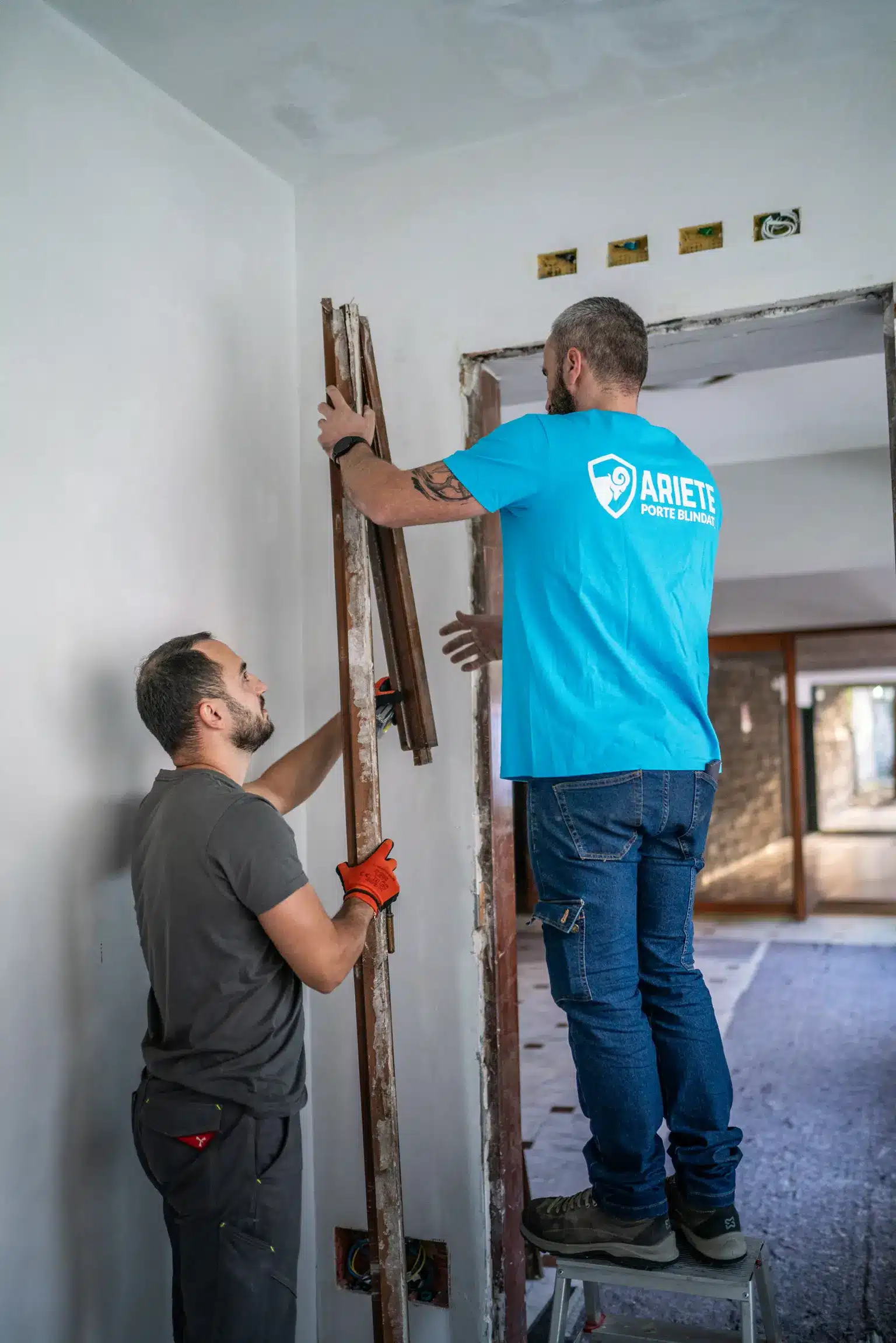
A truth that few retailers admit: even the best class RC4 door, fitted badly, loses much of its certified class.
If the frame is not anchored to the wall with the right fixings, if the auxiliary bolts do not engage the frame correctly, if the door is not perfectly plumb, the certified resistance drops.
The EN 1627 certification applies to the door as a product tested in a laboratory.
In your home it only holds if whoever fits it follows the required installation protocol.
For this reason, at Ariete all the fitting technicians are trained at the Accademia della Posa in Opera in Genoa, the leading technical school in the sector in Italy.
We do not work with “hired-in” outside fitters: they are in-house people, trained and certified.
What to check before the fitting.
Check that whoever fits the door has had specific training (not just “general experience”).
Ask whether they will give you a declaration of conformity of the fitting.
Make sure they use fixings and anchorings suited to the type of wall (plasterboard, hollow brick and reinforced concrete all require different solutions).
If the retailer hesitates over these questions, it is a warning sign: look elsewhere.
Conclusions
Choosing between an armoured door in class RC3 and class RC4 is above all a question of context: where you live, which floor, which area, which block of flats.
For most Italian families class RC4 is the sensible choice.
Class RC3 is fine only in a few well-defined scenarios: upper floors, supervised blocks of flats, low-risk areas.
The extra cost of class RC4 over class RC3, spread across the 25-30 year life of the door and net of the Italian tax deductions, makes very little difference to the overall cycle.
More than the class itself, what counts is who fits the door for you.
A class RC4 door fitted badly loses much of its certified resistance: always check the training of whoever does the fitting.
If you want to work out which class is right for your home, request an assessment tailored to your context from our consultants.
Frequently asked questions
For most private Italian homes the right choice is class RC4. Class RC3 is only enough in specific scenarios: flats on the upper floors of supervised blocks, documented low-risk areas, cases where the door is one of many lines of defence. In all other cases (ground floor, detached houses, holiday homes, exposed areas) class RC4 is the sensible choice.
The toughest class available is RC6, but for a private home it is almost always oversized. Class RC4 offers the best balance of real resistance, service life and cost for a home. Classes RC5 and RC6 are needed in rare cases, such as isolated villas with very high-value goods or the homes of exposed individuals.
A class RC3 armoured door is certified under the EN 1627 standard to resist hand tools (screwdrivers, levers, crowbars up to 71 cm, pliers, hammers) for at least 5 minutes. It withstands a static load of around 600 kN on the locking points. It is designed to stop a semi-amateur break-in.
A class RC4 armoured door is certified to EN 1627 to resist power tools too (drills, jigsaws, portable angle grinders) for at least 10 minutes. It withstands a static load of around 1,000 kN. It is designed to stop an organised break-in: after 10 minutes of noisy work with power tools, the burglar has almost certainly already been noticed.
Technically it is possible, but for a detached house it is not a good choice. Access is direct, there are no neighbours across the landing, the burglar can work undisturbed. Class RC3 resists hand tools for 5 minutes, but a detached house calls for greater resistance: class RC4 is the sensible choice.
With the naked eye, no, from the outside the door looks the same. The difference is in the internal structure: steel sheet thickness, number of locking points, frame reinforcements. On Ariete doors the cylinder and defender are identical for class RC3 and class RC4. The only reliable way to identify the class is the certified manufacturing label, usually on the edge of the leaf on the hinge side.
Not automatically. The EN 1627 classes measure only resistance to break-in. For insulation there are other certifications (U-value transmittance for thermal, dB reduction for acoustic). Ariete class RC4 and 4S doors combine the top class with market-leading thermal and acoustic insulation. You will find the details on the thermal transmittance.
A well-fitted class RC4 armoured door lasts 25-30 years with no structural work. The lock may need maintenance every 8-10 years (lubrication, possible recoding of the cylinder), and the seals may be replaced after 15-20 years. The body of the door stays intact for the whole life of the building.
It is not possible to move up to a higher class without replacing the whole door. The class is a structural property: it depends on the steel sheet thickness, the number of locking points, the type of anchoring. That is why it pays to choose well at the time of purchase.
Look for the manufacturer’s label (usually on the edge of the leaf on the hinge side or inside the frame): if the door is certified, the class is shown there. If you cannot find any label, the door is probably not certified and the “class” is just a commercial claim by the maker. In that case it is worth having the door assessed by a technician.
The class of the door as a certified product remains. The actual security can drop if the new cylinder is not certified to the same level as the original. When you replace a cylinder, choose a model with equivalent certifications (anti-bumping, anti-picking, anti-drill). For Ariete doors the 5+1+1 system lets you recode the cylinder up to twice without physically replacing it.
