
Are you planning to replace your front door and want to learn more about the armoured door incentives you can take advantage of?
Have you heard about the Italian 2026 security bonus, the Italian Ecobonus, the Italian Renovation Bonus, the invoice discount or the Superbonus, and it has all become confusing?
Good, you have landed on the right article.
Here you will find all the information you need to better understand the Italian 2026 tax deduction for replacing an armoured door.
I will explain what a tax deduction means, the Italian security bonus, the Italian Ecobonus for energy saving and the tax deduction when you replace the lock on your armoured door.
By the end of this article you will know which Italian tax reliefs apply to armoured doors and which one to use for your next purchase.
Ready? Let’s begin!
The Italian 2026 armoured door bonus in brief
If you want to understand how it works straight away, here is the summary:
- you can recover 50% of the cost if it is your main home (the home you live in)
- or 36% in other cases (second home, etc.)
- the deduction is spread over 10 years
- both the armoured door and the installation are covered
- you must pay by traceable “talking” bank transfer
- a full renovation is not required
- it can be claimed by owners, tenants and cohabiting family members who bear the cost
- maximum limit: €96,000 per property
Armoured door deduction 2026: what it is and how it works
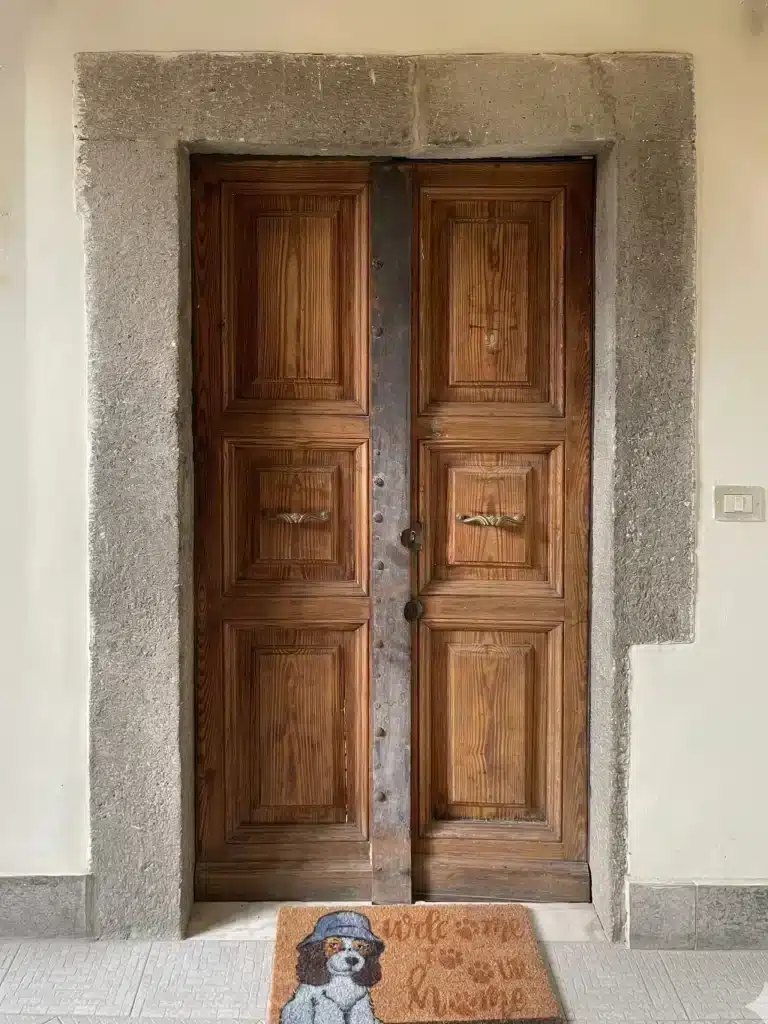
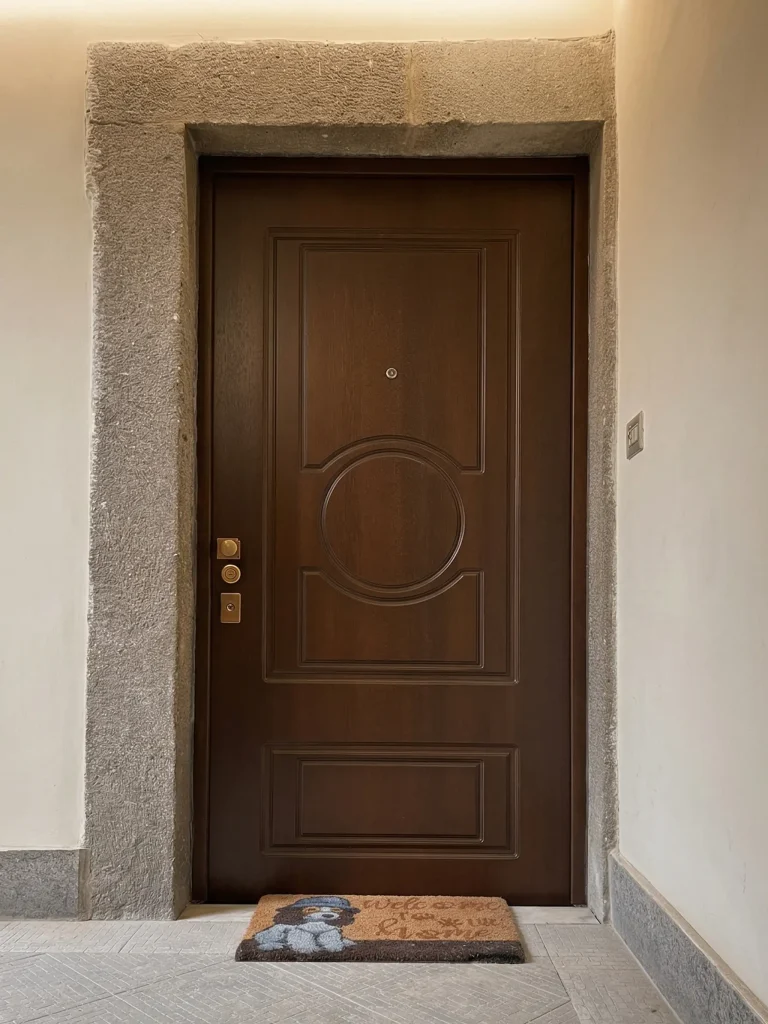
Ariete armoured door fitted in Rome – before and after
The Italian 2026 armoured door bonus is, in very simple terms, a way to recover part of the money you spend when you decide to improve the security of your home.
It is not an immediate discount, but a tax deduction provided for by the Italian Revenue Agency.
This means the money you spend to buy and fit an armoured door is returned to you over the following years, in the form of lower taxes to pay.
In practice, you pay for the door today and the State gives you back part of the cost over time.
There is just one thing to remember: you do not bear the whole cost on your own.
Many people think there is a specific incentive only for armoured doors, but that is not the case.
Armoured doors actually fall under the Italian home Renovation Bonus, because they are considered work that improves the security of the home.
The Italian rules include among the eligible costs all work aimed at preventing unlawful acts, such as theft and break-ins.
For this reason, alongside armoured doors, other protection systems are also covered, such as security locks, window grilles and burglar alarms.
This is an important point to grasp: you are not receiving an incentive because you change a door, but because you are making your home safer.
The bonus can be used in most cases where you decide to fit a new armoured door or replace the existing one.
A full renovation is not required: even a targeted security upgrade can qualify for the relief.
Put even more simply, if you change your front door to protect yourself better, it is very likely you can recover part of the cost.
How much you recover with the Italian 2026 armoured door bonus
| Item | What you need to know |
|---|---|
| Type of bonus | Italian Renovation Bonus (security improvements) |
| Deduction percentage | 50% main home 36% other cases |
| Spending limit | €96,000 per property unit |
| Deduction period | 10 years (annual instalments) |
| Deductible costs | Armoured door + installation + related works |
| Payment method | Traceable “talking” bank transfer required |
| Is renovation needed? | No, improving security is enough |
| Valid for second homes? | Yes (with a 36% deduction) |
| ENEA submission | Only in some cases (linked to energy saving) |
| Invoice discount | Not available |
Now we get to what really matters: how much money you can recover.
In 2026, the deduction for armoured doors can be 50% or 36%, depending on your situation.
Put simply, it means you can recover up to half of what you spend.
The higher percentage, namely 50%, applies when the work concerns your main home. In this case, if you fit or replace an armoured door, the State gives you back half of the cost you incurred.
In other cases, the deduction drops to 36%. This happens, for example, when the property is not your main home or when it is a second home. The mechanism stays the same, only the percentage you can recover changes.
There is also a maximum limit on which the bonus is calculated, equal to €96,000 per property unit. It is a very high ceiling and, in the case of armoured doors, it rarely amounts to a real limit. In practice, you can almost always deduct the entire cost you incurred.
An important thing to understand is that the money is not returned to you straight away. The deduction is split over 10 years and every year you recover a share in the form of lower taxes to pay.
Let’s take a simple example, so everything is clearer. If you spend €3,000 on an armoured door including installation and you are entitled to 50%, you recover €1,500 in total. This amount is split over 10 years, so around €150 a year. If instead you fall under the 36%, you recover €1,080 in total, that is around €108 a year.
The point to take away is this: even though the recovery happens over time, the saving is real.
And it is precisely for this reason that many people take advantage of the bonus when they decide to change their door: it is work they would do anyway, but with a lower final cost.
When you are entitled to the 50% and 36% armoured door bonus
Understanding when you are entitled to the bonus is essential, because this is where confusion often arises.
The good news is that, in most cases, you can claim it without any trouble.
The important thing is to meet a few precise conditions set by the Italian Revenue Agency.
Let’s start from the beginning.
The bonus applies when the work serves to improve the security of the home.
And it is precisely for this reason that armoured doors are among the eligible costs: they are considered work to prevent theft and break-ins.
This means you are entitled to the bonus when you fit a new armoured door or replace the existing one with a safer model.
You do not need to redo the whole house or start major renovation work. Even a single job, aimed at security, is enough to access the deduction.
Another important point concerns who can claim the bonus.
You do not necessarily have to be the owner in the strict sense: others can claim it too, such as someone who holds a right over the property or who actually bears the cost.
Put simply, what counts is who pays and who has a genuine connection with the property.
There is, however, one aspect to be careful about.
The work must be real and documented.
Buying a door is not enough: there must be an actual replacement or installation, with a traceable payment and a correct invoice.
In addition, the armoured door must be fitted in an existing property.
So it is not an incentive for new builds, but for improving a home that already exists.
To sum up very simply, you are entitled to the bonus when:
- you are improving the security of your home;
- the work is real and documented;
- and the property already exists.
If these conditions are met, in most cases you can access the deduction without any trouble.
When you cannot get the bonus
There are some cases in which the bonus does not apply.
For example, you cannot claim it if it is a new build or if the payment is not made in the correct way.
A missing invoice or documentation can also compromise the deduction.
For this reason it is important to follow every step carefully.
Which costs you can deduct with the armoured door bonus
One of the most frequent questions is this: can you deduct only the door or the rest of the work too?
The answer is simple: you can deduct far more than you think.
According to the Italian Revenue Agency, the bonus covers all the costs directly linked to the security improvement work.
This means you are not deducting only the product, but the entire job.
In the case of an armoured door, then, you can include both the cost of the door itself and everything needed to fit it correctly.
In practice, the deduction also covers installation costs, that is the labour needed to remove the old door and fit the new one.
In the same way, any related works can also be included, if they are needed to complete the job. For example, work on the masonry, adjustments to the door opening or small jobs connected to the fitting.
What matters is that all these costs are consistent with the work and clearly stated on the invoice.
This point is far more relevant than it seems. Many people think they can deduct only the door, but in reality they are underestimating the benefit. When you also take into account the fitting and the related works, the overall saving becomes far more interesting.
There is, however, one condition to meet: payments must be made in the correct way and all costs must be traceable. We will come back to this in the next section, because it is one of the most important aspects if you do not want to lose the bonus.
In short, when you fit an armoured door you are not deducting just a product, but a complete piece of work on the security of your home. And this is exactly what makes the bonus so worthwhile.
How to pay so you do not lose the armoured door bonus
At this point, there is something you need to know very well.
You can have all the right requirements, choose the perfect door and do a flawless job, but if you pay in the wrong way, you risk losing the deduction completely.
To avoid problems, the Italian Revenue Agency requires the payment to be made with a specific method, called a traceable “talking” bank transfer.
It is an ordinary bank or post office transfer, but with certain mandatory details entered correctly.
The transfer must state:
- the reason for the payment, referring to the Italian rules on tax deductions
- the tax code of the person claiming the bonus
- the VAT number or tax code of the company carrying out the work
These details serve to link the payment to the work and to prove that everything was done correctly.
If even just one of these details is missing, you could run into problems with the deduction.
Another key aspect is that the payment must be traceable.
You cannot therefore pay in cash if you want to claim the bonus. In general, everything must be clearly documented: the payment and the invoice must match.
Many people think it is complicated, but in reality it is simpler than it seems.
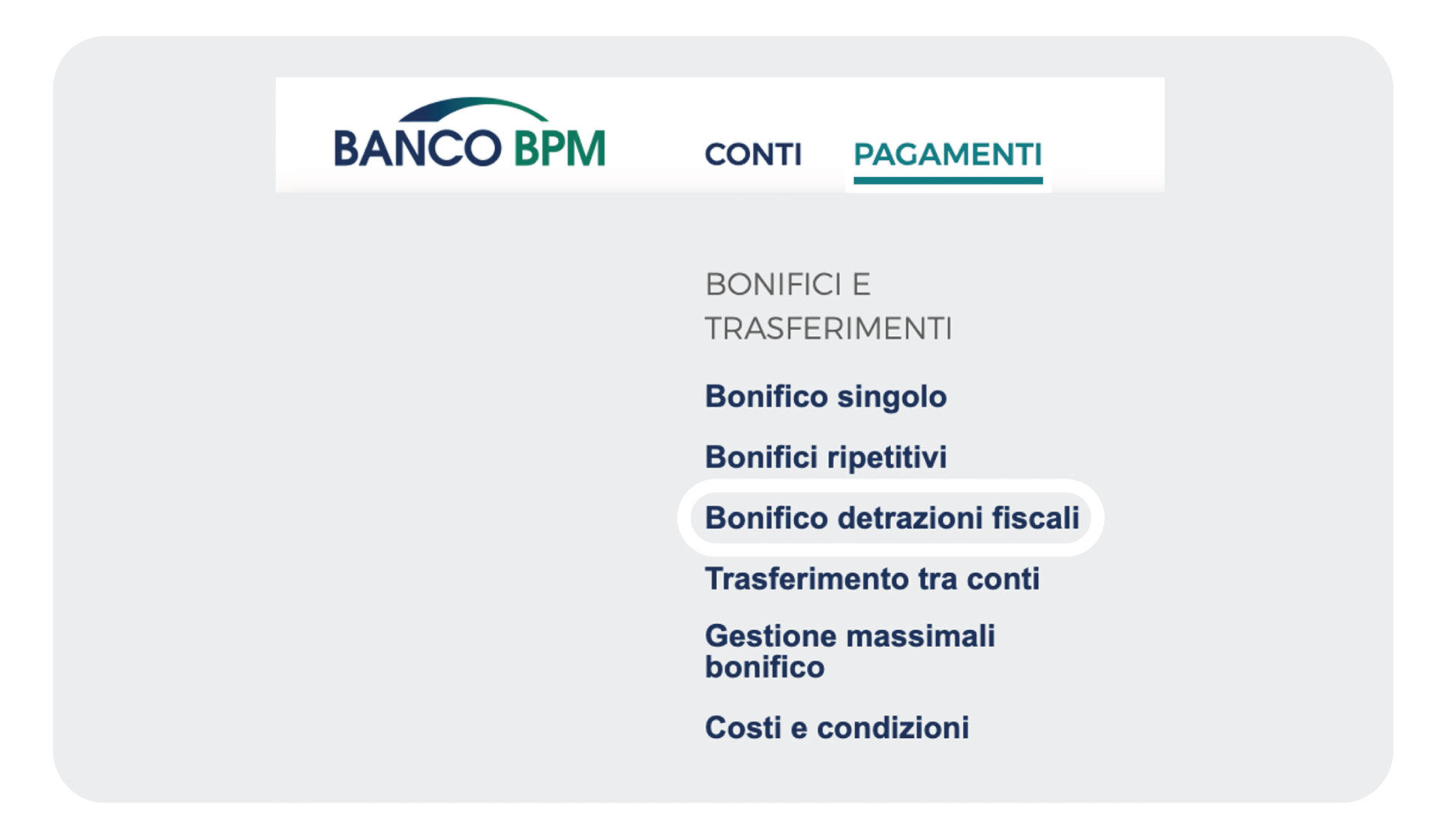
Today most banks (within their online portal) offer a ready-made renovation bank transfer directly, where you only have to enter the required details.
To make everything even simpler, many banks now provide practical step-by-step guides on how to fill in the bank transfer for tax deductions correctly.
The advice is simple: before making the payment, follow your bank’s guide and check that all the details have been entered correctly.
Below you will find some official guides from the main Italian banks, so you can see exactly what to do in your case.
- Intesa Sanpaolo: Guide to the bank transfer for tax reliefs
- Unicredit: Guide to the bank transfer for tax reliefs
- Poste Italiane: Guide to the bank transfer for tax deductions
- BPER Banca: Guide to the bank transfer for tax deductions
- Banco BPM: Guide to the bank transfer for tax deductions
- Mediolanum: Guide to the bank transfer for tax deductions
How to get the armoured door bonus step by step
By now you have understood how the bonus works, how much you can recover and which costs are covered.
Now let’s look at what you actually need to do to get the deduction without mistakes.
The first step is very simple: choose the armoured door and define the work. Whether it is a new installation or the replacement of an existing door, what matters is that the goal is to improve the security of the home.
Once the work is defined, it is essential that a correct invoice is issued, clearly stating the work carried out. This document is essential, because it will be the basis for claiming the deduction.
At this point you move on to the payment, which must be made by traceable “talking” bank transfer, entering all the required details. It is one of the most important steps, because it officially links the cost to the bonus.
After paying and completing the work, in most cases you do not need to handle particularly complex procedures. The deduction is in fact obtained by entering the cost in your Italian tax return, in the following years.
In practice, it will be your accountant (or the tax assistance centre) who handles the tax side, using the documentation you have kept.
And this is another key point: keep everything.
Invoices, payment receipts and documents must be kept carefully, because they may be requested in the event of checks.
If all these steps have been done correctly, the mechanism is automatic: every year you will recover part of the cost in the form of lower taxes.
In the end, the process is far simpler than it seems.
You do not need technical skills or complicated procedures. All it takes is care over the main steps and a little organisation.
How much an armoured door really costs with the bonus
When it comes to the bonus, the most important question is always one: how much do I really spend in the end?
Let’s take a very simple example.
If a complete armoured door (supply and installation) costs €4,000 and you are entitled to the 50% deduction, the real cost drops to around €2,000 over time.
This is because half of the cost is returned to you over the years in the form of lower taxes.
Even in the case of the 36%, the saving remains significant and concretely reduces the final cost of the work.
The point to understand is this: you are not paying the full price, you are investing in security at a real cost that is lower than the initial one.
Want to understand how much you can recover in your case?
Every situation is different and the bonus can vary depending on the property, the type of work and your tax position.
For this reason, before making a decision, it can be useful to understand precisely how much you can really recover.
If you like, you can request a check: we will help you understand whether you can claim the deduction and what the real saving could be in your case.
Frequently asked questions about the Italian 2026 tax deduction for armoured doors
Yes. The armoured door qualifies for the Italian Renovation Bonus because it is considered work to increase the security of the home and prevent theft and break-ins.
In 2026 you can recover 50% of the cost if it is your main home, or 36% in other cases. The deduction is spread over 10 years.
Yes. You do not deduct only the door, but also the fitting and related works, provided they are stated on the invoice.
No. Even simply replacing the armoured door is enough, if the work serves to improve the security of the home.
You must use a traceable, itemised bank transfer for building renovation, entering the payment reason, the tax code and the supplier’s VAT number.
For the Italian Renovation Bonus it is not always mandatory. It is required only in some specific cases linked to energy saving. In that case, you need to consider the thermal transmittance of the armoured door in relation to the climate zone where the front door is fitted.
Yes. The bonus is also valid for second homes, but in this case the deduction is 36% instead of 50%.
Yes. The limit is €96,000 per property unit. The deduction is calculated on this amount.
The bonus was created to encourage work that improves the security of homes.
Reducing the risk of theft and break-ins means increasing the protection of people and properties.
For this reason, the Italian State grants a tax deduction to those who invest in security systems such as armoured doors.
Armoured door bonus: conclusions
Here we are at the end of this long article on armoured door tax reliefs.
If you have made it this far, it means you now have a clearer idea about armoured door deductions, and I hope I have helped you understand how they work.
If you need to replace your front door, request a quote by clicking here: armoured door quote.
If instead you need other information, or simply some advice on the armoured door deduction, leave a comment using the forum below and I will try to reply as soon as possible.
Warm regards,
Mauro
Important disclaimer: The information in this article is based on the guidance provided by the Italian Revenue Agency and is up to date as of 2026. However, Italian tax law can change over time and can vary depending on the specific situation of each person and each property. For this reason, the information given here is for informational purposes only and does not constitute tax advice. Before carrying out any work or claiming any deduction, it is always advisable to check the up-to-date requirements on the official website of the Italian Revenue Agency or to consult a professional, such as an accountant or a qualified technician.
Sources:
– Guide to Building Renovations (Italian Revenue Agency)
– Amount of the deduction and deductibility limits (Italian Revenue Agency)
– Building Renovations (Italian Revenue Agency)

70 Responses
Complimenti! Articolo molto chiaro ed Esaustivo.
Grazie Massimiliano
Sono felice che ti stia stato utile.
Un caro saluto,
Mauro
Ciao, articolo chiaro ed esaustivo. Solo un dubbio: io vivo in una casa indipendente di proprietà di mia madre con la formula del comodato gratuito. Posso usufruire io direttamente del bonus sicurezza. ?? Secondo me si
Ciao Corrado,
Si puoi usufruirne.
La legge dice che possono goderne “i proprietari o nudi proprietari, i locatari o comodatari, il familiare convivente e chiunque abbia un diritto di godimento (usufrutto, uso, abitazione o superficie)”.
Un caro saluto
Mauro
Articolo molto chiaro.
Ho solo un dubbio: nel mio caso la porta blindata andrebbe a sostituire una normale porta in legno che collega il garage (non riscaldato) all’abitazione. Posso usufruire del bonus fiscale? In riferimento al bonus sicurezza o risparmio energetico?
Grazie mille.
Ciao Massimo,
Si, puoi usufruire della detrazione fiscale sia come risparmio energetico che bonus sicurezza (ristrutturazione).
Un caro saluto,
Mauro
Buongiorno,
Articolo molto chiaro. Mi rimane un solo dubbio: occorre predisporre la pratica all’ENEA anche se si vuole usufruire del bonus sicurezza e non del risparmio energetico? E’ necessaria la certificazione?
Grazie mille,
FV
Si, Fabrizio.
L’invio delle pratica ENEA è obbligatoria in ogni caso (anche se si vuole usufruire del bonus sicurezza e non dell’ecobonus).
AGGIORNAMENTO 2022: La pratica ENEA, in caso di bonus sicurezza, non è più obbligatoria.
Un caro saluto,
Mauro
sul sito enea, l’installazione di porte blindate non mi sembra compresa nell’elenco degli interventi soggetti all’obbligo di invio.
https://www.efficienzaenergetica.enea.it/component/jdownloads/?task=download.send&id=248&catid=33&Itemid=101
Nell’articolo è espressa un’opinione diversa: è ripetuto due volte che, optando per il bonus sicurezza, non è necessaria nessuna comunicazione all’ENEA.
Ciao Giuseppe,
I commenti risalgono a novembre 2020, mentre l’articolo viene aggiornato settimanalmente.
Ti confermo che se si opta per il bonus sicurezza non è necessaria alcuna comunicazione all’ENEA.
Un caro saluto,
Mauro
Buon pomeriggio.
Domani mi verrà consegnata una porta blindata che sostituirà quella fin qui in uso.
Ho provveduto, tempo fa (nel 2019) a pagare l’acconto con bonifico parlante (rientrante nella casistica “ristrutturazione”).
La Ditta che, domani, emetterà la fattura di saldo dovrà specificare che trattasi di sostituzione?
Ho inteso che dovrò dirlo anch’io nella comunicazione all’Enea.
Ho paura che detta mia dichiarazione possa essere incompleta e che, poi, possa essere impossibile modificare la fattura della ditta installatrice (che viene inviata immediatamente) al mio cassetto fiscale.
Che fare?
Gentile Vitangelo,
Si, deve trattarsi di sostituzione.
Un caro saluto,
Mauro
Articolo contraddittorio. Perché inviare la pratica all’ENEA se si usufruisce del “bonus sicurezza”? All’ENEA non vanno solo gli interventi di risparmio energetico?
No, Salvatore. La comunicazione all’ENEA è richiesta per tutti gli interventi (anche bonus sicurezza).
AGGIORNAMENTO 2022: La pratica ENEA, in caso di bonus sicurezza, non è più obbligatoria.
Un caro saluto,
Mauro
Anche nelle domande frequenti è ribadito che per il bonus sicurezza non è necessaria la comunicazione all’ENEA:
Porta blindata ENEA: in quali casi devo inviare la pratica all’ENEA?
Se decidi di optare per l’ecobonus, entro 90 giorni dal termine dell’installazione della porta blindata, dovrai predisporre la pratica Enea, da fare esclusivamente in via telematica.
Se invece decidi di optare per il bonus sicurezza / ristrutturazione, non hai l’obbligo di invio pratica all’ENEA.
L’articolo è davvero scritto bene e molto utile, ma queste contraddizioni rovinano tutto: non sarebbe possibile apportare le opportune correzioni?
Ciao Giuseppe,
Il commento in questione risale a novembre 2020 (quando la pratica ENEA era effettivamente richiesta per questo tipo di interventi), mentre l’articolo viene aggiornato settimanalmente.
Ti confermo che se si opta per il bonus sicurezza non è necessaria alcuna comunicazione all’ENEA.
Un caro saluto,
Mauro
Articolo molto bello.
La mia domanda è la seguente:
Sostituisco la porta blindata del mio appartamento in un condominio.
Non avrò benefici in termini di risparmio energetico in quanto l’isolamento rimane lo stesso che ho adesso, ma
avrò benefici in termini di sicurezza (migliore serratura, chiavi a cilindro europeo).
Devo comunque fare la registrazione su ENEA oppure è sufficiente in dichiarazione dei redditi (mod. 730) appellarmi al bonus ristrutturazione. Ovviamente il pagamento verrà effettuato con bonifico bancario apposito e con i riierimenti del bonus ristrutturazione (Bonifico per detrazioni previste dall’art. 16-bis del Dpr 917/1986 – pag. fatt.n…. del…a favore di …. CF/PIVA… – Beneficiario della detrazione …. CF…..-
Grazie
Fulvio G.
Gentile Fulvio,
Per usufruire del bonus, l’invio pratiche all’ENEA è obbligatoria in ogni caso (anche nel caso di bonus ristrutturazione o sicurezza).
AGGIORNAMENTO 2022: La pratica ENEA, in caso di bonus sicurezza, non è più obbligatoria.
Un caro saluto,
Mauro
Complimenti x l’articolo.
Ho appena terminato una ristrutturazione di un appartamento con la cila, però vorrei cambiare la porta d’ingresso fra qualche mese. La domanda….. posso avere la detrazione anche se ho finito la ristrutturazione della casa?
Grazie anticipatamente
Massimiliano S.
Si, Massimiliano.
Un caro saluto,
Mauro
Articolo ben fatto e chiarissimo!! Complimenti per la competenza!!!
Sono contento che il mio articolo ti sia stato utile, Patrizia.
Un caro saluto,
Mauro
Buongiorno,
devo sostituire solamente la serratura del portone blindato per installare quella con cilindro europeo , mi hanno detto che posso usufruire delle detrazione del 50% stabilite dal “Bonus Sicurezza” senza compilare la pratica ENEA , è vero?
Grazie.
Se sostituisci solo la serratura, non hai l’obbligo di invio pratiche all’ENEA.
Un caro saluto,
Mauro
Ottima spiegazione
Una domanda sto acquistando una porta blindata da un privato
Come posso usufruire della detrazione
Che cosa mi deve rilasciate per poter usufruire del bonus
Grazie
Gentile Bruno,
Hai bisogno della certificazione del produttore relativa alla trasmittanza termica della porta blindata (riferimento all’allegato F, legge 296, articolo 345).
Un caro saluto,
Mauro
tutte le porte blindate con qualsiasi trasmittanza termica si possono detrarre con il bonus sicurezza (no ecobonus)?
Grazie
Ottimo e chiarissimo articolo.
Vorrei sostituire il mio portoncino d’ingresso all’appartamento (abito in un condominio).
Oltre al bonus sicurezza è attivabile in aggiunta anche il bonus fiscale che deriva dal risparmio energetico (anche acustico?) considerando che il vano scale non è riscaldato?
Anche considerando che il condominio ha già attivato per ciascun condomino il bonus energetico per la sostituzione della caldaia con una a condensazione.
Ciao Pierluigi,
Puoi optare per uno o altro: o bonus sicurezza o risparmio energetico.
Non per entrambi.
Un caro saluto,
Mauro
Buongiorno, se intallo un porta corrazzata artigianale posso usufruire del bonus sicurezza?
Si deve sempre produrre il cetificato relativo aI valori di trasmittanza termica sia della vecchia porta che della nuova porta (dopo aver inserito i dati, il sito calcola in automatico qual’è il valore di risparmio energetico ottenuto grazie alla sostituzione della tua porta)?
Chiedo questo perché alcune ditte mi dicono che sui prodotti artigianali non è possibile fare questa certificazione.
Grazie e saluti
Gentile Gino,
Si, devi essere per forza in possesso della certificazione relativa alla trasmittanza termica della nuova porta blindata (riferimento all’allegato F, legge 296, articolo 345), altrimenti non hai diritto al bonus.
Un caro saluto,
Mauro
Salve,
devo sostituire una vecchia porta in legno interna (che da sulle scale) con una porta blindata.
Ho letto che la detrazione è valida solo per la “sostituzione”.
Non mi è chiaro questo passaggio: per sostituzione si intende solo da porta blindata ad una nuova porta blindata? o rientro anche io che la sto installando al posto di una vecchia porta in legno?
Grazie in anticipo
Roberto
Gentile Roberto,
Per “sostituzione” si intende la sostituzione di una porta (anche non blindata) con una blindata.
Quindi si, puoi usufruire della detrazione fiscale.
Un caro saluto,
Mauro
..per chiarezza, se sfrutto il Bonus Sicurezza per la sostituzione della porta Blindata, devo fare comunque la pratica Enea ?
Ciao Massimo,
Si, la pratica ENEA è obbligatoria in ogni caso.
AGGIORNAMENTO 2022: La pratica ENEA, in caso di bonus sicurezza, non è più obbligatoria.
Un caro saluto,
Mauro
Complimenti, finalmente un articolo chiaro ed esaustivo ma credo che sia una domanda che molto cercano e di cui non trova risposta.
Se acquisto una porta blindata ma la installo in maniera autonoma, posso usufruire lo stesso della detrazione?
In questo caso chiaramente non avrei la certificazione di posa ma solo la fattura di vendita della porta blindata.
Grazie
Gentile Simone,
Senza certificazione di posa non puoi usufruire della detrazione quindi la risposta alla tua domanda è no, se installi la porta in autonomia non puoi detrarre nulla.
Un caro saluto,
Mauro
Grazie mille.
Molto chiaro, grazie. Ma come faccio a sapere i valori di trasmittanza termica sia
della vecchia porta ?
Gentile Lucia
Se decidi di optare per il bonus sicurezza, il valore di trasmittanza della vecchia porta viene inserito in automatico.
Se invece opti per detrazione per risparmio energetico devi inserire un valore verosimile: o lo chiedi al produttore o ne inserisci uno che va dai 3 ai 5 W/m²K.
Un caro saluto,
Mauro
Buon giorno. Una sua collega del servizio clienti Ariete mi diceva al telefono che le normative cambiano in continuazione e non sapeva cosa dovesse essere comunicato e a chi nel caso dell’installazione di una nuova porta blindata, ma che poi me lo avrebbe fatto sapere. Io gradirei avere informazioni certe se nel caso mi affidassi a voi per la sostituzione di una porta blindata, perché poi non vorrei perdere il bonus. Quindi, a luglio del 2021, è ancora valida la seguente frase? “Fra i due bonus, nella pratica, non cambia praticamente nulla. Per entrambi è necessario inviare la comunicazione all’ENEA e dover rispettare dei requisiti minimi di trasmittanza termica.” Oppure se decido di optare per il bonus sicurezza non devo comunicare nulla all’Enea?
Gentile Luca,
La collega Mara ha ragione.
Purtroppo le normative cambiano in continuazione e non abbiamo ancora aggiornato l’articolo.
In sintesi, la differenza fra bonus ristrutturazione e bonus infissi è la seguente:
BONUS SICUREZZA
È possibile usufruire del bonus sicurezza che prevede la detrazione fiscale del 50% in 10 anni dell’intero importo sostenuto per l’acquisto della porta blindata. Se invece si vuole optare per lo sconto in fattura, è necessario avere una pratica edilizia aperta (CILA/SCIA).
ECO BONUS (RISPARMIO ENERGETICO)
È possibile usufruire dell’Ecobonus anche se non si è in possesso della pratica edilizia. Tuttavia, è possibile portare in detrazione solamente un massimale di spesa al metro quadro (660€/mq per le zone A,B,C e 780€/mq per le zone D,E,F).
Inoltre è necessario acquistare una porta che rispetti i valori minimi di trasmittanza termica (maggiori info qui).
Per quanto riguarda la pratica ENEA, nel caso dell’Ecobonus è richiesta, mentre nel caso del Bonus Sicurezza / Ristrutturazione è “consigliata” ma non obbligatoria.
Se hai bisogno di altre info chiedi pure.
Un caro saluto;
Mauro
Fossero tutti così chiari e precisi!
Grazie Claudio per il tuo commento, felice che il mio articolo ti sia utile.
Un caro saluto,
Mauro
Articolo chiaro. Manca però di specificare come fa un soggetto FORFETTARIO 65K (o latro) ad usufruire dei bonus. Grazie per una chiarificazione.
Gentile Daniele,
Se hai il reddito derivante dall’attività con partita IVA in regime forfettario si, puoi usufruire delle detrazioni fiscali.
Un caro saluto,
Mauro
Buongiorno, complimenti per l’ articolo. Solo una cosa non mi è chiara. Per la sostituzione della sola serratura va fatta la comunicazione all’ Enea?
Un saluto
Francesco
No, Francesco.
Un caro saluto,
Mauro
Complimenti per l’articolo.
Le faccio una domanda: se ho un appartamento in comodato (di proprietà di mio padre) e voglio sostituire la porta d’ingresso (non blindata) con una porta blindata posso usufruire io stessa del bonus sicurezza pur avendo chiuso già la pratica cila per la ristrutturazione?
Si, puoi usufruirne. Puoi sfruttare il bonus sicurezza o l’ecobonus.
Un caro saluto,
Mauro
Buongiorno, complimenti per l’ articolo. Vorrei però sapere se, volendo usufruire del bonus sicurezza per la sostituzione di una porta esterna con una blindata, devo fare la comunicazione ENEA. Lo chiedo perchè dal 6/10/2020 i limiti di trasmittanza sono ancor più stringenti (1,3 W/m2 K) e la porta blindata potrebbe non soddisfare tali requisiti ma garantisce lo stesso la “sicurezza”. Oppure in questo caso non ci sono limiti? Ed inoltre come distinguo nella dichiarazione ENEA il caso sicurezza dalla ristrutturazione?
No, non è obbligatoria la comunicazione ENEA se opti per bonus sicurezza.
Non ci sono nemmeno limiti di trasmittanza termica.
Se opti per ecobonus, invece, devi inviare pratica ENEA e rispettare valori di trasmittanza termica.
Un caro saluto,
Mauro
Buonasera,
a seguito del ricambio degli infissi del mio appartamente, la pratica Enea l’ho presentata in autonomia . Ora, quale tipo di pratica occorre presentare per aver sostituito la sola porta blindata? Ecobonus o Bonus Casa ? perché del tanto decantato Bonus Sicurezza non mi pare vi sia traccia nel sito dell’Enea, così come anche degli spazi per inserire i dati della porta blindata. Grazie se vorrà aiutarmi e complimenti per le sue spiegazioni. Un saluto
Gentile Maurizio,
Il bonus sicurezza fa parte del bonus casa / ristrutturazione.
Un caro saluto,
Mauro
Buongiorno Mauro,
la ringrazio per l’articolo, molto utile.
Le vorrei chiedere un chiarimento, vale a dire se i massimali di detraibilità della porta blindata si applicano anche a chi sceglie di avvalersi del bonus “sicurezza” (oppure soltanto a chi opta per l’ecobonus)? In tale caso, saprebbe indicarmi i riferimenti legislativi?
Grazie e saluti
I massimali si applicano solo per l’ecobonus, Egidio.
Un caro saluto,
Mauro
buongiorno Mauro,
grazie delle spiegazioni molto chiare ed esaustive.
devo sostituire una porta d’ingresso in una seconda casa, mi verrà posata una porta blindata che pagherò con bonifico per ristrutturazione edilizia.
ho capito dalla sua spiegazione che dovrò fare comunicazione Enea per bonus sicurezza .
vorrei sapere le caratteristiche che deve avere la fattura emessa dal venditore/posatore :
dicitura “sostituzione porta ingresso con porta blindata” ,
deve essere distinto il valore del bene da quello della manodopera? con conseguente differente aliquota iva (10-22%)
l’importo da detrarre è la spesa totale ? materiale + manodopera + iva ?
grazie e saluti
Catia
Ciao Catia,
Non è obbligatoria la pratica ENEA.
Con il bonus sicurezza / ristrutturazione, puoi portare tutta la spesa in detrazione (compresi manodopera, materiale, IVA).
Un caro saluto,
Mauro
Buongiorno,
bell’articolo molto esaustivo, la mia richiesta è questa:
Devo sostituire gli infissi che attualmente sono con vetro singolo, i nuovi infissi hanno il doppio vetrocamera con una trasmittanza termica di 1,1 W/m2K, e fin qui tutto ok, però devo sostituire anche il portoncino ingresso con un blindato la cui trasmittanza è di 1,7 W/m2K.
Considerando che dal 1 gennaio 2021 la trasmittanza termica nella fascia climatica E è pari a 1,3 W/m2K, comunicando tutti i dati all’ENEA, posso usufruire della detrazione fiscale del 50% come ristrutturazione edlizia anche per la porta blindata?
Grazie per la sua risposta.
Buongiorno e grazie per questo articolo così chiaro. A me interessa cedere il credito a seguito di acquisto porta blindata. Senza altri lavori. In questo caso quindi Bonus Sicurezza 50% senza altre complicazioni, corretto?
Grazie e saluti.
Buonasera Chiara,
No, non è possibile cedere il credito o usufruire dello sconto in fattura per l’acquisto di una porta blindata, a meno che non vi sia una pratica edilizia (CILA/SCIA).
In quel caso, puoi comunque scontare in fattura non l’intero importo ma quello rientrante nei massimali al metro quadro.
La parte restante è da pagare a parte.
Un caro saluto,
Mauro
Posso usufruire della detrazione fiscale del 50% anche se trattasi di installare una porta blindata nella mia seconda casa?
Si, Alfonso.
Un caro saluto,
Mauro
C’è un errore, che purtroppo fanno in tantissimi , e che mi permetto di correggere per evitare fraintendimenti…
nello schemino delle differenze tra i 2 bonus vengono presi 2 valori diversi tra loro…
Spesa e detraibilità sono cose diverse:
nel Bonus casa ( in questo caso bonus sicurezza ) la spesa massima è 96.000,00 ma la spesa detraibile è 48.000,00
Nel Ecobonus la spesa massima è 120.000,00 con una detraibilità massima di 60.000,00
La guida dell’ AdE ha creato questa confusione citando per la Ristrutturazione il valore massimo di spesa e per la riqualificazione il valore massimo di detraibilità
Buongiorno, complimenti per l’articolo, molto esaustivo. Domanda: la posa in opera del portone blindato può avvenire in autonomia o serve una certificazione di posa in opera? Mi riferisco al bonus sicurezza. Grazie
Gentile Francesco,
Serve una certificazione di corretta posa (benestare di collaudo).
L’installazione non può avvenire in autonomia.
Un caro saluto,
Mauro
Grazie mille. La ditta che rilascia il benestare quali requisiti deve avere?
Buonasera
in caso di installazione di una porta blindata (volendo seguire le regole per accedere al bonus sicurezza) non devo avere una CILA.
Questo mi è chiaro.
Ma l’IVA che applicherà il venditore è al 22% o al 10%?
Grazie per l’aiuto che mi potrà dare.
Buonasera Barbara, viene applicata IVA mista 10/22%.
Trovi maggiori info qui: IVA su infissi.
Un caro saluto,
Mauro