
The latch of an armoured door is the part of the lock that keeps the door closed even without turning the key.
It is the small shaped metal element, usually with a sloping or “wedge” shape, that draws back when you press the handle down or when it meets the frame as the door closes.
When the door is pushed to, the latch slides against the strike plate on the frame and, thanks to an internal spring, springs back automatically, temporarily holding the leaf in place.
In practice, it is the part that lets an armoured door “stay shut” even without turning the key.
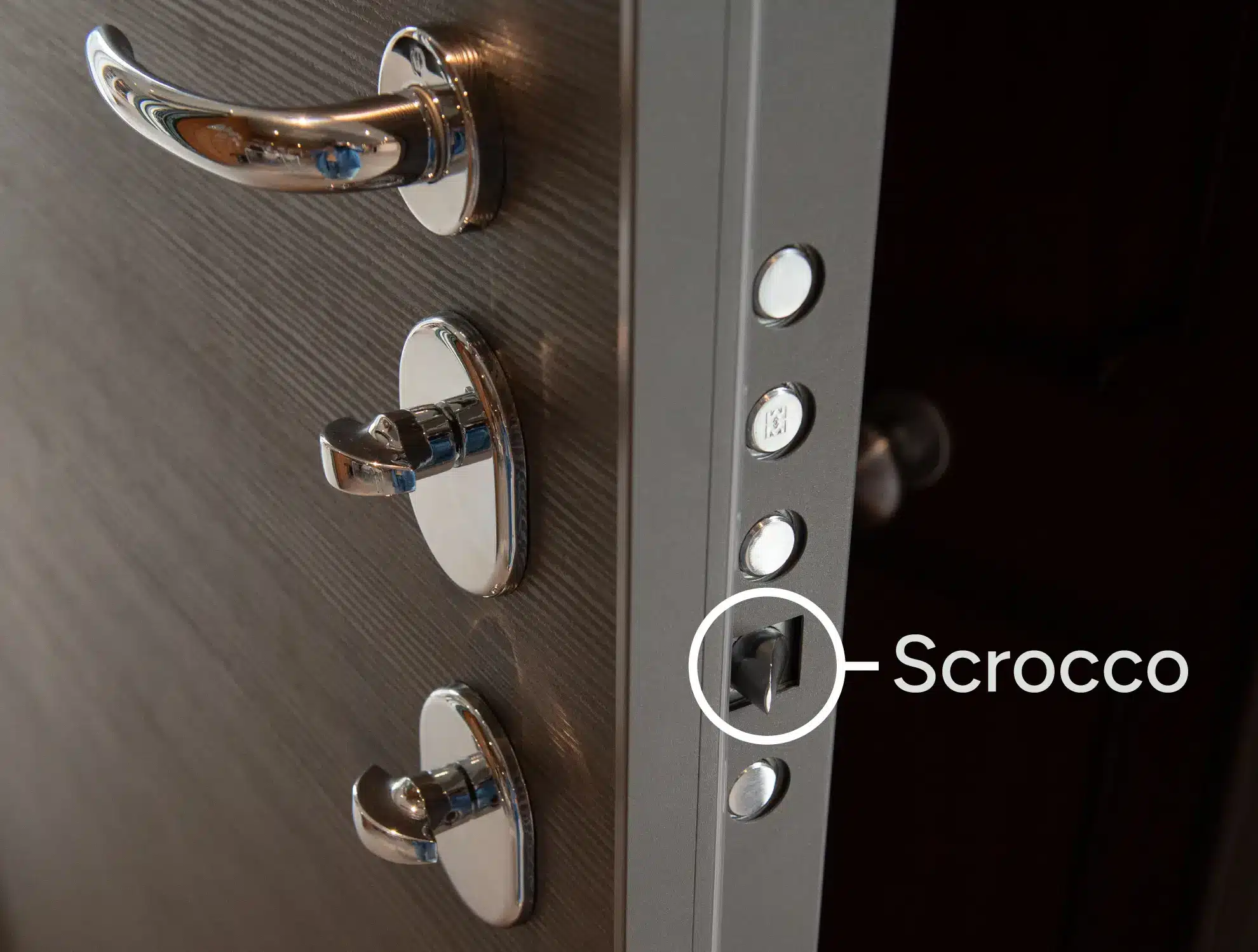
Many people confuse the latch with the deadbolts or with the turns of the lock, but these are different parts.
The latch works during the everyday closing of the door, while the key turns serve to raise the security level by driving the side bolts into the frame.
In modern armoured doors, the latch also plays an important role in home comfort. Correct adjustment helps to improve the pressure of the seals, reduce draughts and noise and make closing smoother and quieter.
What the latch does in the lock
The latch keeps an armoured door closed without having to use the key every time. It is the first element that comes into action when you push the door to, and it lets the leaf stay held against the frame quickly and conveniently.
In functional terms, the latch has three main jobs: to make the door close at once, to make opening with the handle easy, and to improve the stability of the leaf when the door is fully home.
Beyond everyday convenience, a properly adjusted latch also contributes to the comfort of the home.
A precise close lets the seals of the armoured door press more closely against the frame, improving acoustic insulation and reducing the passage of air and draughts.
When the latch is worn, out of line or poorly adjusted, several problems can appear: the door may fail to stay closed, may be hard to open, or may produce noises, vibrations or slight play in the leaf.
In the most modern armoured doors there are also adjustable latches, designed to make closing even quieter and more precise.
Some electronic models, instead, use motorised systems that replace the classic mechanical latch.
How the latch of an armoured door works
The way the latch of an armoured door works is quite simple, but essential for correct everyday use of the door.
When the door is pushed to, the sloping part of the latch meets the strike plate fixed to the frame.
The pressure of the frame makes the latch draw back temporarily into the lock thanks to an internal spring.
Once past the point of contact, the spring pushes the latch outwards again so that it enters its housing in the frame.
It is exactly this automatic movement that lets the door stay closed even without turning the key.
When you press the handle down, instead, the internal mechanism retracts the latch, allowing the door to open.
In traditional armoured doors, then, the latch works continuously together with the handle and is one of the most used parts of the whole lock.
Correct operation depends on several factors, including:
- the alignment between leaf and frame;
- the adjustment of the hinges;
- the position of the strike plate;
- the pressure of the seals;
- any wear of the lock or the internal spring.
If even one of these elements is not properly adjusted, the latch can start to work badly. In these cases the door may become hard to close, fail to catch correctly or spring open on its own after being pushed to.
Difference between the latch and the key turns of the lock
| Feature | Latch | Key turns of the lock |
|---|---|---|
| Main function | Keeps the door closed when it is pushed to | Lock the door securely by means of the key |
| How it is activated | Automatically, by spring and handle | By turning the key in the lock |
| Everyday use | Comes into action at every opening and closing | Used when you want to secure the door |
| Allows closing without the key | Yes | No |
| Security level | Limited: keeps the door pushed to | High: drive deadbolts or bolts into the frame |
It is very common to confuse the latch with the key turns of the lock, but these are two completely different parts, with different functions.
The latch is the part that lets an armoured door close simply by pushing it to. It works automatically thanks to an internal spring and is operated directly by the handle. Its main job is to keep the door closed during normal everyday opening and closing.
The key turns, on the other hand, come into action only when you turn the key. In this case the lock drives out the bolts or metal deadbolts that enter the frame, raising the security level of the armoured door.
In practice:
- the latch serves for the immediate closing of the door;
- the key turns serve to lock the door securely.
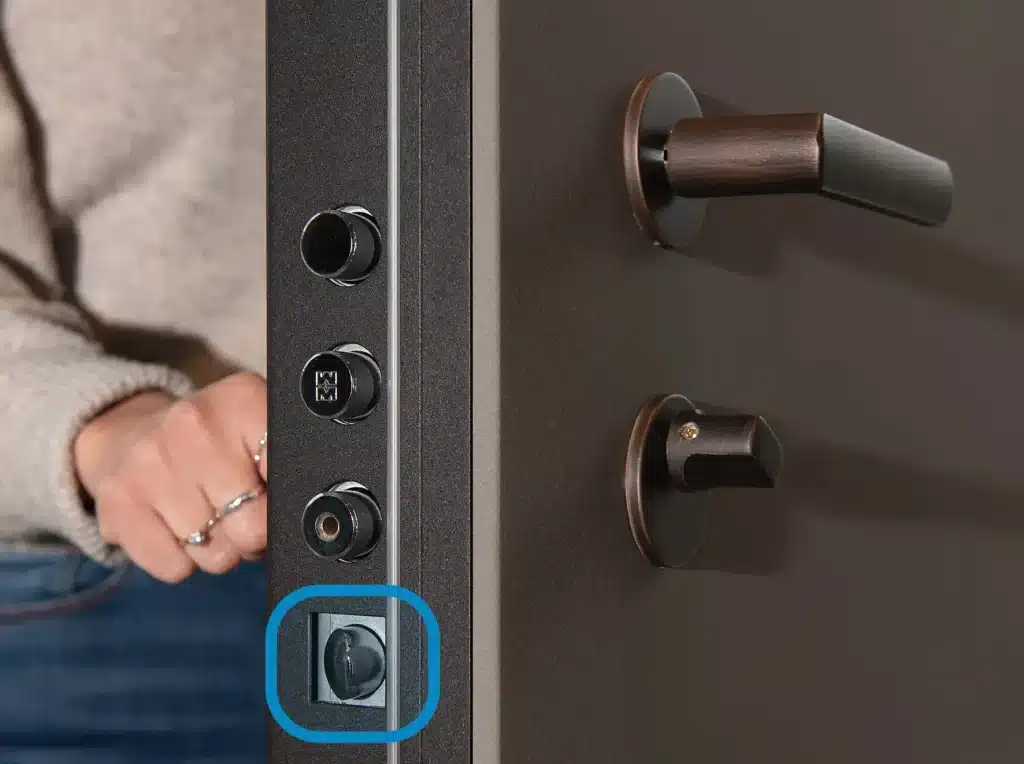
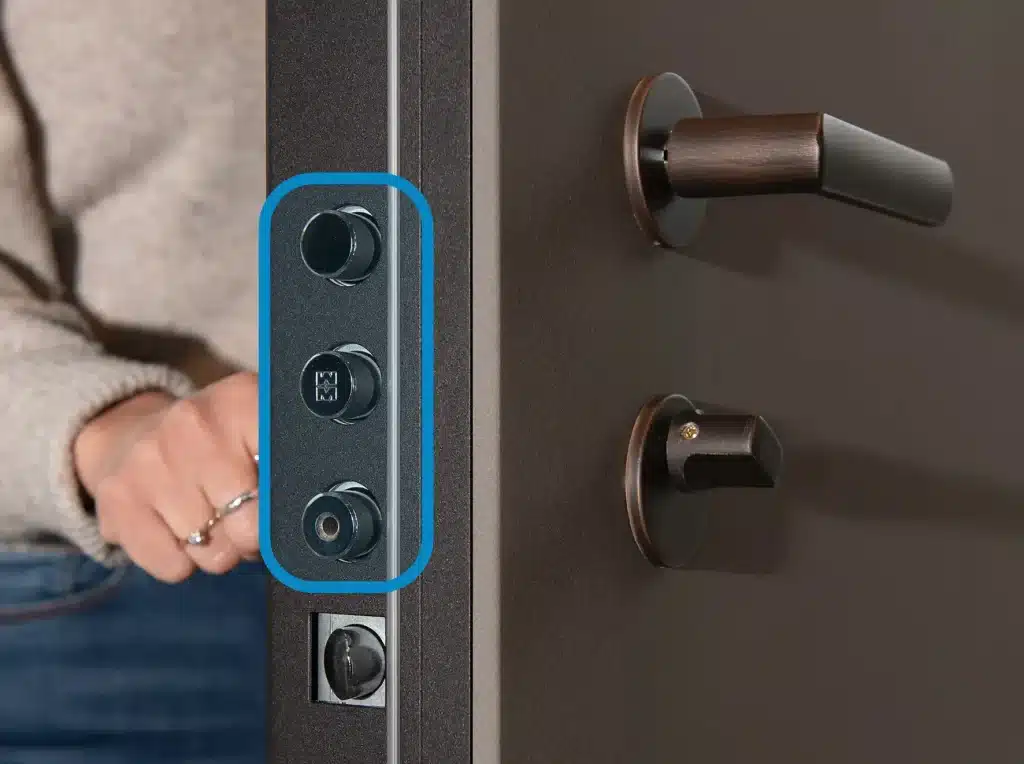
Armoured door latch (photo 1) and key turns of the lock (photo 2)
This difference matters in practical terms too. A door can have a perfectly working latch but problems with the key turns, or the other way round.
For example, if the door pushes to but does not stay closed, the problem is often linked to the latch or its adjustment.
If, on the other hand, the key turns badly or the bolts struggle to come out, the problem generally concerns the lock or the alignment of the key turns.
In modern armoured doors, especially in electronic models, the latch and the key turns can work together through motorised systems, but the operating principle stays the same: the latch manages quick closing, while the key turns provide the real security.
How to adjust the latch of an armoured door
Adjusting the latch of an armoured door serves to restore a smooth, precise and quiet close when the door starts to struggle to catch or shows play and friction.
In most cases there is no need to replace the lock: it is enough to work on the adjustment of the door or the strike plate to bring the latch back to the correct position.
Before starting, it is important to understand where the problem comes from.
If the door springs open on its own, the latch probably does not go far enough into its housing. If instead the door is hard to close, there may be too much pressure between leaf and frame.
The most common adjustments concern the strike plate fixed to the frame, the adjustable hinges and any adjustment cams present on the armoured door.
In many modern armoured doors the strike plate can be moved slightly to bring the latch’s point of contact closer or further away.
In other cases you can adjust the hinges directly to realign the leaf and improve closing.
Generally the procedure consists of loosening the strike plate screws slightly, moving it a few millimetres and checking the door’s closing step by step.
It is important to work always with minimal movements, because even small changes can noticeably alter how the latch works.
If the armoured door has adjustable 3D hinges, it may also be necessary to work on the height or pressure of the leaf to improve the overall alignment between door and frame.
When the adjustment is correct, the door should close without effort, stay pushed to without the key turns and show no abnormal vibrations or play.
If, instead, the latch keeps working badly even after the adjustments, the problem may be due to mechanical wear, distortion of the door or damaged internal parts of the lock.
How to lubricate the latch correctly
Correct lubrication of the latch of an armoured door helps to keep the mechanism smooth, quiet and less prone to wear over time.
Many problems of a stiff, noisy or slow latch can in fact come down simply to a lack of maintenance.
Before lubricating, it is important to remove any dust or dirt that has built up around the latch and in the area of the lock. Even small residues can increase friction and impair the correct movement of the mechanism.
For maintenance it is advisable to use WD-40. These products help to reduce friction without leaving overly greasy residues that over time could trap dirt.
Generally it is enough to spray a small amount of product directly onto the latch and work the handle several times to spread the lubricant inside the mechanism.
It is better, on the other hand, to avoid thick greases, heavy oils or generic lubricants not suited to locks.
Many oily products, in fact, seem to improve things at first but over time can make them worse by building up dust and making the mechanism even stiffer.
If after lubrication the latch keeps drawing back slowly or stays stuck, the problem may be due to a worn internal spring, a misalignment of the door or parts that are now worn out.
Periodic maintenance, even very simple, can help to extend the life of the lock and keep the armoured door closing more smoothly and quietly over time.
Conclusions
The latch of an armoured door is a part that is often underestimated, but essential to ensure a smooth, quiet and properly adjusted close.
When it works well, it lets the door close immediately and precisely, improving not only everyday practicality but also home comfort, insulation and the life of the lock over time.
Many common problems, such as doors that spring open on their own, stiff handles or noisy closing, simply come down to an incorrect adjustment of the latch or the hinges.
For this reason it is important not to ignore the first signs of trouble and to carry out periodic maintenance of the armoured door.
In most cases, a simple adjustment or lubrication is enough to restore correct operation.
Understanding how the latch works and recognising the most common symptoms therefore lets you keep your armoured door more efficient, secure and pleasant to use every day.
Frequently asked questions about the armoured door latch
In most cases the problem is down to the latch failing to catch the strike plate on the frame correctly. The causes can be an incorrect adjustment, hinges out of line, wear of the lock or excessive pressure of the seals.
Yes, in many armoured doors the latch can be adjusted by working on the strike plate, the cams or the door’s adjustable hinges. Even small movements can noticeably improve closing.
A slight pressure of the seals is normal, especially in highly insulated armoured doors. If, however, closing requires too much force or the handle feels stiff, there may be a problem with the adjustment of the latch or the leaf.
For small adjustment or lubrication jobs yes, especially if the door has simple adjustable systems. However, if the problem concerns the lock, the hinges or more complex alignments, it is advisable to call in a professional to avoid incorrect adjustments.
For maintaining locks it is generally better to use a silicone spray or products made specifically for locks. Some overly oily lubricants can attract dirt and make the latch work worse over time.