
Are you considering an armoured door with concealed hinges and wondering whether, on top of looking better, it is also secure and built to last?
Then you are in the right place.
An armoured door with concealed hinges is a door where the hinges are hidden inside the frame: they are not visible from the outside, they cannot be attacked from outside and the leaf sits perfectly in line with the frame.
The result is a door that looks cleaner and, at the same time, is harder to attack at the very point where older doors used to be vulnerable.
And this is exactly the point.
Almost everyone presents the concealed hinge purely as a design choice, a door that “disappears” into the wall.
In reality a hidden hinge touches three things at once: looks, security and maintenance, and it is the last two that nobody really talks about.
An exposed hinge has its pins and body on show on the outside, which is exactly where an intruder works to lever the leaf off.
A concealed hinge, set into the frame, removes that point of leverage and leaves a smooth surface outside with nothing to grip.
Then there is the matter of adjustment: a concealed hinge must be set up correctly during fitting, otherwise the door sits crooked and wears out.
That is why it matters enormously who fits it for you, not just which door you buy.
In this guide I will explain:
- how a concealed hinge works and how it differs from an exposed one
- how the hidden hinge affects looks and security
- how much maintenance it really needs and how long it lasts
If you are renovating and looking at a door with concealed hinges, these are the points that really matter before you decide.
Read on to find out more.
What concealed hinges on an armoured door are


The hinge is the part that connects the leaf to the frame and lets it open and close.
On an armoured door it carries dozens of kilos of leaf on its own, so it has to be sturdy and must not warp over the years.
On a concealed hinge this whole mechanism is housed inside the frame and inside the leaf: with the door shut you see absolutely nothing.
The leaf and the frame stay flush, that is, on the same plane, with no step and none of the protruding metal bodies of traditional doors.
An armoured door normally has two hinges, one at the top and one at the bottom.
Three hinges are only fitted on leaves that are particularly heavy or larger than standard size.
The practical difference between the two types is something you can see and touch.
An exposed hinge has its body and pin sticking out on the outer edge of the leaf: you spot it straight away because there is metal in relief along the edge.
A concealed hinge, by contrast, leaves a smooth, continuous profile, because the mechanism works hidden on the inside.
It is not just a matter of taste: it changes the way the door defends itself and the way it has to be adjusted, and we will look at both shortly.
Are armoured doors with concealed hinges less secure?
It is the first question many people ask, and the answer is reassuring.
A concealed hinge removes a weak point: with the door shut it cannot be reached from outside, so it cannot be tampered with or unscrewed to lever the leaf off.
This strengthens resistance on the hinge side and contributes to the passive security of the entrance.
On a door with exposed hinges, the body and pin stay on show on the outer edge.
There an intruder has something to lever against in an attempt to force the leaf off at its point of rotation.
With the hinge set into the frame that point of leverage disappears: on the outside all that is left is a solid, smooth surface, with nothing to grip or to slip a tool into.
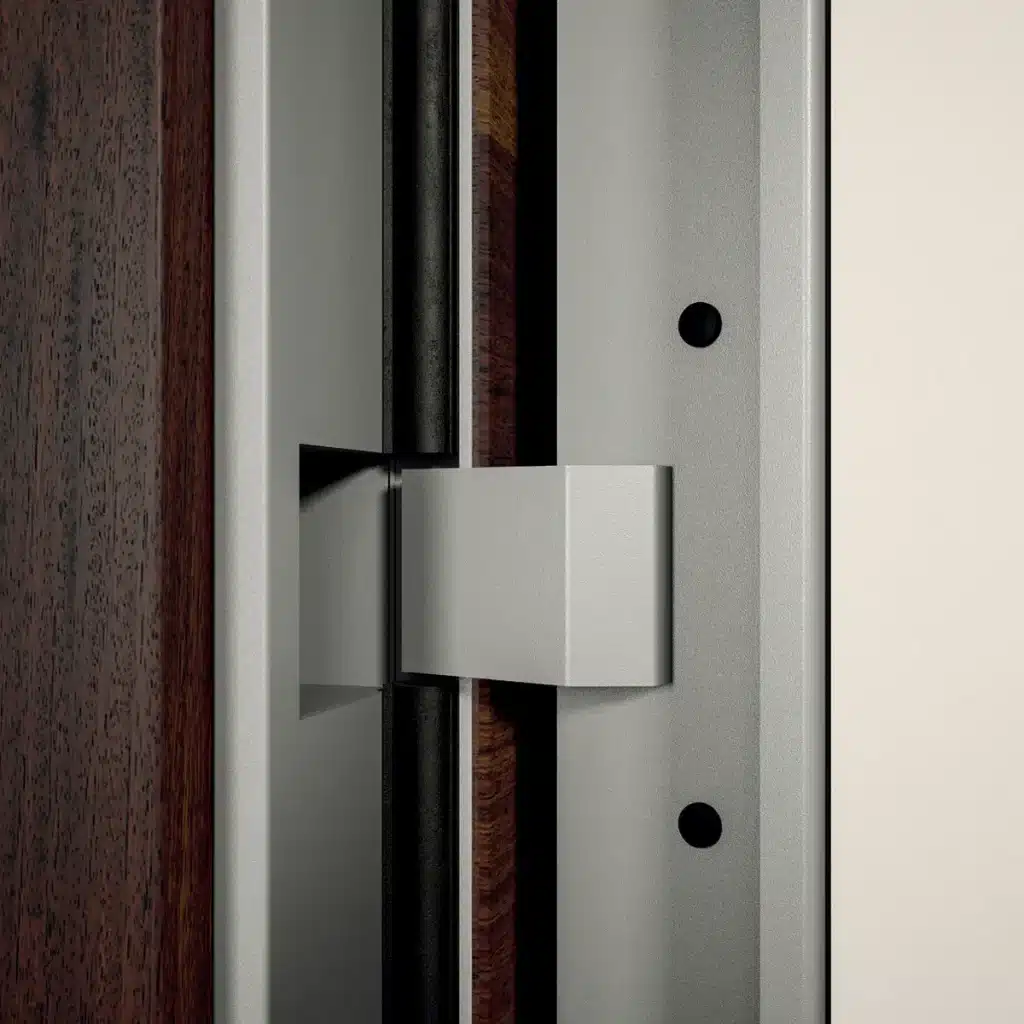
Be careful, though, not to read the hinge as an isolated detail.
An armoured door is secure as a system, not because of a single part.
The concealed hinge works together with the defender that protects the cylinder, with the deadbolts of the lock and with the fixed anti-lever lips on the hinge side.
On an Ariete door the defender is square with chamfered corners, a shape that on its own renders the scaffolding-pipe technique used to bend round defenders ineffective.
It is the combination of these elements that makes the difference, and it is the reason why no break-in attempt has ever succeeded on an Ariete door.
An armoured door with an up-to-date lock is named as the home’s first line of passive defence, including by the Italian State Police advice on protecting your home from burglars.
If you want to understand how all these parts hold together, you will find the full picture in the article on how an armoured door is made.
The aesthetic benefits of entrance doors with concealed hinges
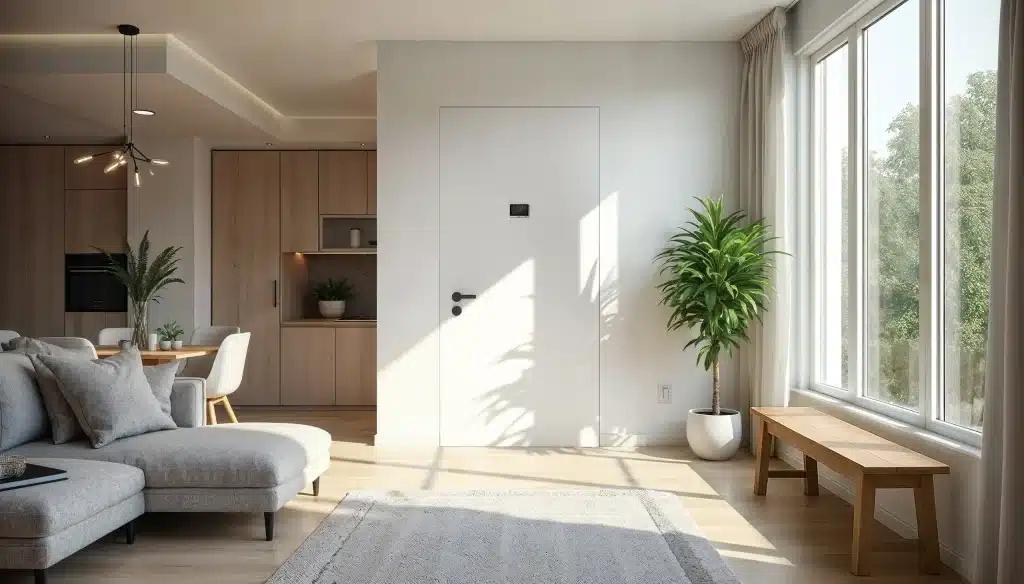
The reason most people come to the concealed hinge is the look, and it is a legitimate one.
With no protruding hinges, the door becomes a clean, continuous surface that blends into the wall instead of imposing itself.
No metal in relief along the edge means a door with a minimalist look, one that suits modern furnishings and pared-back entrances.
It is the solution sought by high-end renovations, where the entrance door should not “stand out” but become part of the wall.
On an Ariete door this pairs with the fact that every door is made to measure, not adapted from a standard size.
Perfect flushness depends precisely on this: a leaf and a frame made for your opening, not the nearest millimetre available in stock.
The concealed hinge is at its best when paired with a flush-to-wall door.
On a flush-to-wall armoured door the leaf is aligned with the wall, with no frames and no protruding jambs: at that point the hinges have to disappear too, otherwise the “continuous wall” effect breaks.
The two elements go together: it is the pairing that delivers the cleanest possible look on an armoured entrance door.
If this is the look you have in mind, you will find prices and details in the dedicated piece on the flush-to-wall armoured door.
How far an armoured door with concealed hinges opens
A practical question many people ask: with the hinges hidden, does the door open well or is it limited?
Ariete armoured doors with concealed hinges open up to 105°, an angle that lets you pass through comfortably, bring furniture inside and use the entrance without feeling restricted in your movements.
In everyday use you notice no difference from a door with traditional hinges: you come in, go out and move bulky items through exactly as you would expect.
The 105° opening is designed for the real entrance of a home, where the door sits between the landing and the hallway and must not bang against the wall or the nearby furniture.
Why on a door with concealed hinges the fitter matters
This is the part that makes the difference between a door that lasts twenty years and one that gives trouble after six months.
A concealed hinge must be adjusted precisely during fitting: if the setting is off, the leaf sits crooked, scrapes and wears out over time.
Like any hinge on an armoured door, it must be set square during installation: this is a job for a technician, not something to do by eye.
The point is who adjusts it: a job done well gives you a door that works perfectly for years, one done badly ruins it within a few months.
On this Ariete has a firm rule: the technicians who fit the doors are in-house and trained at the Accademia della Posa in Opera in Genoa, the first of its kind in Italy.
It is the reassurance that counts when how the door performs depends on whoever adjusts it on site.
If you want to see how simple a well-done adjustment is, there is the practical guide on how to adjust an armoured door.
Maintenance and durability over time
Another question nobody explains in the search results: does a hidden hinge wear out? Does it need greasing? Will it hold the weight over the years?
A concealed hinge, shut inside the frame, stays better protected from dust and dirt than an exposed hinge, and in normal use it needs little maintenance.
Being protected, it picks up less of the grime that over the years hardens and makes exposed hinges squeak.
The rule of thumb is simple: a check once a year, in which you make sure the leaf opens and closes effortlessly and without scraping on the frame.
If you feel the door starting to “pull” or to catch on the frame, do not wait: it is time for an adjustment, not a problem to ignore for months.
A well-made concealed hinge transfers the weight of the leaf onto a mechanism that works without friction, so it does not wear like a cheap hinge.
That is why on a serious door the hinge lasts as long as the door itself, twenty years and more, with no extraordinary work.
The real maintenance job, when it is needed, is the adjustment carried out by a technician: quick, but to be done with the right tools, not by eye.
Exposed or concealed hinges: which is better?
Let us put them side by side, with honest pros and cons, so you choose knowingly and not because it is in fashion.
| Exposed hinges | Concealed hinges | |
|---|---|---|
| Looks | Hinges visible on the edge | Leaf and frame flush, clean profile |
| Security | Pin exposed on the outside | Mechanism set in, no external holds |
| Opening | Wide | Up to 105°, wide for a real entrance |
| Maintenance | Exposed to dust and dirt | Protected in the frame, little maintenance |
The summary is simple: the concealed hinge offers the aesthetic advantage, an extra point on the hinge side and less maintenance, in exchange it demands fitting done properly.
The exposed hinge remains a sound, sturdy choice, with security performance that depends in any case on the whole door.
If you like the minimalist look and you have someone who fits it well, the concealed hinge is the better choice.
The Ariete models with concealed hinges
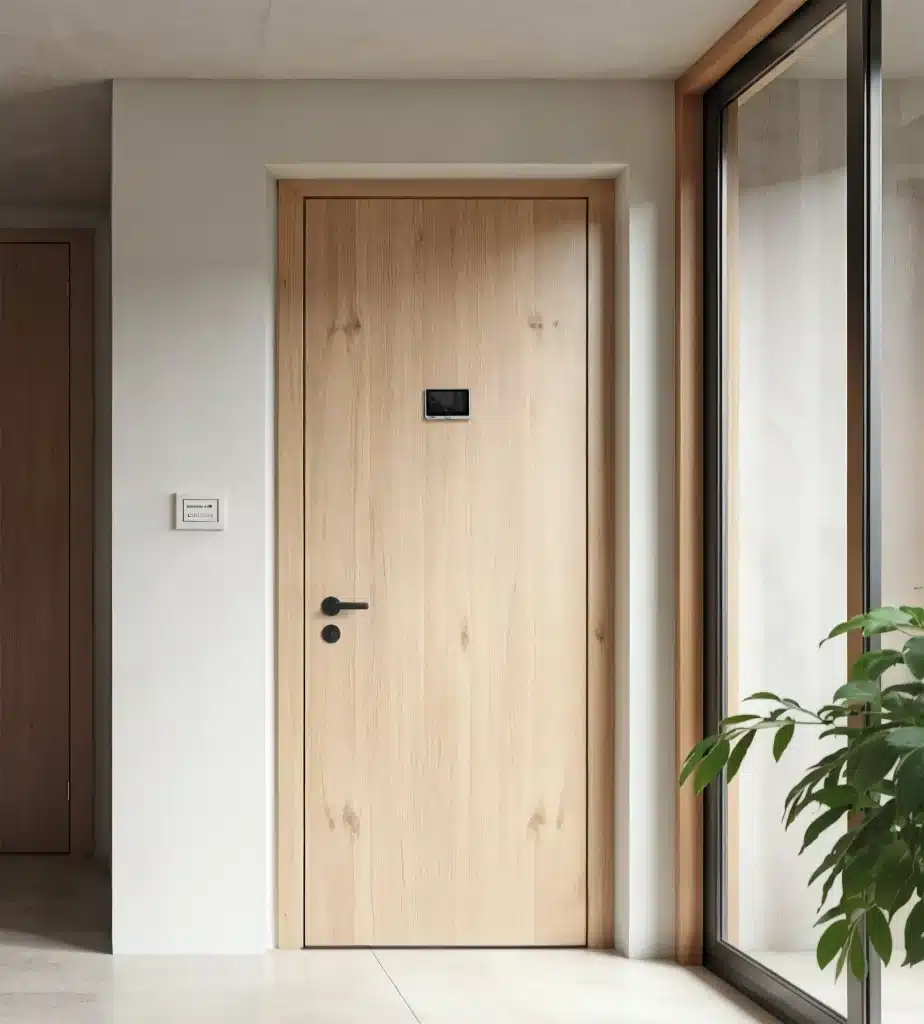
Concealed hinges come as standard on Ariete’s flagship models.
The models with concealed hinges are Interior 4S for indoors, Exterior 4S for outdoors and Futura 4S in the electronic version, all in burglar resistance class RC4. Concealed hinges are also available as an option on the Aurora and Luce models.
The 4S label means exactly this: class 4, the highest among those common in homes, with the frame flush to the leaf and hinges hidden away.
With the concealed hinge you get the highest burglar resistance level and, on top of that, the clean look.
Class 4 is the one recommended for city flats and exposed homes, and it is explained in detail in the guide to armoured door burglar resistance classes.
All these models are made to measure for your opening, which is why the flushness comes out perfect and not approximate.
If you want to see the style of these doors on real entrances, there is the overview of Ariete’s modern armoured doors.
| Feature | Interior 4S | Exterior 4S | Futura 4S |
|---|---|---|---|
| Ideal use | Inside a flat | Outdoors, detached houses and street-facing entrances | Indoors, with access control |
| Burglar resistance class | 4 | 4 | 4 |
| Hinges | Concealed, flush frame | Concealed, flush frame | Concealed |
| Leaf opening | Up to 105° | Up to 105° | Up to 105° |
| Lock | Rectangular deadbolt | Rectangular deadbolt | Motorised electronic, automatic locking |
| Defender | Ariete square defender with chamfered corners | Ariete square defender with chamfered corners | Ariete square defender with chamfered corners |
| Cylinder | Site cylinder + Ariete euro cylinder (5 owner keys + 2 emergency) | Site cylinder + Ariete euro cylinder (5 owner keys + 2 emergency) | Security euro cylinder (mechanical backup) |
| Opening and access | Key | Key | App, fingerprint, badge, keypad + backup key |
| Acoustic insulation | Up to 44.8 dB | Up to 44.8 dB | Up to 46 dB |
| Thermal insulation | Up to 1.2 W/m²K | Up to 0.6 W/m²K | Up to 0.8 W/m²K |
| Threshold / draught excluder | Ariete draught-excluder blade | Aluminium floor threshold | Draught-excluder blade or floor threshold |
| Panels | Insulating and sound-absorbing | Insulating, sound-absorbing, weather-resistant | Insulating and sound-absorbing, weather-resistant (external version) |
Want to know which model with concealed hinges is right for your home and how much it costs in your case?
Fill in the form with two pieces of information about your home and the kind of door you have in mind: we need them to prepare an accurate quote for you and to point you towards the models suited to your entrance.
If you would rather see it in person, in the showroom you can view the flushness for yourself and try the opening with an expert consultant.
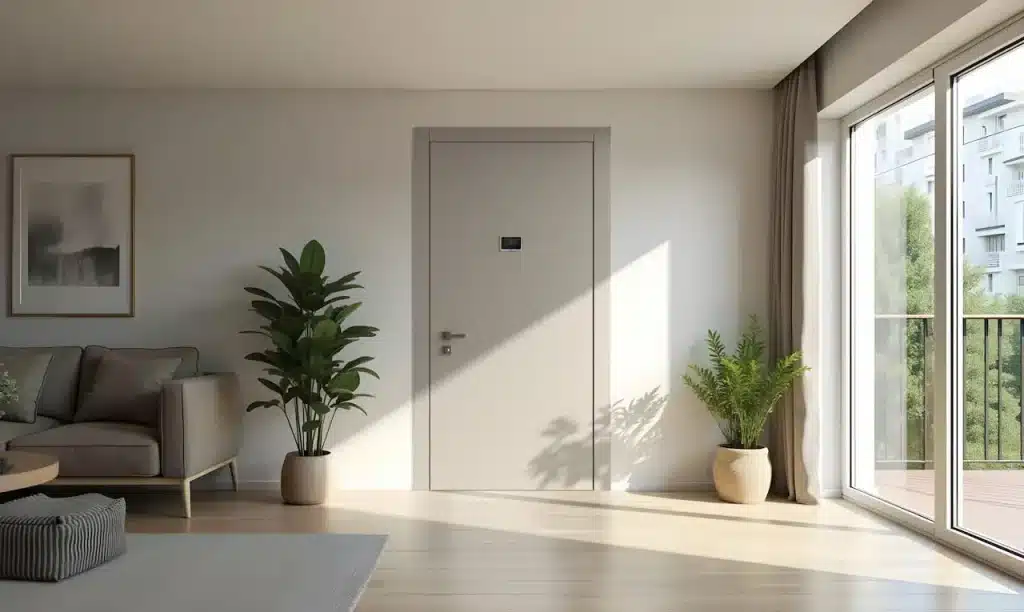
Ariete armoured doors with concealed hinges: photos
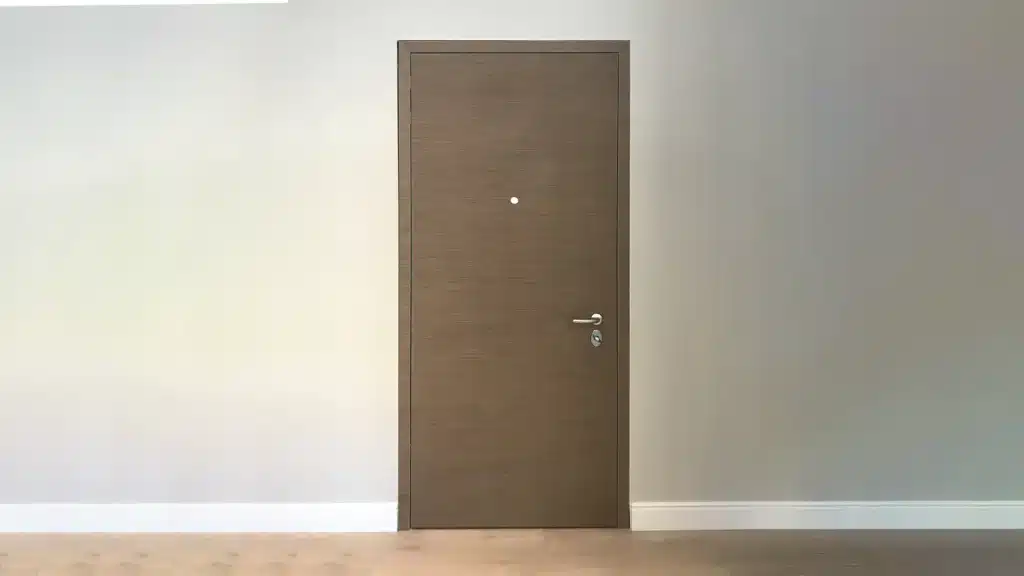
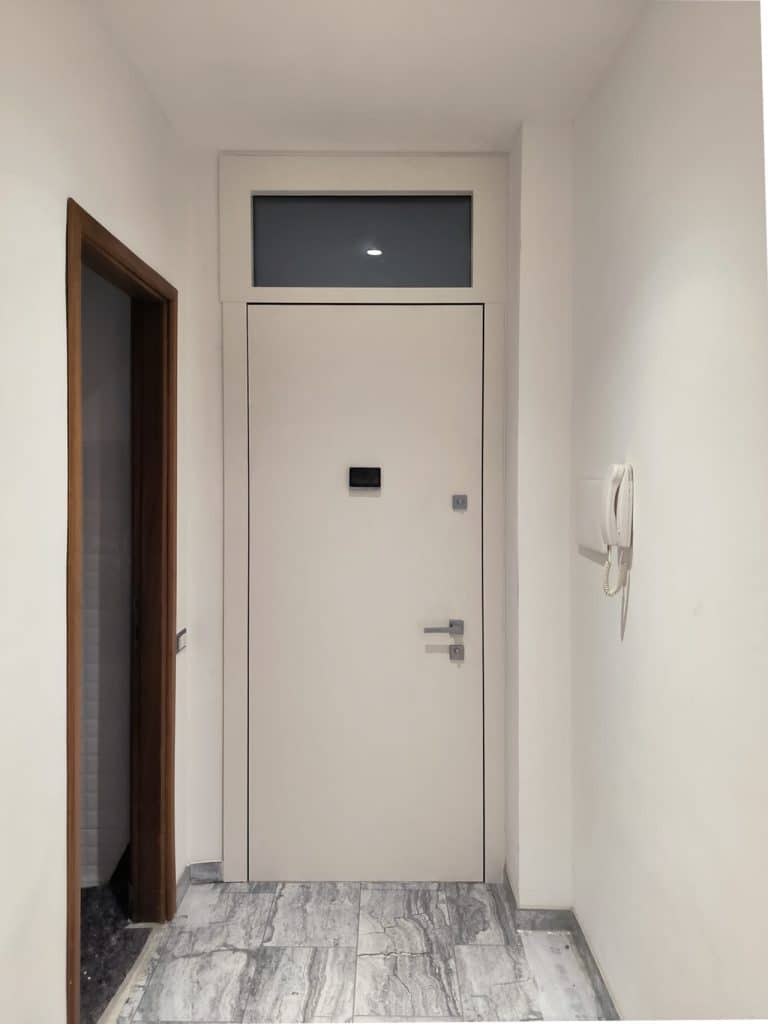
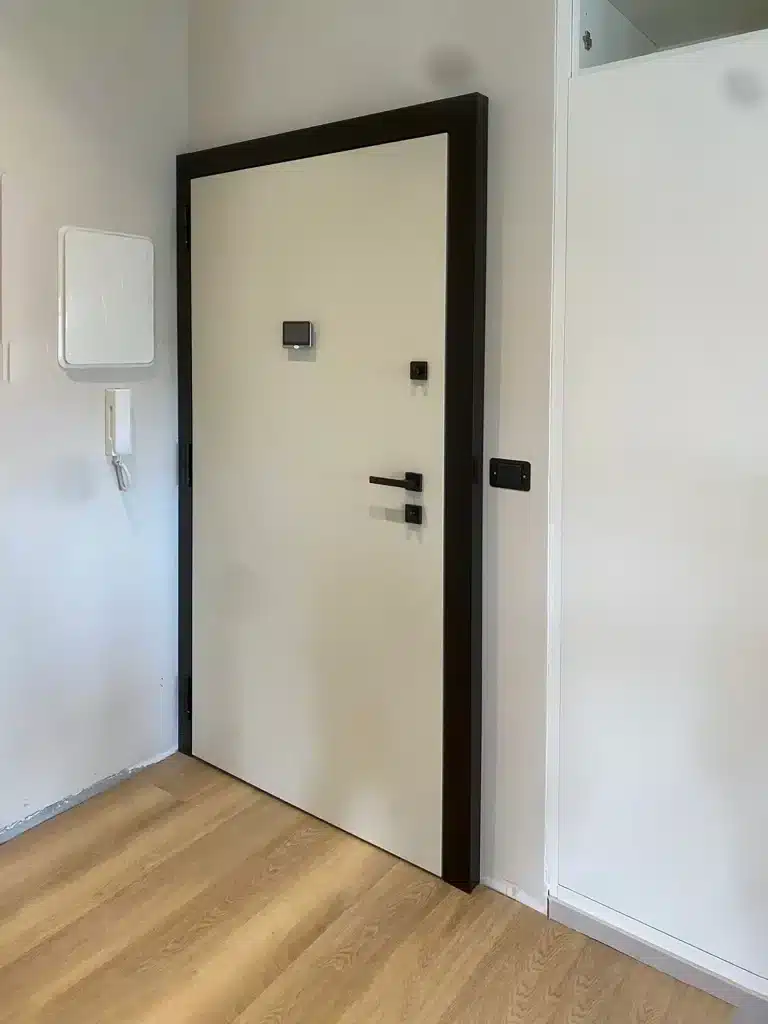
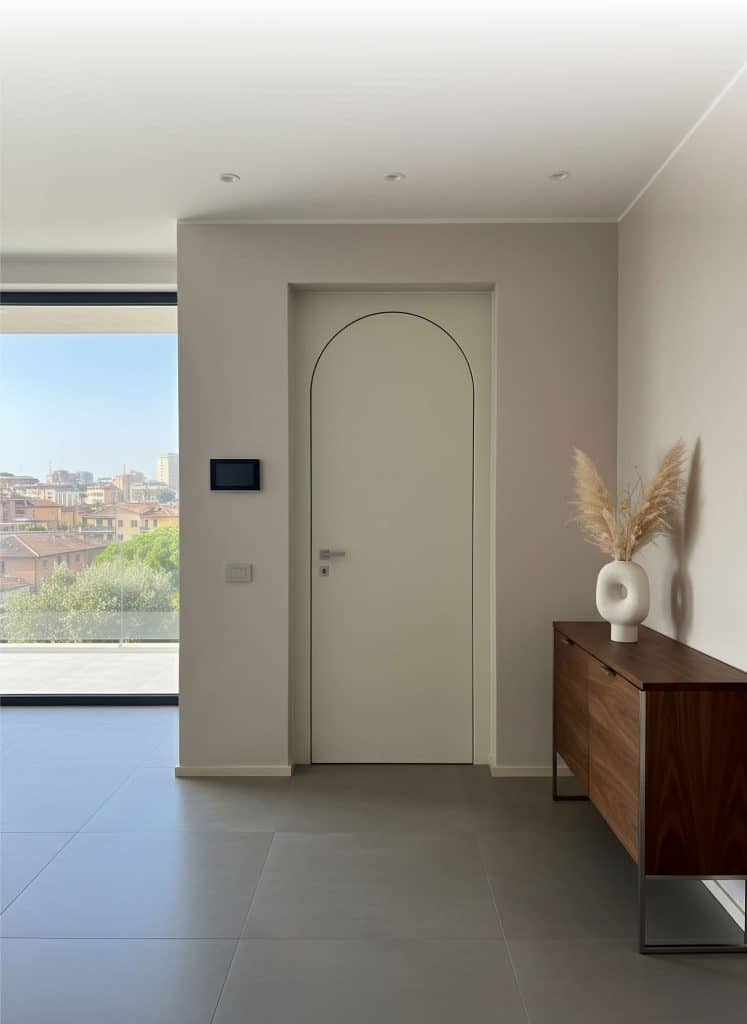
Below are some Ariete doors with concealed hinges already installed: see how the leaf and frame stay flush on a real entrance.
Conclusions
An armoured door with concealed hinges is first and foremost a choice of aesthetic integration that, on a well-built armoured door, adds an advantage on the hinge side and little maintenance.
The hidden hinge removes a weak point, leaves a clean surface that blends into the wall and, staying protected in the frame, asks for little maintenance over the years.
One firm point remains: it gives its best only if it is adjusted precisely, so who fits it matters as much as the door you choose.
At Ariete concealed hinges come as standard on the 4S models in class 4, made to measure and fitted by in-house technicians trained at the Accademia della Posa.
That way you get the clean look and the highest burglar resistance class together.
If you want to replace your entrance door with an armoured one with concealed hinges, request a quote giving us your measurements and the type of home, or book a showroom consultation with an expert consultant.
Frequently asked questions
Yes. With the door shut the mechanism is set into the frame and cannot be reached from outside, so it cannot be tampered with or unscrewed to lever the leaf off: that is one less weak point. Security still comes from the whole system of door, defender and lock, not from the hinge on its own.
Ariete armoured doors with concealed hinges open up to 105°. It is an opening designed for the real entrance of a home: you pass through comfortably, bring furniture inside and in everyday use you notice no difference from a door with traditional hinges.
Yes. Like exposed hinges, they must be set square during fitting by a technician: it is not a job to do by eye. The difference is not how well they can be adjusted, but that the adjustment is done by someone who knows how.
Very little. Being shut inside the frame, they do not pick up dust and dirt the way exposed hinges do, so they do not stiffen or squeak. A check once a year is enough, plus an adjustment by a technician if you feel the door starting to scrape on the frame.
It depends on looks and fitter. If you want a clean profile, the advantage on the hinge side and little maintenance, and you have someone who fits it well, the concealed hinge is the better choice. The exposed hinge stays sound and sturdy, but it does not give the flush effect or the same security advantage.
Yes. The Exterior 4S model brings concealed hinges to a door designed for outdoors, with weather-resistant panels. Outdoors, the fact that the mechanism is shut inside the frame also keeps it better protected from the weather and dirt.
