
These days, protecting your home from burglars and intruders has become a priority for every family.
Fitting an alarm system can be an effective solution, but installing an armoured door is even more useful.
Armoured doors, as the name suggests, are special closures used for the entrance to your home, offering greater protection against break-in attempts.
The armoured door falls under passive defence systems: it acts as a deterrent for anyone trying to force the lock to get into the flat, and it makes that task far harder.
Of course, for the door to be truly effective in achieving these aims, it must have certain features.
Let us look at which armoured door features you should consider when buying.
But before we start, two points to clarify:
- Since these are highly specialised products, it is above all important to rely only on trusted companies and on fitters who know exactly how to handle the product.
- The cost of the product and the work will depend on your individual needs and on your home setting.
The parts of an armoured door
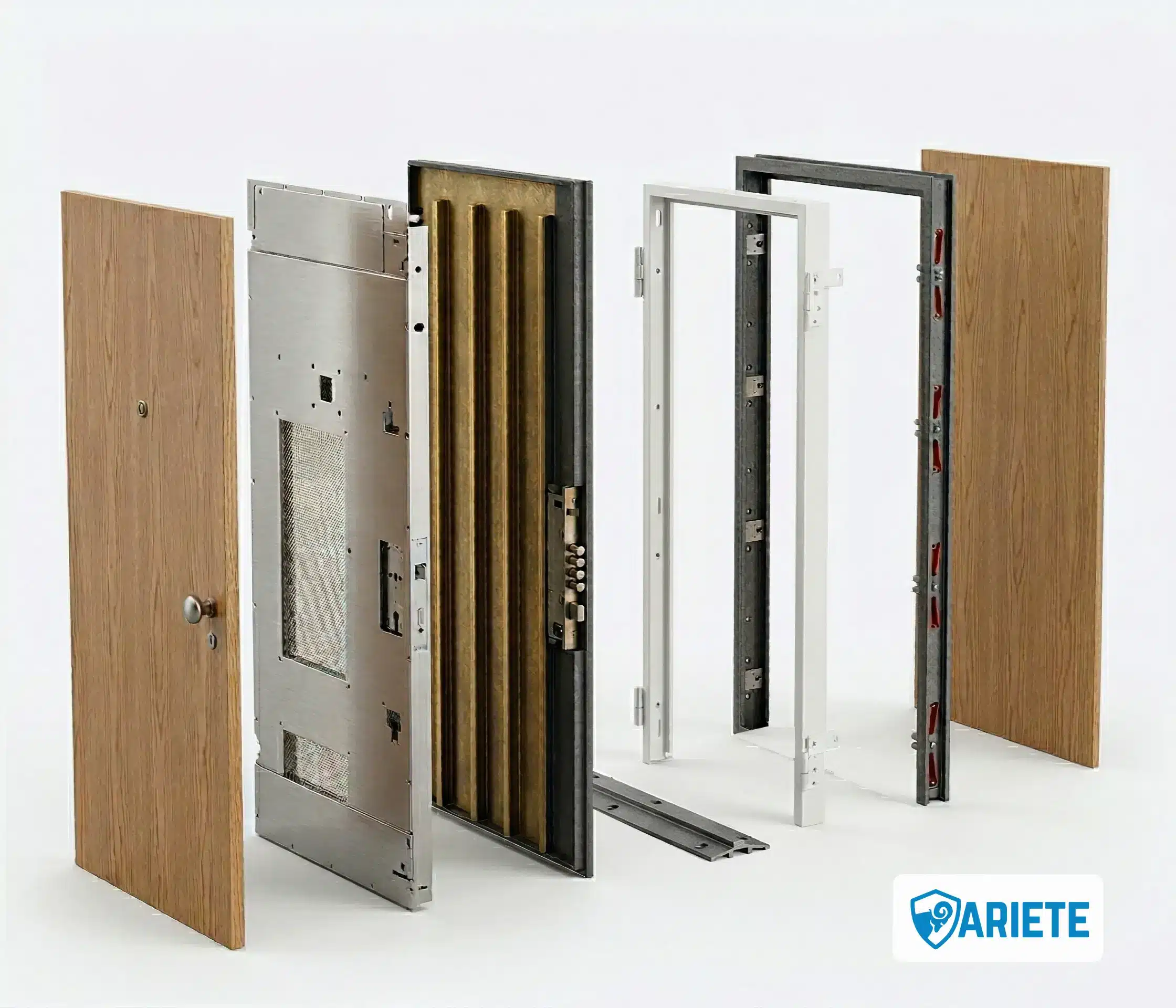
First of all, it helps to know which features of an armoured door set it apart from a standard door.
A door is called armoured when it has a specific physical structure that makes it hard to open without the proper key.
For the door to resist a forced opening attempt, it must be made up of certain well defined parts and built with very strong, hard-wearing materials.
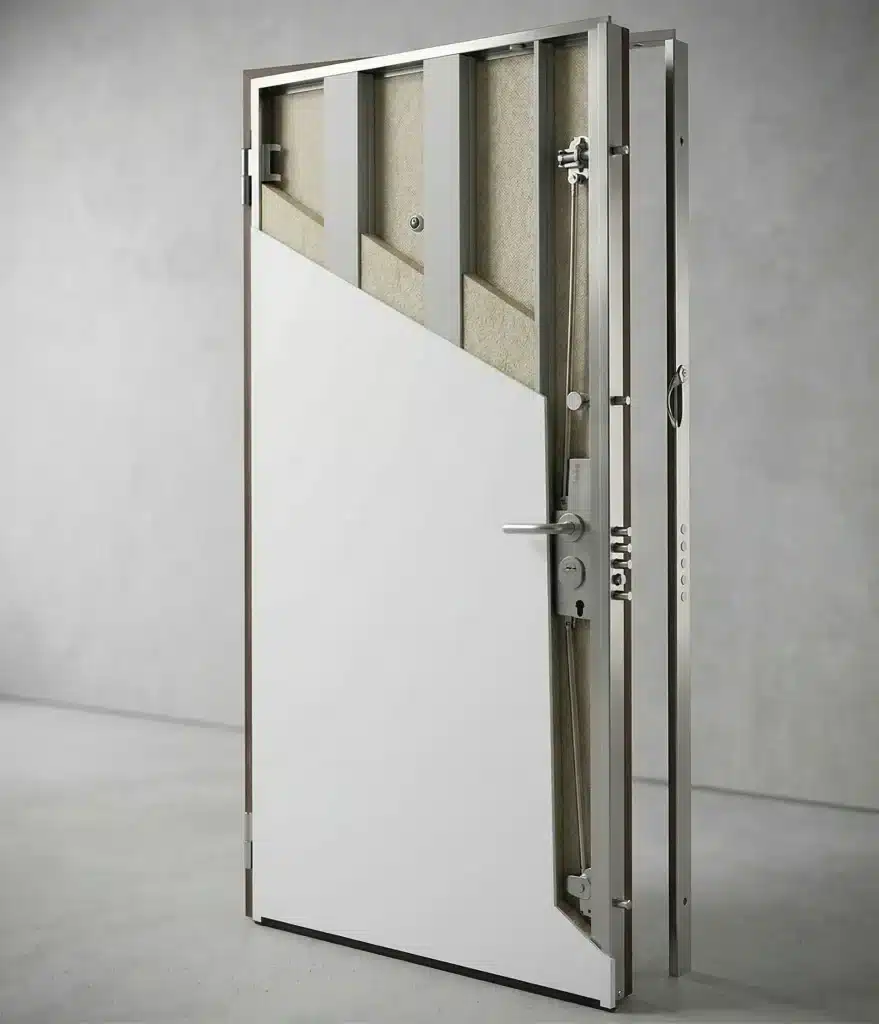
Below you will find an image of a cross-section of an armoured door, showing the different elements that make it up.
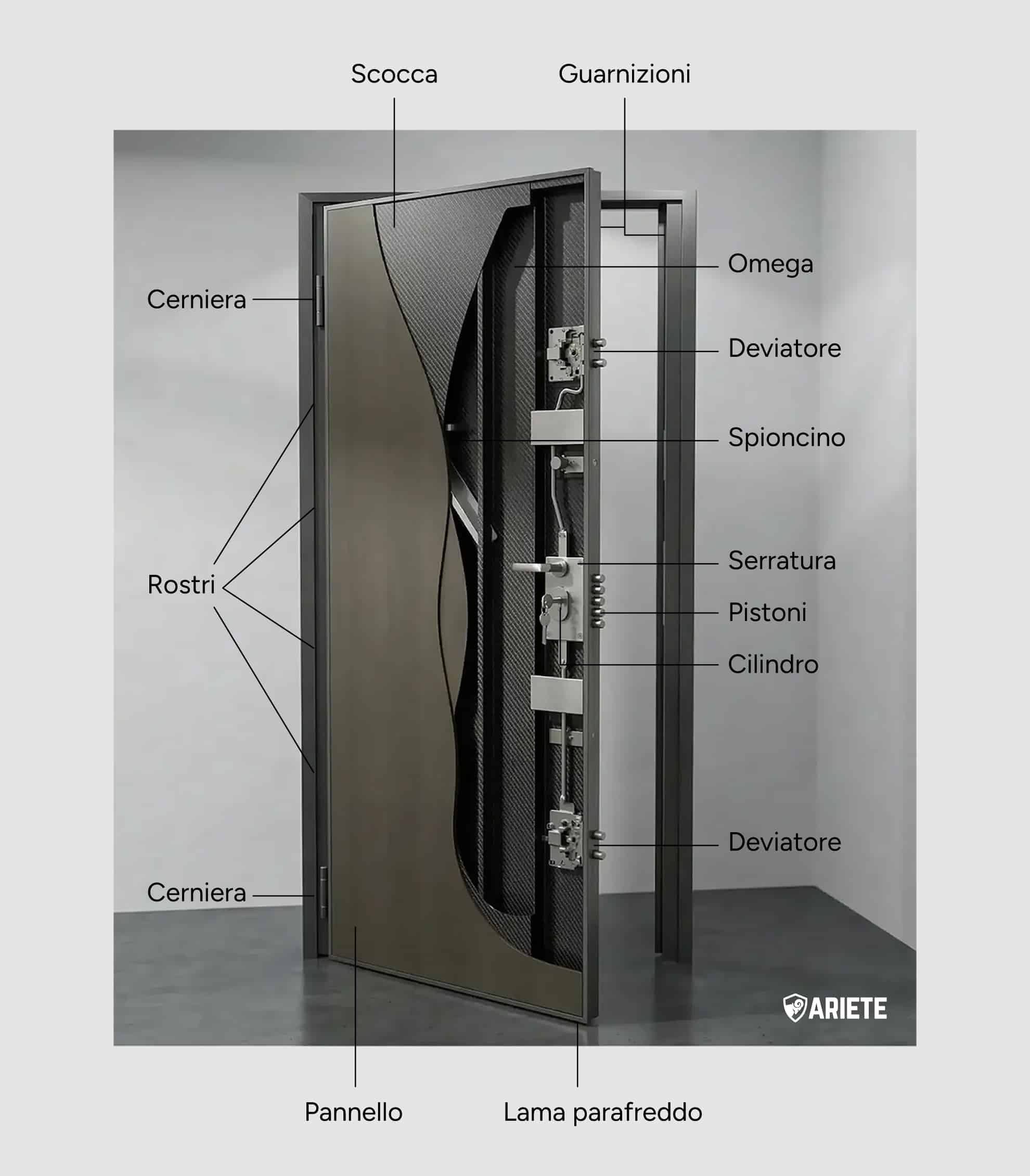
Below you will find a table with the 17 main components of an armoured door.
| Component | What it does |
|---|---|
| Subframe | Structure fixed to the wall that supports the whole door |
| Frame | Element the leaf is mounted on, holding the closing points |
| Shell (leaf) | Main structure of the door, made of steel |
| Reinforcement omega profile | Internal reinforcements that increase rigidity and strength |
| Hinges | Allow opening and closing and bear the weight of the armoured door |
| Anti-lift dog bolts | Prevent the door being levered off on the hinge side |
| Lock | Manages the door closing system |
| Euro cylinder | The part the key is inserted into |
| Defender | Protects the cylinder from break-in attempts |
| Auxiliary bolts | Add closing points at the top and bottom |
| Closing bolts | Side deadbolts that lock the door into the frame |
| Internal insulation | Improves thermal and acoustic insulation |
| Seals | Seal the door against air, noise and dust |
| Cladding panels | Define the look and finish |
| Threshold / draught-excluder blade | Close off the lower part, preventing draughts |
| Viewer | Lets you see who is outside |
Each of these elements has a precise function: some serve to make the door more resistant to break-in attempts, others improve thermal and acoustic insulation, and others affect durability over time and the quality of the closing.
In the next sections we look in detail at the most important components, so we can understand what really makes the difference between a basic armoured door and a high-quality one.
Armoured door subframe (or false frame)
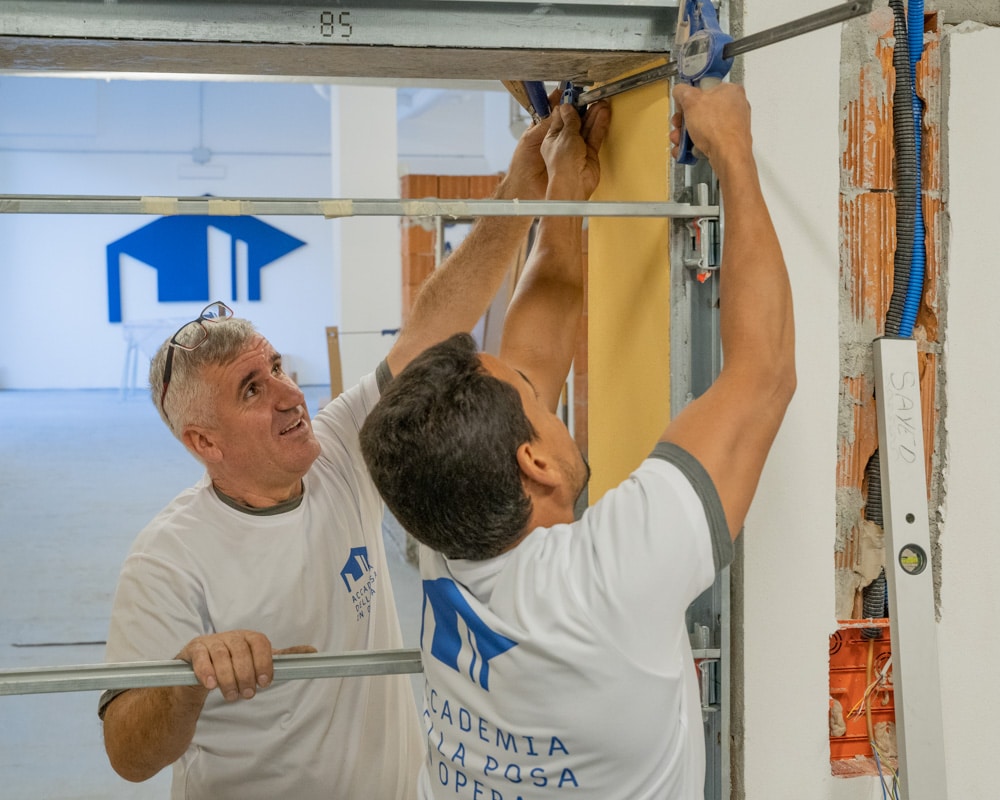
Unlike a traditional door, the armoured door is made up of two frames: the first is called the subframe, false frame or dead frame.
It is a steel armoured door structure that is positioned against the masonry.
Often, if the masonry is not strong enough and risks being knocked out together with the subframe, it is reinforced.
This may require the addition of cement-based material and a metal mesh, and to fit them it might be necessary to remove the external plaster.
There are also cases, however, where you can work without making major changes.
The need for masonry work could be one of the first optional cost items to consider when requesting the installation of an armoured door in an existing home.
When the building is being constructed, of course, the placement of the subframe can take place at the same time as the wall is built.
Armoured door frame
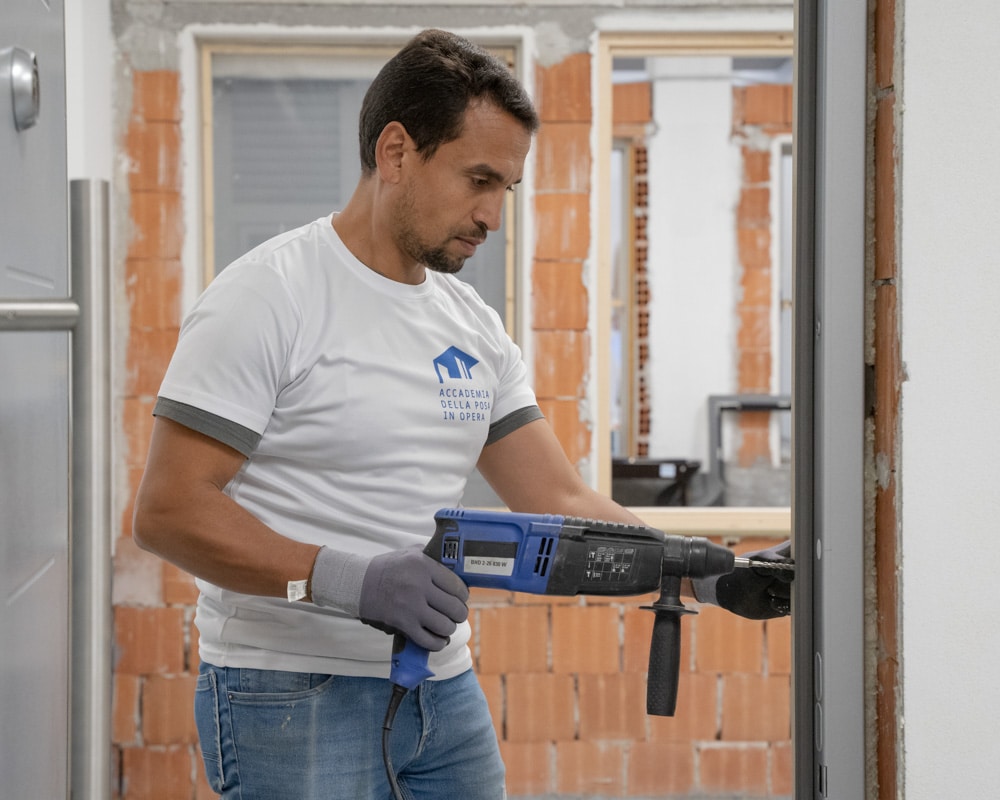
The second frame is mounted on top of the subframe and is the one the door proper is fitted onto.
The frame of the armoured door is made of sheet metal and has the recesses for the lock and the points where the hinges fit.
There are usually two of the latter, as in a traditional door, but there can be three when the armoured door has particular thickness and bulk, for example when it also uses armoured glass panels.
Armoured door frames and subframes are firmly secured to the wall by threaded bars that penetrate the solid masonry by as much as 10 or 15 centimetres, fixed with chemical anchor.
Levering them off is therefore particularly difficult for any would-be burglar.
Shell (or leaf)
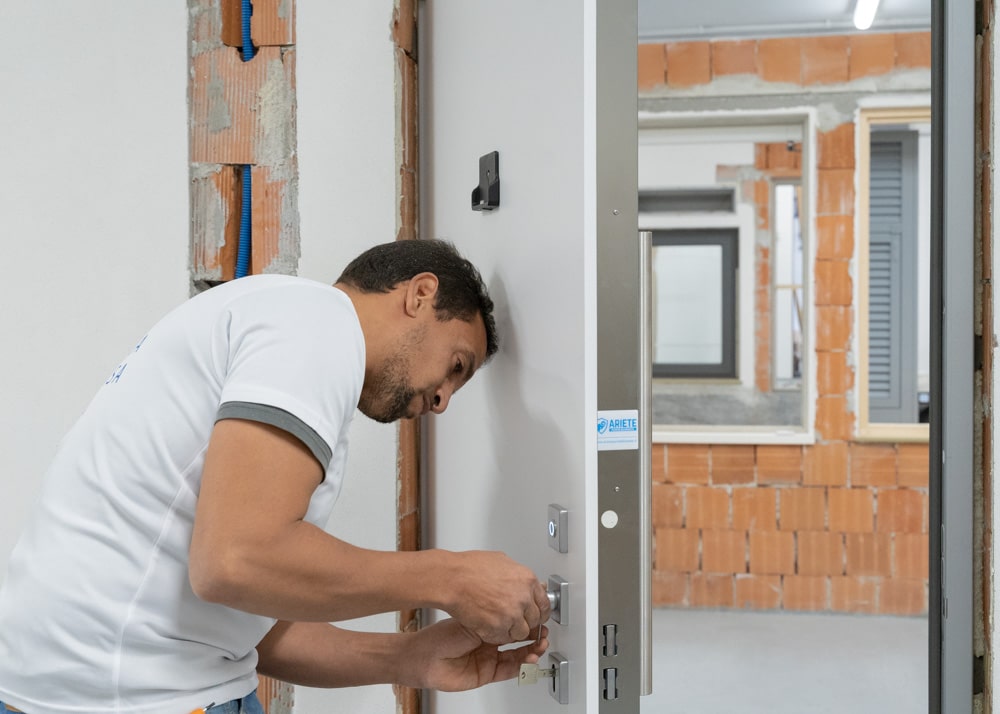
The shell (or leaf) is the central body of the armoured door, that is, the structure of the leaf itself.
It is the element that is mounted on the frame and that holds most of the armoured door components inside it, such as reinforcement omega profiles, lock, hinges, insulation and closing systems.
In construction terms, the shell is made of steel sheet and forms the structural core of the armoured door.
It is largely this structure that determines the rigidity of the leaf, its resistance to deformation and its ability to withstand break-in attempts.
To increase overall solidity, special reinforcement omega profiles are welded to the sheet, that is, shaped metal profiles that stiffen the structure without adding too much weight.
Reinforcement omega profile
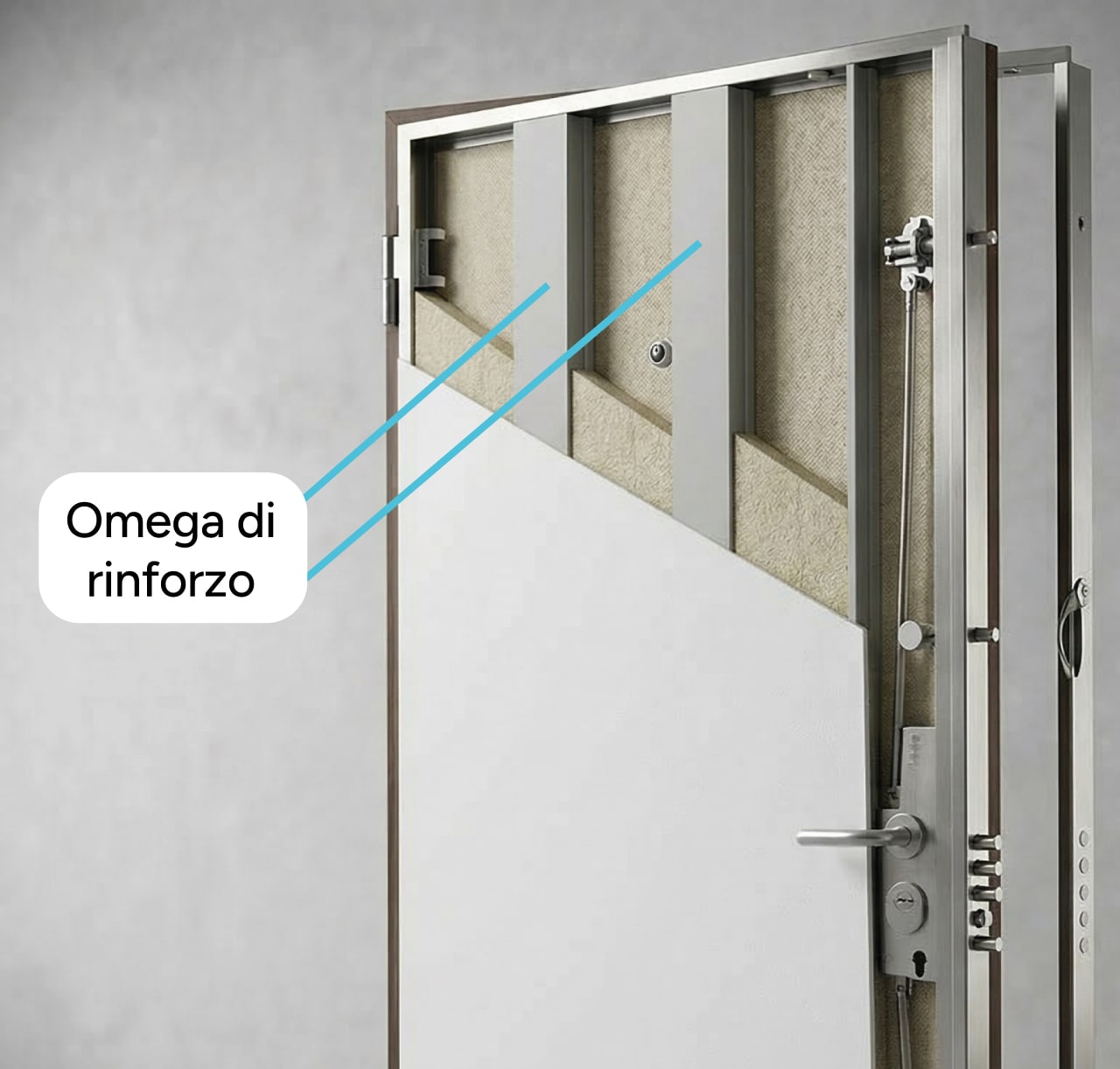
Inside the shell are the reinforcement omega profiles, one of the most important structural elements of an armoured door.
These are shaped steel profiles, welded to the inner sheet of the leaf, designed to increase rigidity and prevent deformation during a break-in attempt.
Their shape (which recalls the Greek letter Ω) is no accident: it serves to stiffen the structure without making it too heavy.
In practice, the omega profiles turn the door into a much more resistant body:
- they reduce the risk of the sheet bending
- they distribute forces more evenly
- they make it harder to use levers or crowbars
In the more advanced doors, the omega profiles are built into double-sheet structures, further increasing overall resistance.
Armoured door hinges
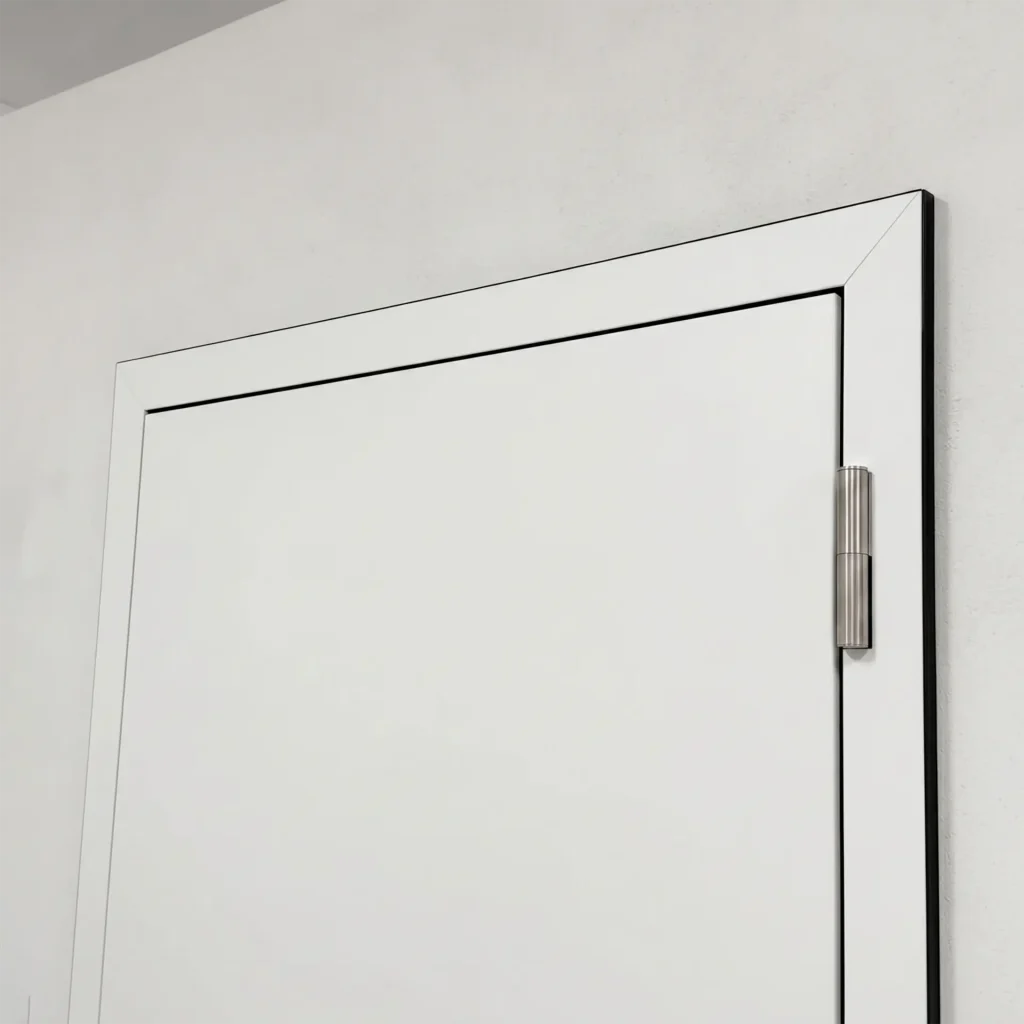
The hinges (or pivots) are the component that connects the leaf to the frame and allows the door to open and close.
In the case of armoured doors, these are not simple mechanical elements: they have to bear very heavy loads (even over 100 kg) and withstand attempts to lever the door off.
For this reason they are made of high-strength steel and fixed extremely solidly to the door structure.
The main types are:
- exposed hinges: visible from outside, but protected by anti-lift dog bolts that prevent the door being removed even if they are damaged;
- concealed hinges: built into the structure, invisible when the door is closed and cleaner from an aesthetic point of view;
- adjustable hinges: they let you adjust the position of the door over time, avoiding sagging or misalignment.
A key point is that, even if the hinges are attacked or damaged, the door cannot be removed: this is possible thanks to the presence of the anti-lift dog bolts, which lock the leaf on the opposite side.
For this reason, in a quality armoured door, the hinges never work on their own, but form part of a wider security system.
Anti-lift dog bolts
Anti-lift dog bolts are essential security elements positioned on the hinge side.
They are steel pins fixed to the door leaf which, when the door is closed, fit into matching housings in the frame.
Their function is very precise: to prevent the door being levered off on the hinge side.
During a break-in attempt, in fact, one of the most common attacks is to lever between the leaf and the frame to break or force the hinges.
Without a protection system, this side would be a weak point.
The dog bolts solve exactly this problem:
- they lock the leaf even if the hinges are damaged
- they distribute forces more evenly along the side of the door
- they increase overall resistance to levering
For this reason, in a well-designed armoured door, hinges and dog bolts work together as a single security system.
It is worth knowing that not all doors use the same type or number of dog bolts: in the more advanced solutions, these elements are designed to provide a greater anchoring surface and superior resistance to break-in attempts.
Armoured door lock
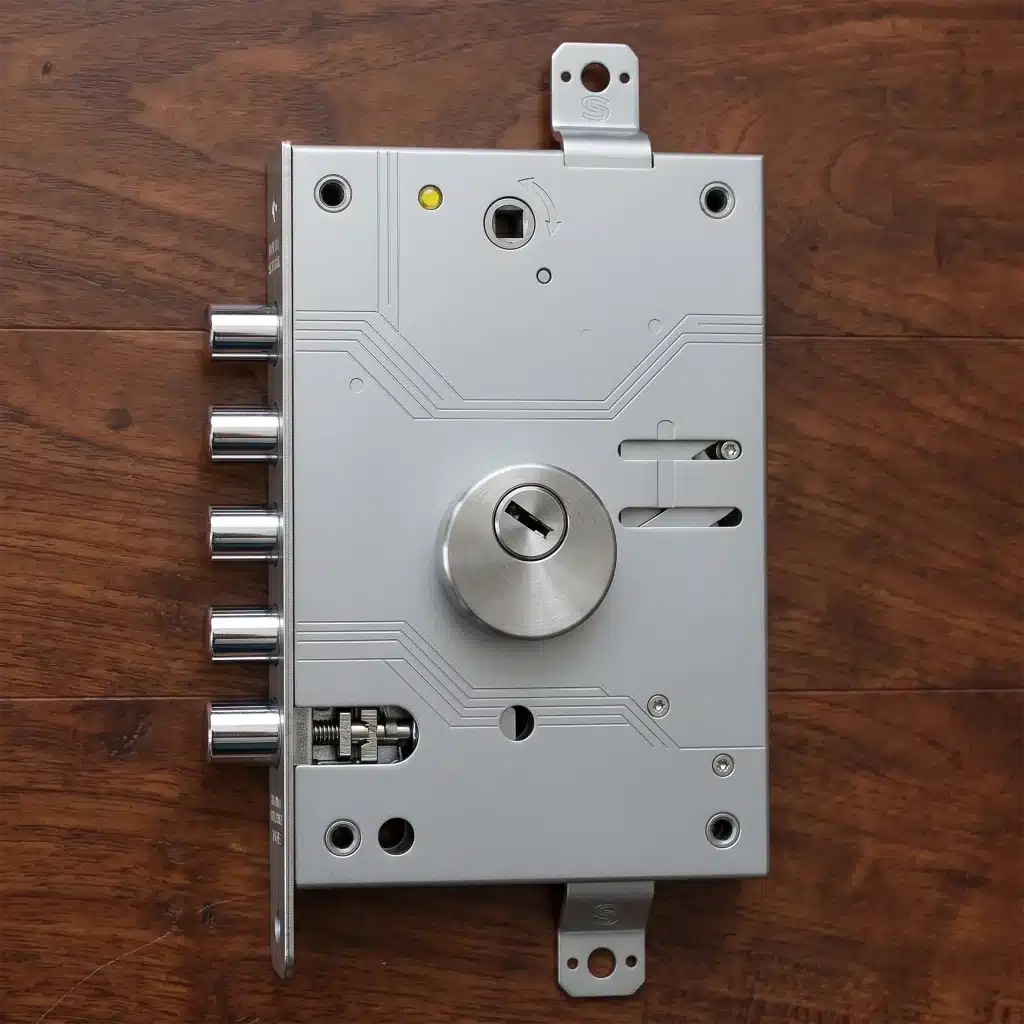
The lock is the component that manages the opening and closing of the armoured door and is one of the most important elements for overall security.
In technical terms, the lock is the mechanism that, operated by the key, moves the door closing points (such as bolts and auxiliary bolts), locking the leaf to the frame.
The main types of lock are:
- double-bit lock: now considered outdated and more vulnerable to break-in attempts
- euro cylinder lock: the current standard, safer and more versatile
In modern armoured doors, the euro cylinder lock is the most widespread solution because it offers several advantages: greater resistance to attacks (picking, bumping, drilling), the option to replace only the cylinder without changing the whole lock, and compatibility with additional security systems.
The cylinder is in fact the “active” part of the lock, while the rest of the mechanism takes care of transmitting the movement to the closing points distributed along the door.
Euro cylinder
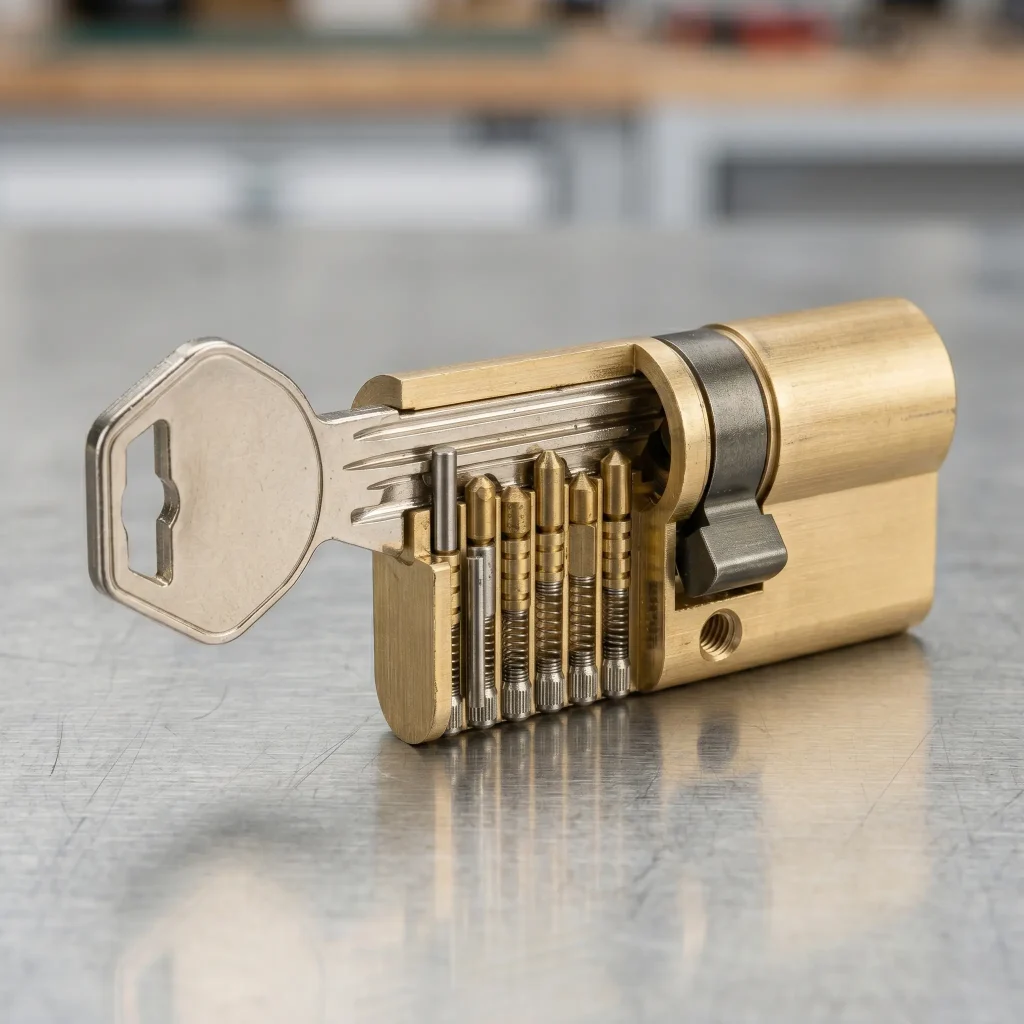
The euro cylinder is the component the key is inserted into and is one of the most delicate and important parts of the armoured door.
In technical terms, the cylinder contains an internal mechanism that, when the correct key is inserted and turned, operates the lock and moves the door closing points.
In modern armoured doors, the euro cylinder has almost everywhere replaced the old double-bit lock, because it offers very concrete advantages:
- it is harder to manipulate
- it allows controlled key duplication
- it can be protected with anti-snap, anti-drill and anti-bumping systems
- in many cases it allows you to replace only the cylinder without changing the whole lock
Precisely because it is one of the first elements targeted during a break-in attempt, the cylinder should never be installed on its own, but always paired with a quality defender that protects its external part.
Defender
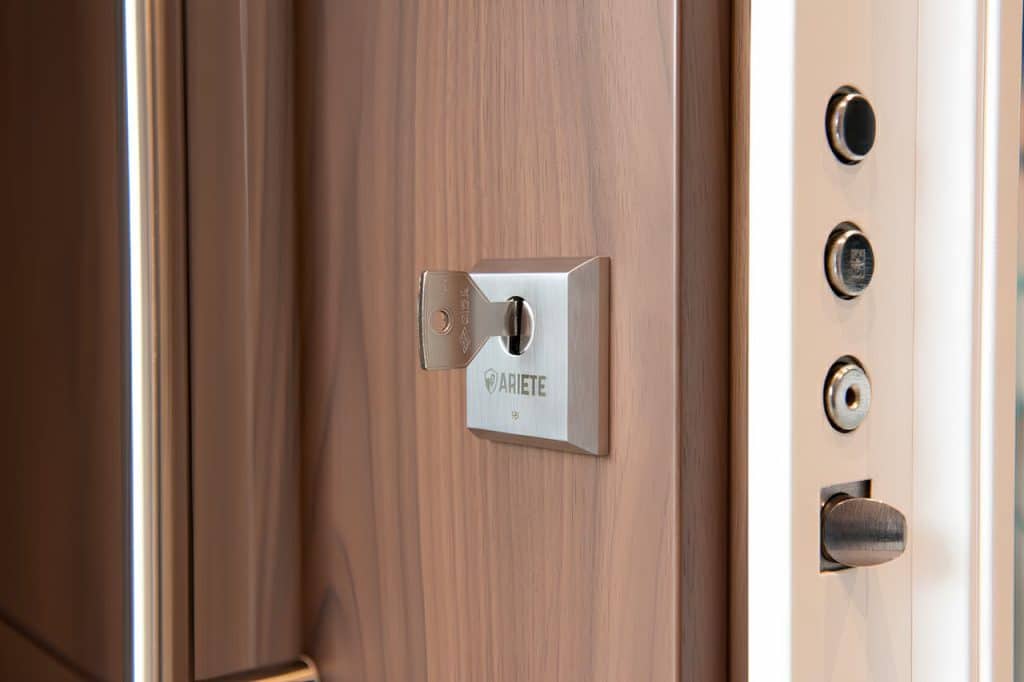
The defender is a steel protection fitted to the outer part of the door, in line with the euro cylinder.
Its task is simple but essential: to protect the cylinder from break-in attempts, which in most cases focus precisely on this point.
During a break-in, in fact, the cylinder is attacked with specific techniques such as snapping, drilling or manipulation with tools.
The defender steps in by creating a physical barrier that makes these operations much harder and less effective.
A quality defender is designed to:
- resist drilling and drill attacks, thanks to the use of hardened steel
- prevent a grip with break-in tools, reducing the surfaces that can be levered
- protect the cylinder in its most vulnerable area, that is, the external part
In construction terms, the defender is made of high-strength steel and fixed directly to the door structure, becoming an integral part of the security system.
It is important to understand that cylinder and defender always work together: even a very high-performing cylinder, if left exposed, can become a weak point.
For this reason, in modern armoured doors, the defender is not an accessory, but an essential component.
In Ariete doors, for example, a square defender with chamfered corners is used, designed to minimise the points where it can be gripped and make any attempt to snap or force it extremely difficult.
The chamfered geometry in fact stops break-in tools from levering effectively, concretely increasing the protection of the cylinder and, as a result, of the whole door.
Auxiliary bolts
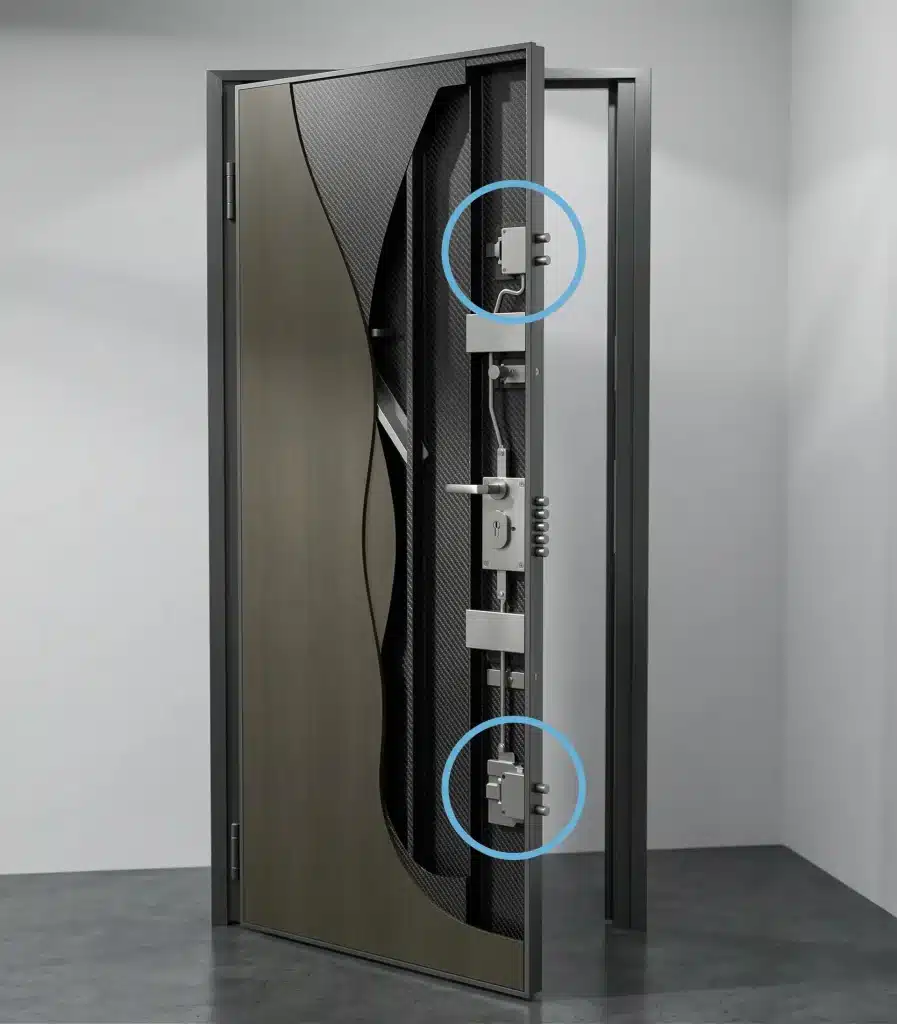
The auxiliary bolt is one of the least visible but most important components inside an armoured door, because it is what turns a simple side closure into a far more advanced security system.
It is a mechanism connected directly to the lock whose job is to increase the closing points of the door, making it more stable and resistant to break-in attempts.
When you turn the key, in fact, it is not only the side deadbolts that are activated: the movement is transmitted through internal metal rods to the auxiliary bolts as well, which push further bolts out at the top and bottom of the frame. In this way the door is not locked on just one side, but is anchored along its entire height.
The result is a multipoint closure, which distributes forces across several points and makes it much harder to bend the leaf, force it with a lever or attempt to lever it off.
Without auxiliary bolts, in fact, the door would concentrate all its resistance in a few side points; with auxiliary bolts, instead, the structure works more uniformly and solidly, concretely increasing the level of security.
In technical terms, the operation is fully integrated with the lock: when the key is turned, the lock sets in motion internal vertical rods that connect the central part of the door to the auxiliary bolts positioned at the top and bottom. These, in turn, push out the bolts that fit into the frame, locking the door at several points at once.
Everything happens automatically: a single movement activates the entire closing system.
The auxiliary bolts are installed inside the door structure and are not visible from outside, but their contribution is essential. It is precisely thanks to this system that modern armoured doors can offer much higher protection than traditional solutions.
Closing bolts (or deadbolts)
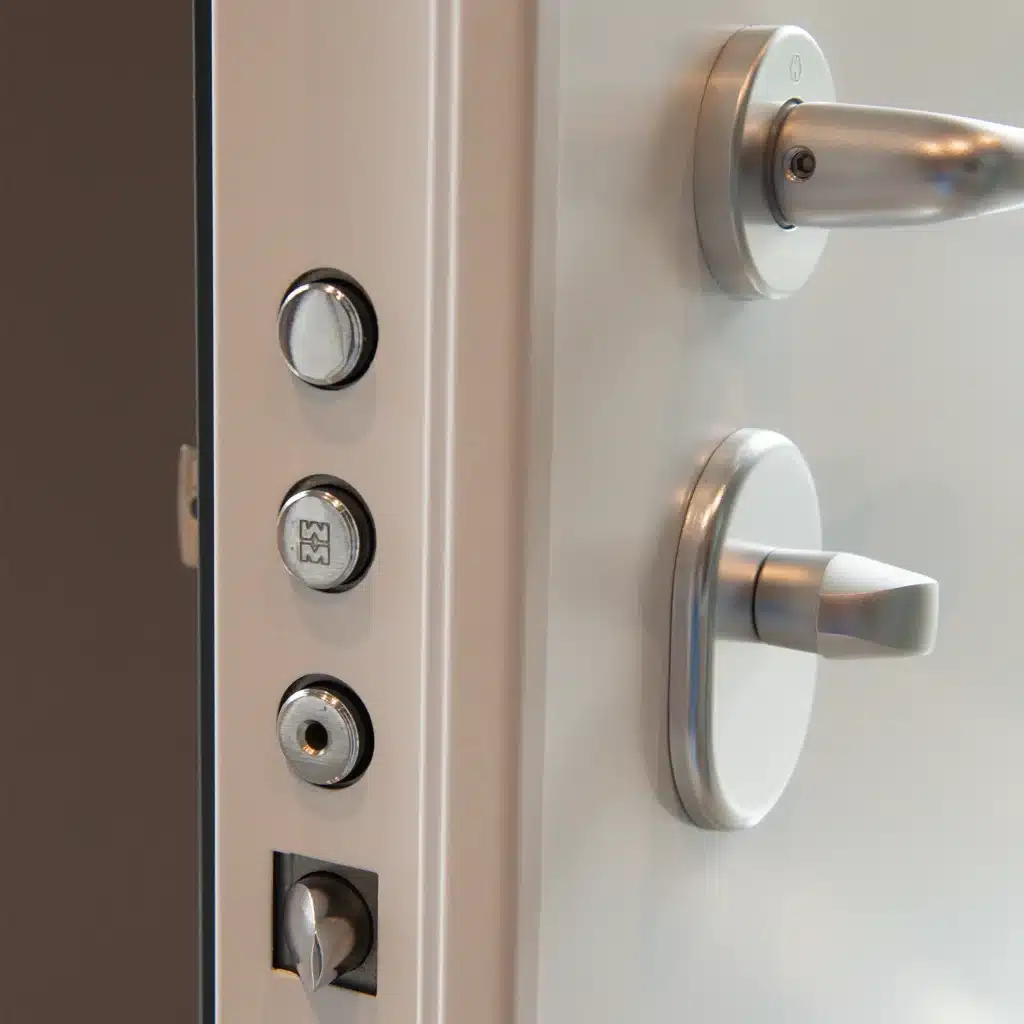
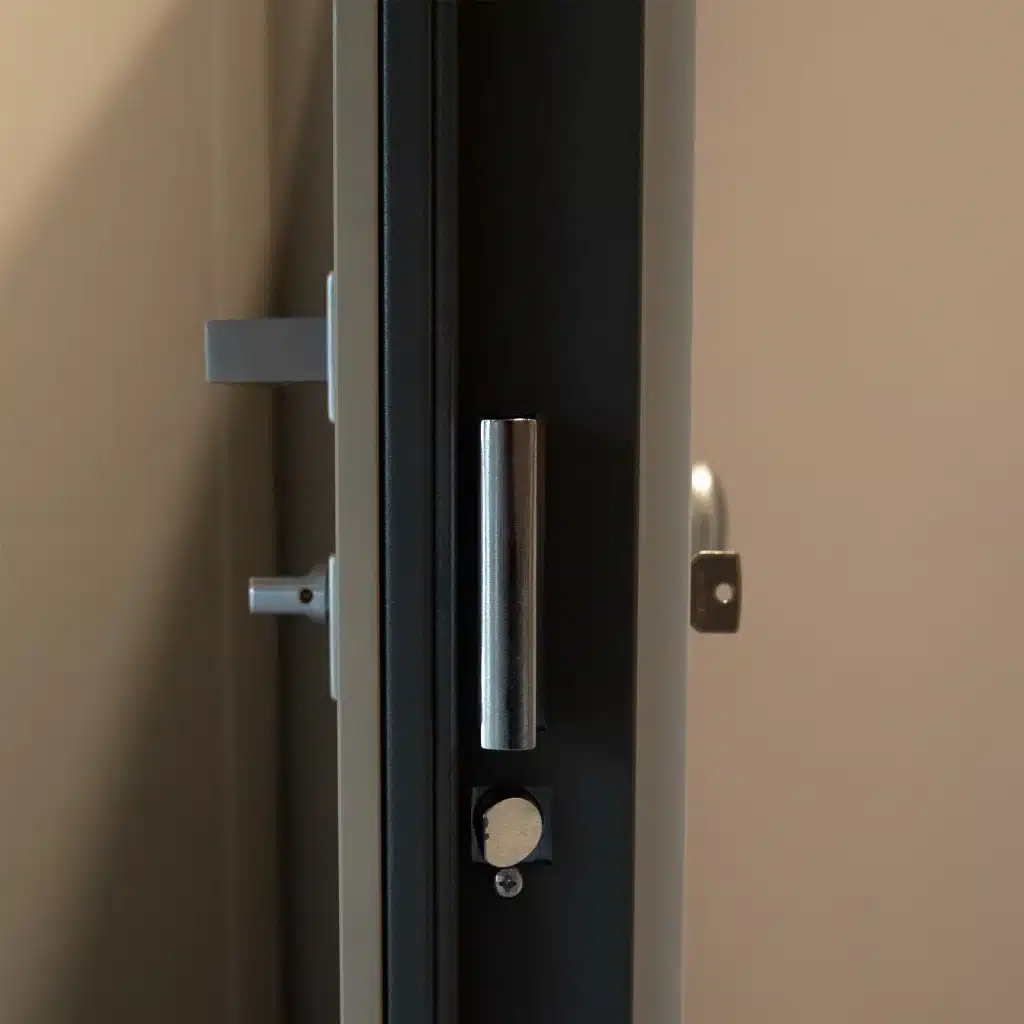
Cylindrical-section deadbolts (photo 1) and rectangular ones (photo 2)
The closing bolts are the side deadbolts that fit into the frame when the key turns are made (more simply, when you turn the key).
They are connected directly to the lock and represent the main closing points of the door on the handle side.
When you operate the lock, the bolts slide horizontally and anchor the leaf to the frame, locking the door in position.
In construction terms, there are round bolts and rectangular bolts.
The round bolts are the more traditional solution, still very widespread, while the rectangular ones are a more advanced development: they offer a greater contact surface with the frame and superior resistance to forcing attempts, especially levering attacks.
In modern armoured doors, the bolts work together with the auxiliary bolts, which activate further closing points at the top and bottom.
The result is a multipoint closure, much more stable and resistant than a simple closure.
The quality of the bolts (material, diameter, number and depth of engagement) directly affects the door’s ability to resist break-in attempts, especially those based on levering.
Internal insulation
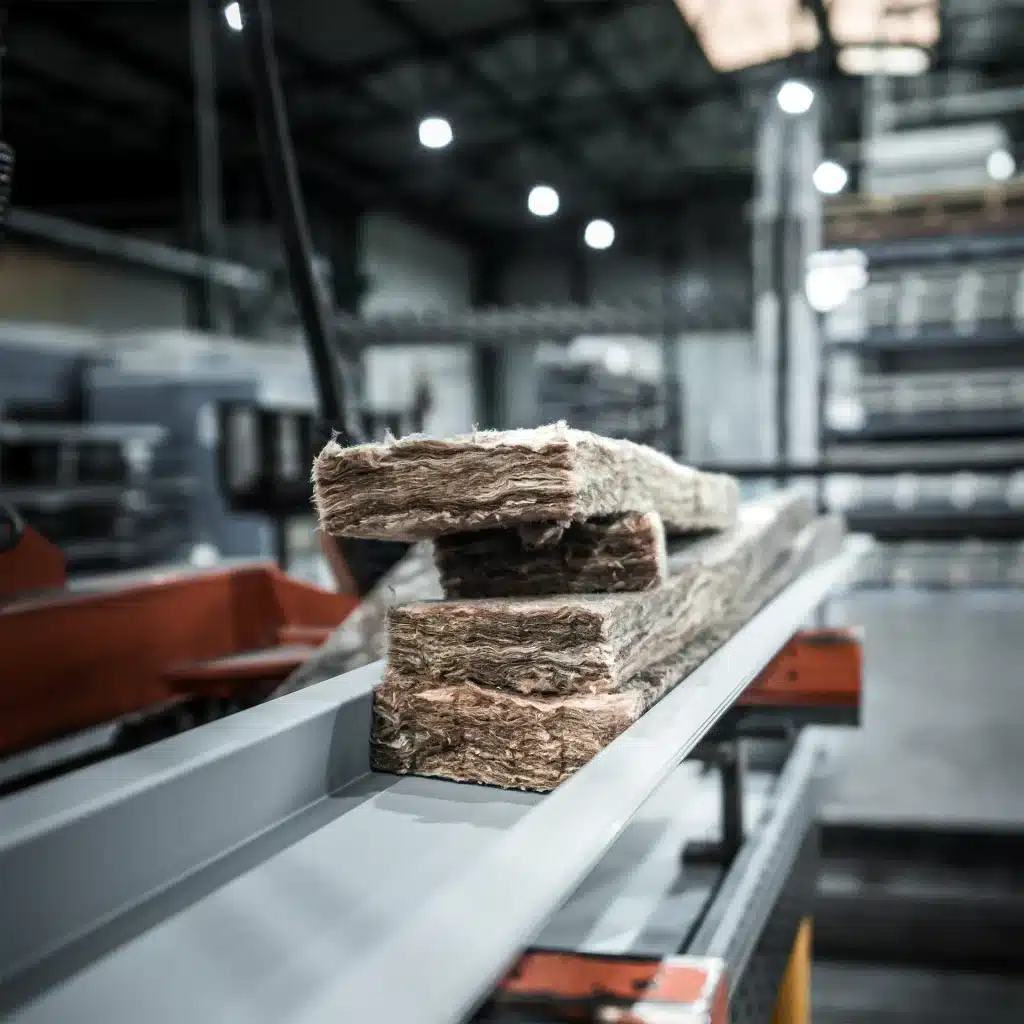
Internal insulation is the element that determines how well an armoured door really insulates the home from cold, heat and, above all, noise.
Many people think all armoured doors are similar in this respect, but in reality the differences can be very significant.
Insulating materials are placed inside the metal structure of the door with the aim of improving both thermal insulation and acoustic insulation.
Among the most widely used are mineral wool, expanded polyurethane and other technical materials designed to reduce the passage of heat and sound.
From a thermal point of view, the reference parameter is the thermal transmittance (Ud), which indicates how much energy passes through the door: the lower the value, the better the insulation.
From an acoustic point of view, instead, we talk about sound reduction, expressed in decibels (dB), which measures the door’s ability to cut down noise coming from outside.
But there is a key aspect that is often underestimated: it is not only the insulating material that makes the difference, but the whole door system.
A well-designed armoured door, in fact, works on several levels:
- insulating materials placed inside the structure
- perimeter seals that stop air and noise from passing through
- lower threshold (draught excluder) that removes draughts in the most critical part
If even one of these elements is lacking, overall performance drops dramatically.
The end result is a door that not only protects against intrusions, but concretely improves living comfort, reducing draughts, limiting heat loss and dampening noise coming from the landing, the stairwell or outside.
Seals
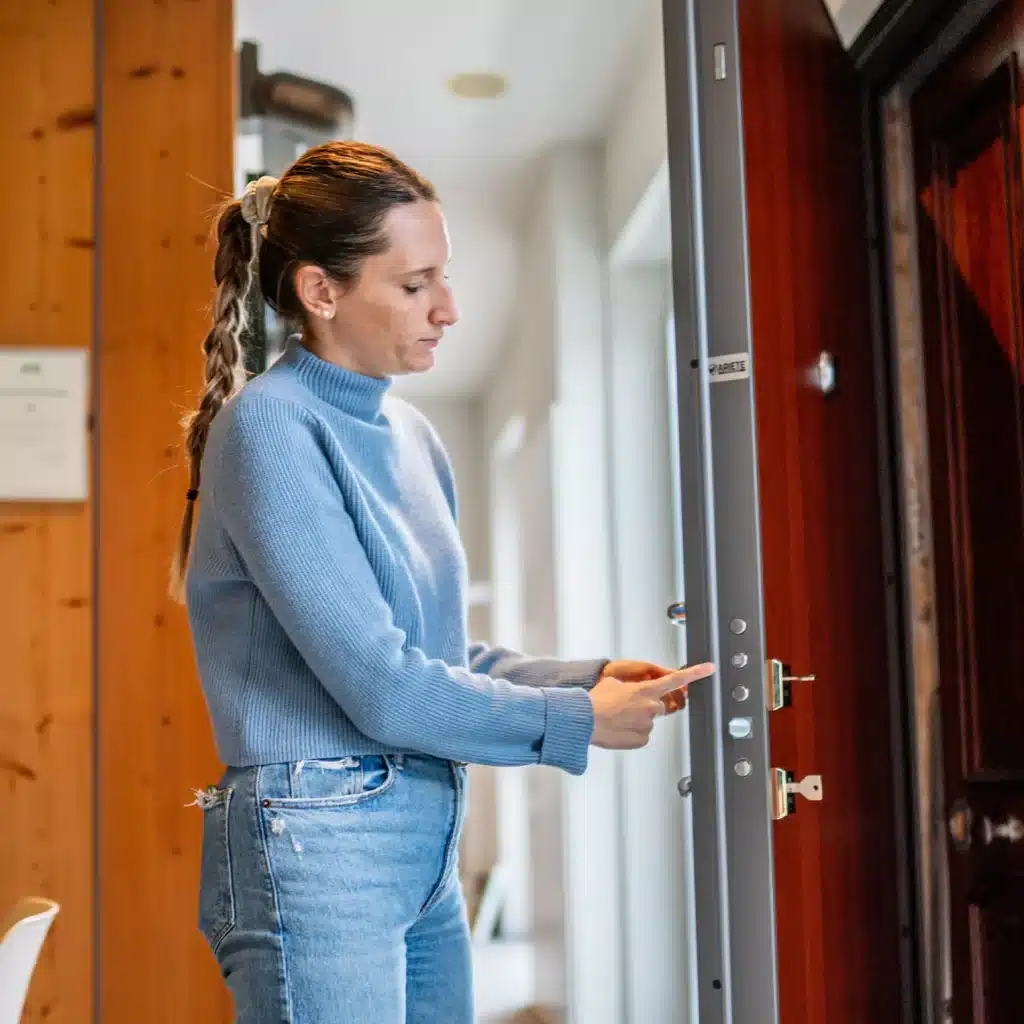
Seals are one of the most underestimated elements in an armoured door, yet they have a direct impact on comfort, insulation and perceived quality.
They are profiles made of an elastic material applied along the perimeter of the leaf and the frame, designed to seal the door closure perfectly and remove any passage of air, noise or dust.
When the door is closed, the seals compress, creating a continuous barrier between inside and outside.
It is precisely this tightness that allows the door to work correctly from a thermal and acoustic point of view too.
An armoured door without effective seals, in fact, even if built with quality insulating materials, risks having much reduced performance.
A small gap is enough to compromise the entire system.
The seals contribute concretely to:
- removing air draughts
- improving acoustic insulation
- reducing heat loss
- increasing the feeling of an airtight closure
In modern armoured doors, double perimeter seals are often used, positioned on both the leaf and the frame, precisely to ensure a more effective and uniform seal.
Another important aspect is the material: the best seals are made of technical rubber, neoprene or highly elastic materials, designed to keep their compression ability over time without deforming or hardening.
This is essential, because a seal that loses elasticity can no longer seal the door correctly, reducing overall performance.
Combined with the lower threshold (draught excluder) and the internal insulation, the seals allow the armoured door to turn from a simple security element into a true filter between inside and outside, concretely improving living comfort.
Cladding panels
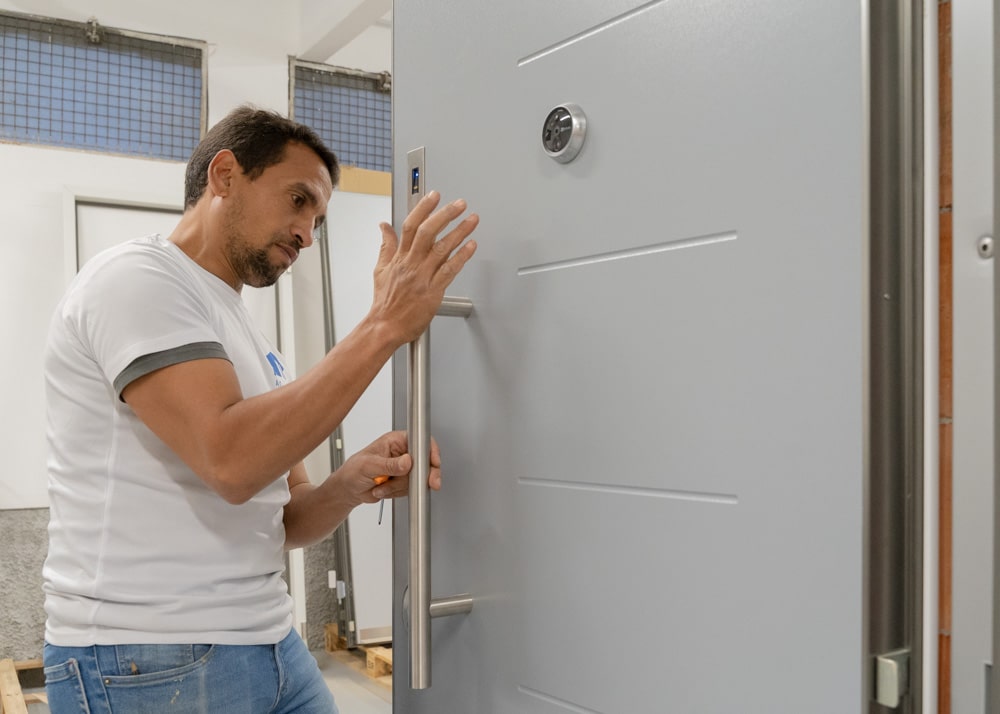
The cladding panels are the visible part of the armoured door and their job is to close off the internal structure, but above all to define its look.
Unlike other more technical components, here personal taste comes into play: the panel is what you see every day, both from inside and outside, so it is essential that it blends perfectly with the style of the home.
Be careful, though: it is not only about looks.
The external panel, in particular, must be chosen according to very precise criteria, because it is exposed to rain, sun, temperature swings and humidity.
For this reason, hard-wearing materials such as marine plywood, PVC or aluminium are used, designed to keep their stability and durability over time even in difficult conditions.
The internal panel, on the other hand, since it is not exposed to the weather, offers greater design freedom and can be made with warmer, more refined materials, such as laminated wood, allowing for wider customisation.
An often underestimated aspect concerns building regulations in blocks of flats.
In many buildings, in fact, the external panel must match the look of the other doors on the landing, ending up the same as them or at least very similar.
This means that, if you replace an armoured door in a block of flats, it is not always possible to choose the external design freely, but you have to adapt to the existing architectural context.
This is why it is essential to rely on a company able to faithfully reproduce existing panels, even complex or non-standard ones.
We at Ariete, for example, have an in-house joinery specialised in reproducing external panels, even in particular styles such as Old Genoa or Old Milan, ensuring aesthetic continuity without giving up on security.
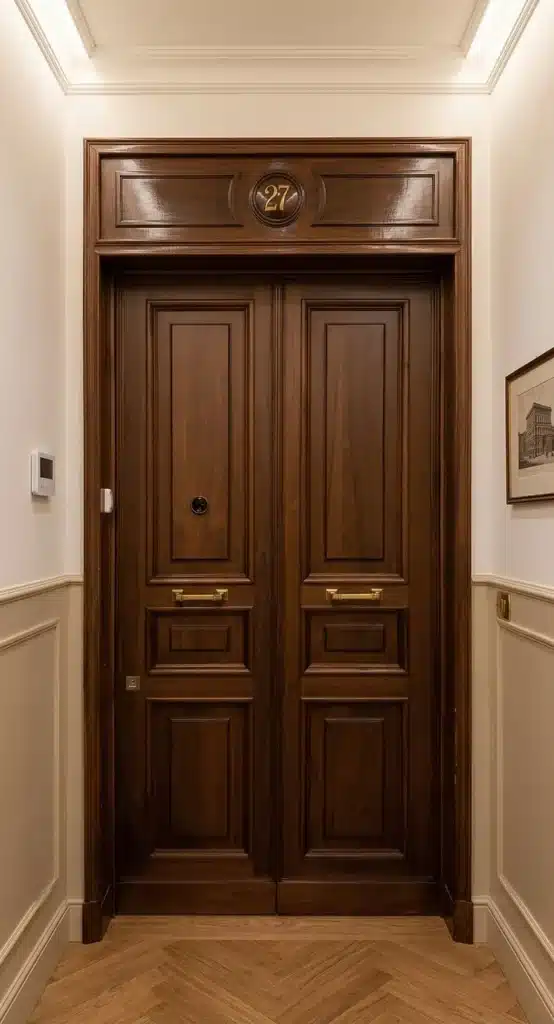
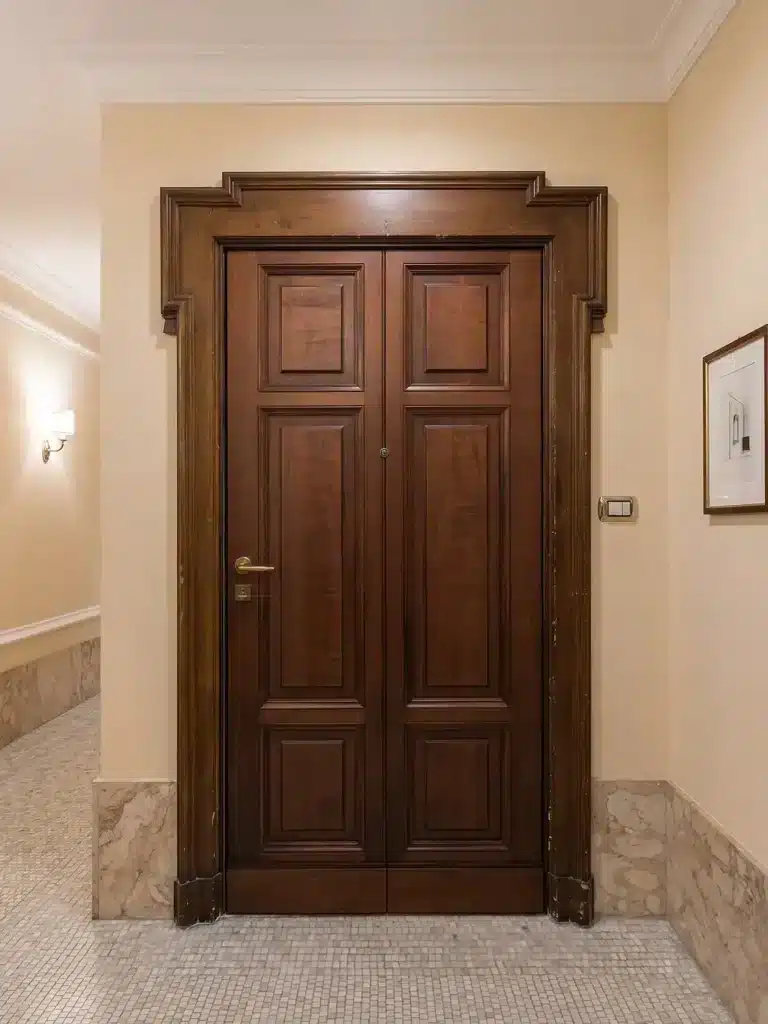
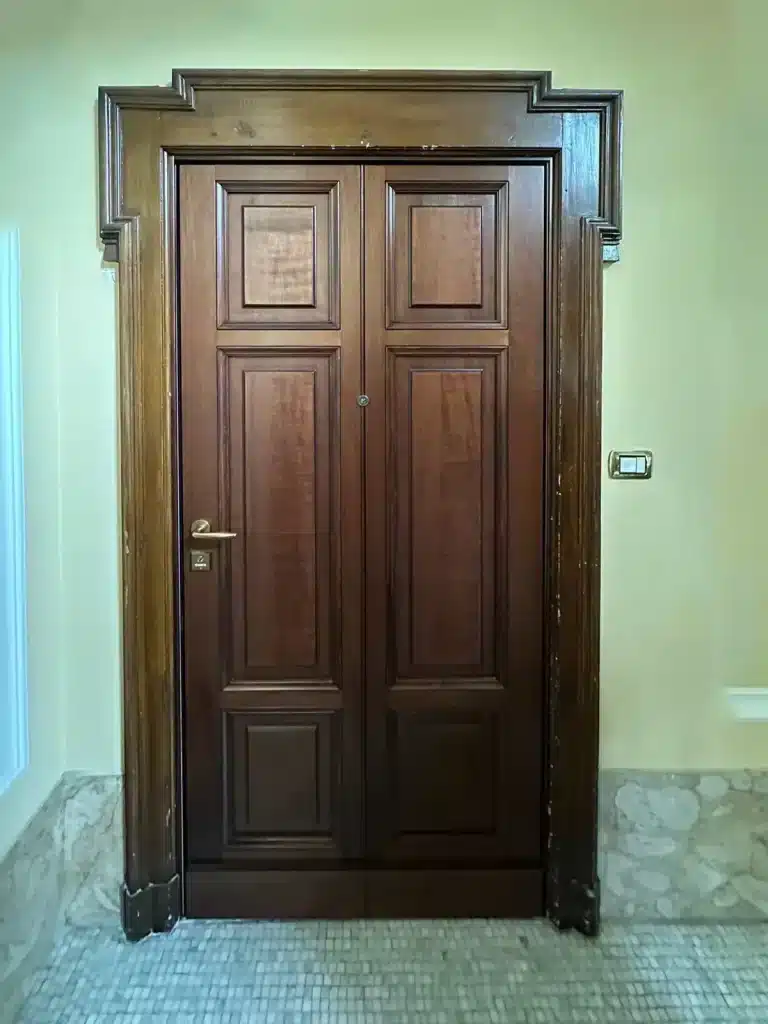
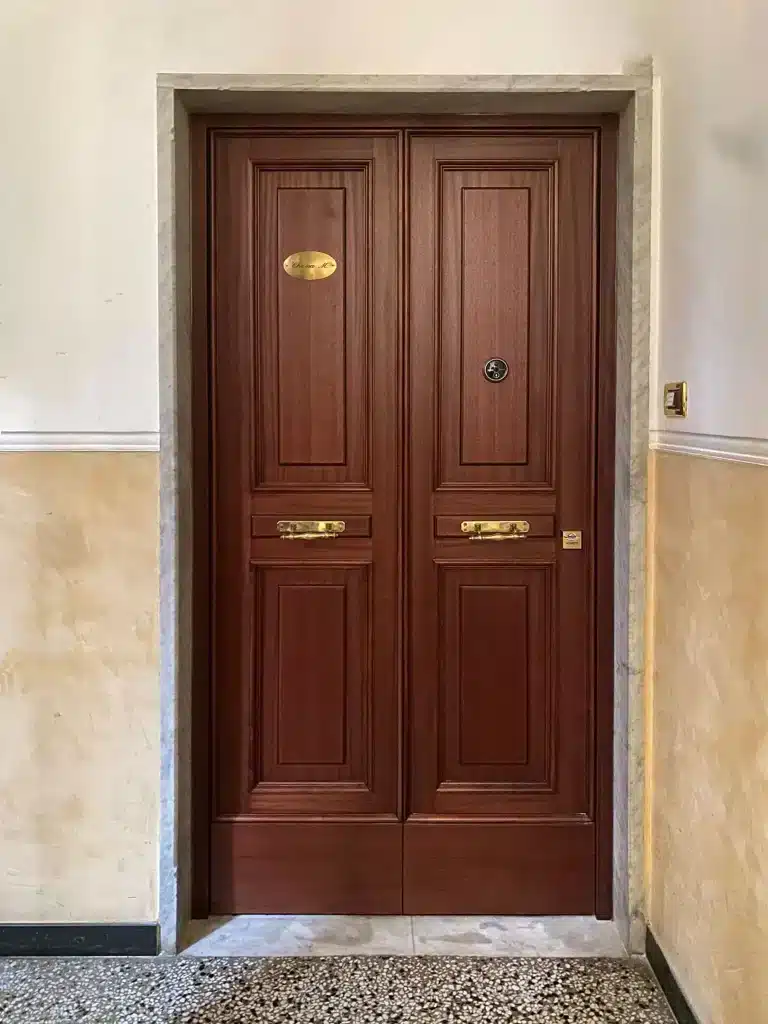
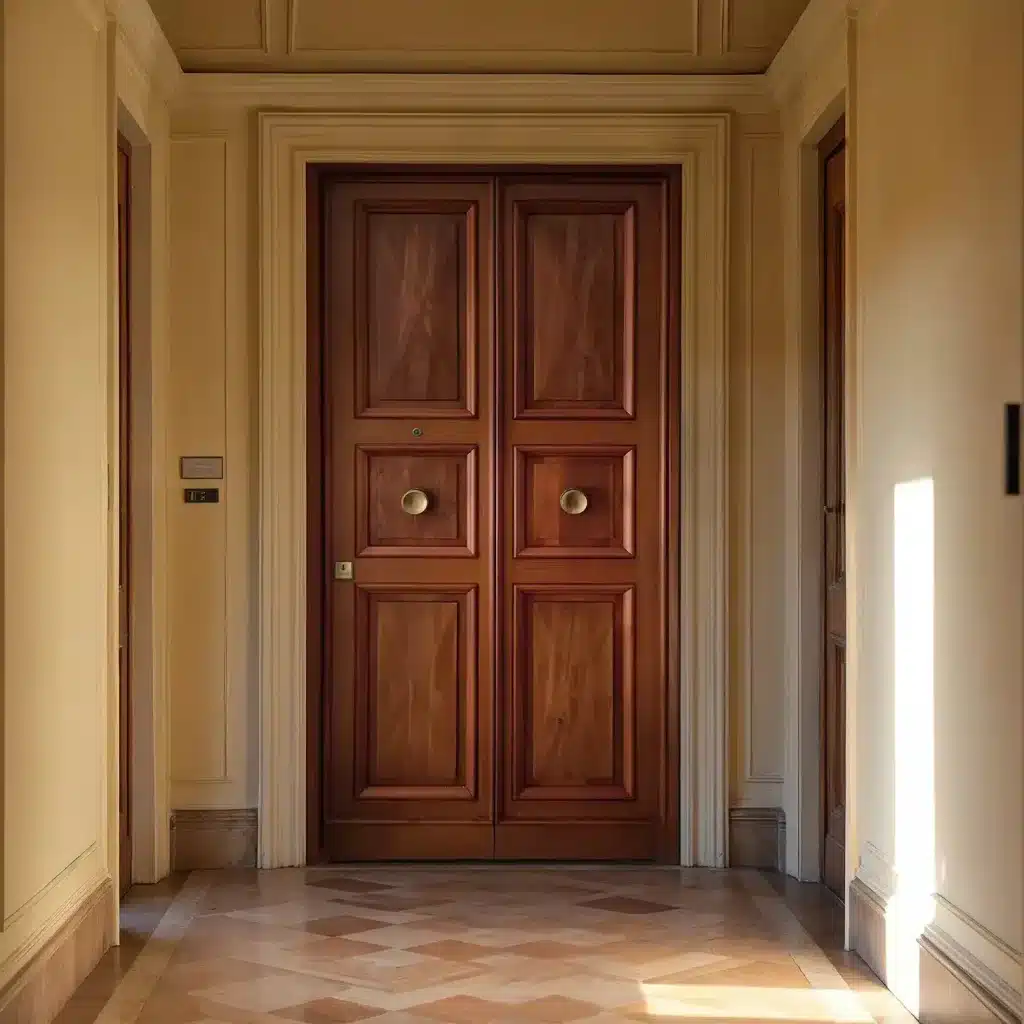
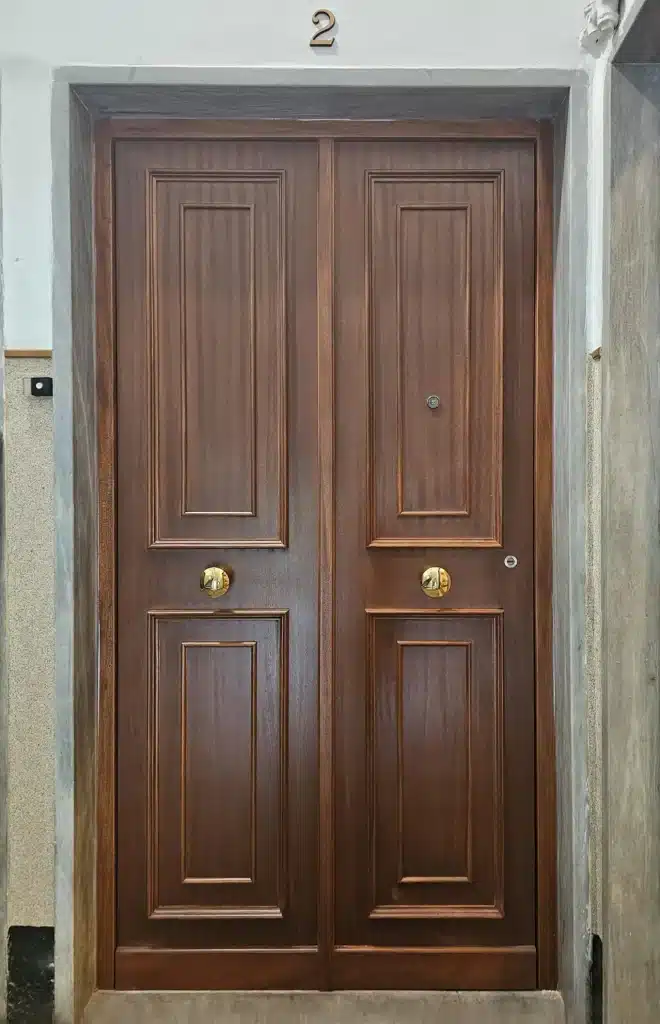
Armoured doors with a panel reproduced identical to the original by the Ariete joinery
Threshold or draught-excluder blade
The threshold and the draught-excluder blade are the elements that complete the door closure in the lower part, which is also the most critical point in terms of insulation.
Unlike the sides and the top, in fact, there is always a small gap beneath the door, needed for the opening to work correctly. Without an adequate system, air, noise, dust and cold easily pass through there.
The threshold is the so-called “fourth side” of the door: it is an element installed on the floor that allows the door to close flush in the lower part too, improving overall tightness.
In the more advanced armoured doors, the threshold is made with thermal break systems, that is, with insulating materials inside it (such as polyamide or technical plastics) that stop the cold passing between outside and inside.
Alongside the threshold, the draught-excluder blade comes into play, also known as the draught stopper or “guillotine”.
It is a movable seal positioned under the door that drops automatically when the door is closed, sealing off the space between leaf and floor completely.
The way it works is simple but extremely effective: when you close the door, an internal mechanism makes the blade drop, pressing against the floor and creating a barrier against draughts and noise; when you open the door, the blade rises automatically, avoiding friction during movement.
These two elements work together to:
- remove draughts in the lower part of the door
- noticeably improve acoustic insulation
- reduce heat loss
- prevent dust and cold air from getting in
In quality armoured doors, the threshold and draught-excluder blade are designed as a single system, because it is precisely in the lower part that the main losses occur.
The result is a much more airtight closure, which turns the armoured door from a simple security element into a true barrier between inside and outside, concretely improving living comfort.
Viewer (traditional or digital)
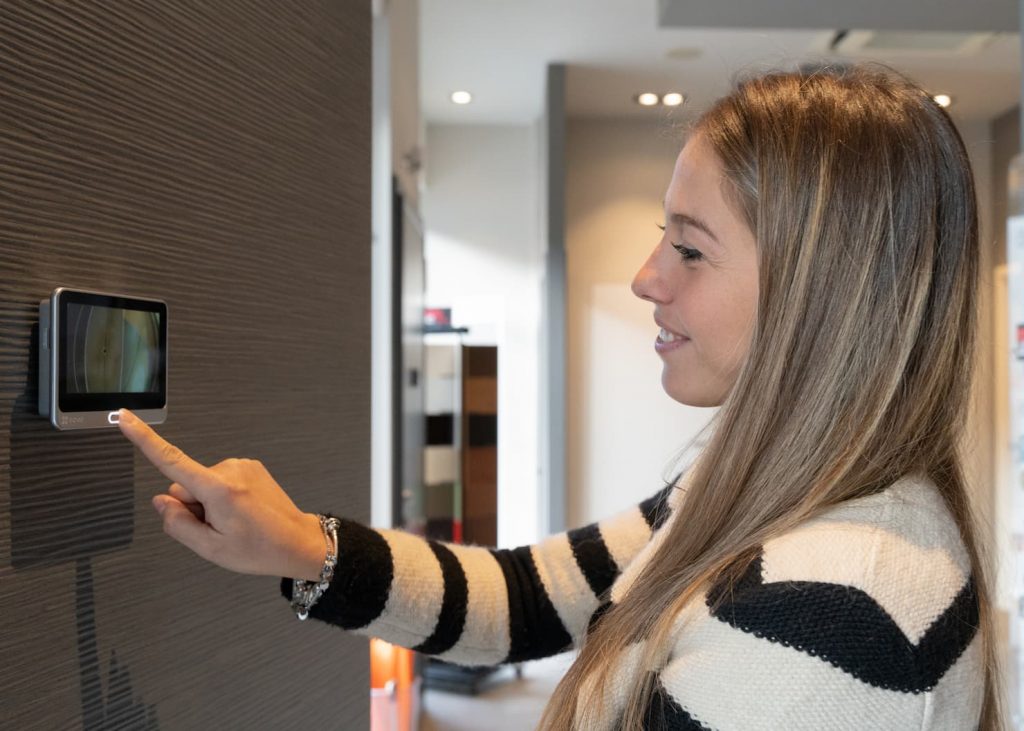
The viewer is an element often considered secondary, but it actually represents the first level of control even before you open the door.
In its traditional version, it lets you see who is outside, but it has several limits: the field of view is small and the image quality depends on the position of whoever is standing in front of the door.
For this reason, in modern armoured doors the digital viewer is becoming more and more widespread, a solution that significantly improves both visibility and security.
Unlike the classic one, the digital viewer uses an external micro-camera connected to an internal display, allowing a much wider and sharper view. This means being able to recognise more clearly who is outside, even if they are not perfectly centred in front of the door.
The more advanced models include features such as:
- remote viewing via smartphone
- video and photo recording
- night vision
- motion sensors with automatic activation
These features turn the viewer from a simple accessory into a true access control system, useful not only for security but also for everyday convenience.
An important advantage also concerns use by children, the elderly or people with mobility difficulties, who can check who is outside without physically going up to the door.
What is more, the ability to check the entrance remotely adds a further level of protection, especially when you are not at home.
How is an armoured door fitted?
The effectiveness of the door also comes from the fitting, which must be carried out properly, following all the relevant guidelines.
This is why it is very important to rely on companies with proven experience.
An armoured door that has been fitted badly, however high its quality and however good the materials it is built with, loses much of its effectiveness.
For more information, read the Accademia di Posa article on how to fit an armoured door professionally.
Armoured door classification: the 6 burglar resistance classes
Armoured doors are not all the same: their features can vary, for example the materials used, the number of hinges or internal omega profiles, or the type of lock.
You should not, in fact, overlook the importance of the lock.
There are various types, which make it more or less difficult when someone tries to force them. In general, however, armoured doors fall under a specific classification that lets you know their security level already at the time of purchase.
We are talking about burglar resistance classes for armoured doors, of which there are 6 in total, ranging from the one that offers the least resistance to burglars and robbers to the one that is the hardest to open without the legitimate keys.
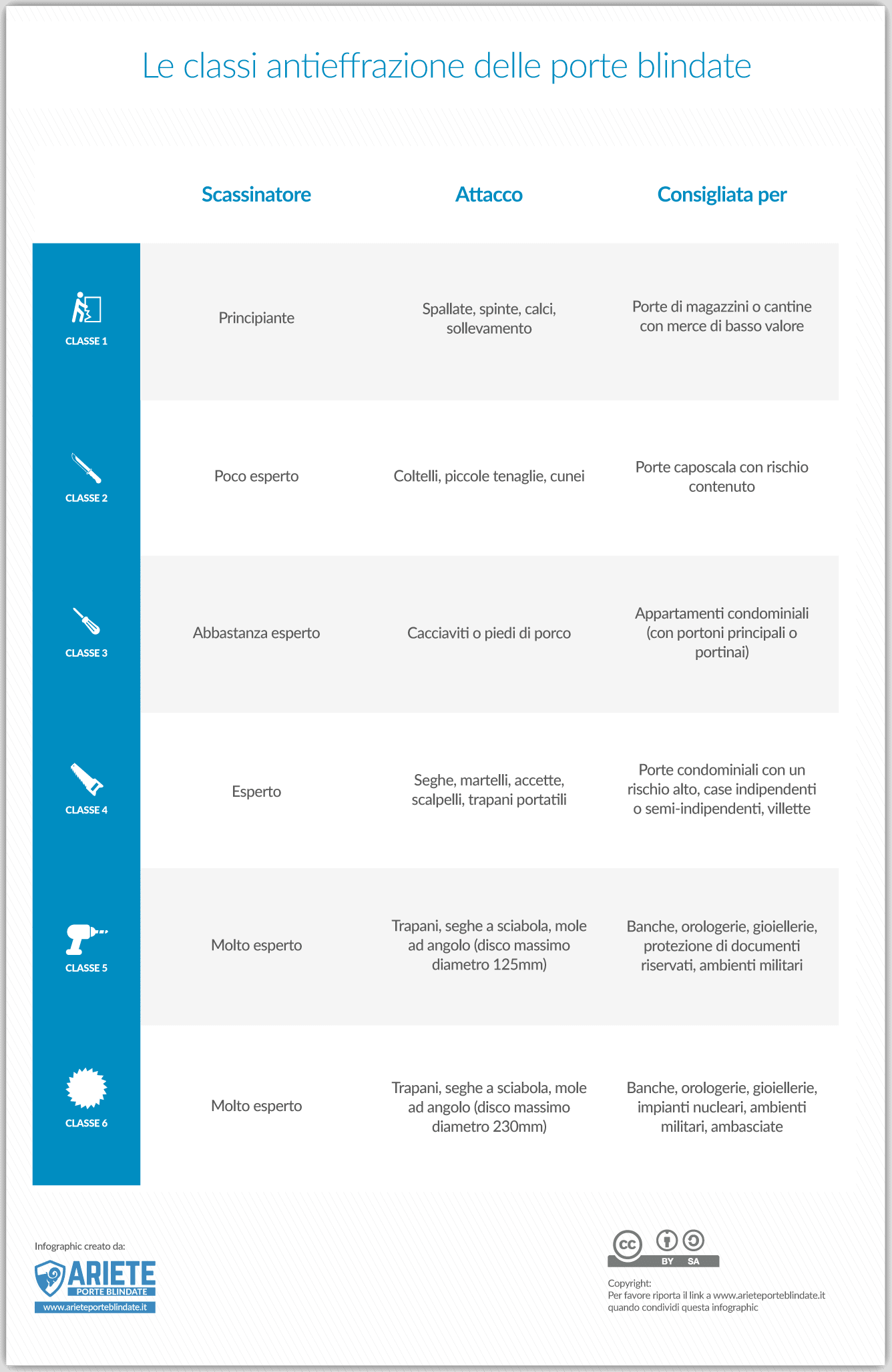
The classification is made according to the tools that burglars might have available to attempt to get into the home, and to the valuables kept inside the property that you therefore want to defend (and which may be more or less tempting to potential burglars).
Let us look together at what the 6 burglar resistance classes are and which to choose depending on your home setting and your needs.
Burglar resistance class RC1
Class RC1 is the lowest of all, and is usually used for garages or storerooms where low-value items are kept. Doors in this class resist shoulder barges or kicks, that is, opening attempts made with bare hands and without the help of any picks.
Burglar resistance class RC2
Class RC2 guarantees slightly higher protection; it is usually used for offices where there are no high-value items and it can resist even basic break-in tools, such as pincers and screwdrivers.
Burglar resistance classes RC3 and RC4
For flats located in built-up areas, that is, close to other homes whose residents could be alerted by excessive noise, armoured doors with a class between RC3 and RC4 are usually recommended.
Burglar resistance class RC3 resists the classic crowbar; the class RC4 armoured door, a little higher, can resist saws and drills too.
In my experience, I always recommend a class RC4 armoured door, which provides a high level of security and is ideal both for flats inside blocks and for detached houses or terraced houses.
Burglar resistance classes RC5 and RC6
Classes RC5 and RC6 are those used for banks, jewellers, isolated homes (for example large detached houses), in short for all those buildings that contain high-value goods or that are further away from other people who could hear the noise made by a break-in attempt.
Class RC5 armoured doors resist power tools too; the class RC6 armoured door can withstand even the most sophisticated tools of the best-organised burglars.
The choice of the armoured door burglar resistance class therefore depends on each person’s needs, and it naturally has a substantial influence on the final price of the door itself.
Resistance to noise and the weather
Obviously, when you decide to install an armoured door, your first thought is defence against burglars and home thieves.
You should not, however, overlook another significant advantage that the armoured door offers over a traditional door, especially if it is not a communal door but faces outside.
The features of armoured doors, if properly thought through at the time of purchase and installation, also let you achieve two other aims that are often essential in a house or flat.
Let us look at them together.
Soundproof armoured doors
How many times have you gone up the stairs at home and heard the noises coming from inside the other flats?
One of the most important features is acoustic insulation.
As anyone who lives in a block of flats knows well, but also anyone who has a busy road running right outside their home, the noise of modern cities often prevents a proper night’s rest.
Sometimes it also disturbs daytime activities.
Noise coming from outside can be considerably dampened by using sound-absorbing materials to fill the shell.
For more information, find out about the features and prices of the Ariete soundproof armoured door.
Protection against draughts and the weather
The second advantage the armoured door offers is thermal insulation.
Modern homes often use a lot of energy for heating in winter and cooling in summer, but bills can be drastically reduced with proper insulation of the home.
Naturally, it is important that all the windows and doors are designed with this in mind.
The features the armoured door can use to stop heat from escaping (or entering) once again concern the materials used to fill the shell, which can be both sound-absorbing and insulating.
The most widely used are polystyrene or rock wool.
The seals used around the shell are also essential to ensure perfect insulation of the internal spaces from the external ones.
What are the features of Ariete armoured doors?
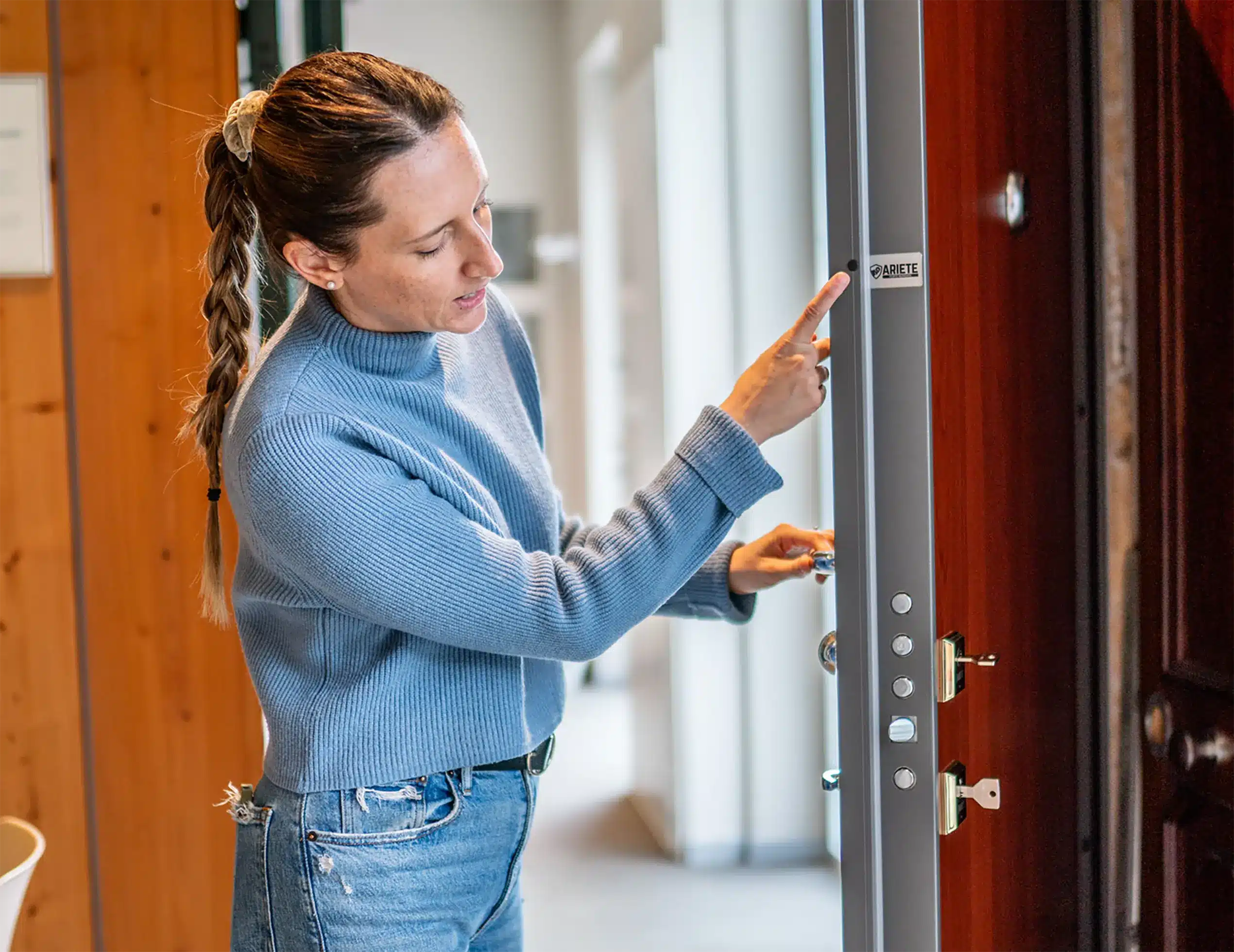
After seeing which elements truly determine the quality of an armoured door, it is easier to understand what sets a carefully designed product apart from a more standard one.
Ariete armoured doors are born precisely with this approach: not as a simple product, but as a complete system, in which every component contributes to security, comfort and durability over time.
From a structural point of view, Ariete doors are designed with an electro-galvanised steel shell and a reinforced internal structure, engineered to ensure rigidity and strength even after years of use.
The closing system integrates advanced locks, high-security cylinders and defenders designed to resist the main break-in attempts, including the most common ones such as drilling, snapping and manipulation.
Another central aspect is the attention to living comfort.
The doors are fitted with internal insulation and seal systems designed to improve acoustic and thermal insulation, helping to make the space quieter and more stable in energy terms.
From a design point of view, each door is configured according to its context: flat, villa, historic building or block of flats with aesthetic restrictions.
This makes it possible to obtain a product that not only protects, but blends perfectly with the surroundings.
Finally, an often underestimated but decisive element is the installation.
Ariete armoured doors are installed by staff trained at the Accademia della Posa in Genoa (the number 1 school for window and door fitters in Italy), because even the best door, without correct installation, cannot guarantee the performance it was designed for.
Technical specifications of Ariete armoured doors
Here are the technical specifications of Ariete entrance doors:
- Burglar resistance classes: class RC3 and class RC4;
- Acoustic insulation: from 39 to 44.8dB;
- Thermal insulation: Ud = 1.7 to 0.6W/m2K;
- Structure: double electro-galvanised steel sheet;
- Insulation: compressed mineral wool + foam insulation (in some models);
- Lock protection: anti-drill steel;
- Dog bolts: fixed steel;
- Viewer: electronic wifi with motion sensor;
- Panels: veneered in real wood or standard laminate;
- Euro cylinder: security cylinder compliant with class RC4;
- Keys: wear-resistant in silver-nickel with a patented anti-duplication profile;
- Panel customisation: the option to make “Old Milan” or “Old Genoa” panels or a scratch-resistant panel.
Frequently asked questions
An armoured door is made up of a load-bearing structure called the shell, made of steel, inside which several essential components are integrated: reinforcement omega profiles, lock, cylinder, defender, auxiliary bolts, insulation and closing systems.
To these are added external and functional elements such as hinges, anti-lift dog bolts, seals, threshold or draught-excluder blade and cladding panels, which complete the door both aesthetically and in terms of performance.
The main parts of an armoured door are:
– Subframe (structure built into the wall)
– Fixed frame (connected to the wall)
– Shell or leaf (the moving part)
– Lock and cylinder
– Defender
– Auxiliary bolts
– Hinges
– Anti-lift dog bolts
– Seals
– Threshold or draught-excluder blade
– Cladding panels
Each component has a specific function and contributes to the overall security and comfort of the door.
The support system of the armoured door is made up of two main elements: the subframe (which is installed inside the wall and has a structural function) and the fixed frame (which is fixed to the subframe and houses the door leaf).
The frame also has essential elements such as anchoring holes, housings for the dog bolts and seals for tightness.
There is no single most important component in absolute terms.
The security of an armoured door depends on the combination of several elements: internal structure, closing system, cylinder protection and quality of installation.
Even the best component, on its own, is not enough to guarantee effective protection.
The internal structure of the armoured door is made of steel, but inside it there are also insulating materials to improve thermal and acoustic performance.
On the outside, instead, the door is clad with panels in different materials (wood, PVC, aluminium), chosen mainly for aesthetic reasons and for resistance to the weather.
Underneath an armoured door, a draught-excluder blade (also known as a draught stopper or guillotine) is generally installed, or a thermal threshold.
The draught-excluder blade is an automatic system that, when the door closes, drops towards the floor, sealing the lower space, preventing the passage of air, noise and dust.
The threshold, instead, is a fixed element that completes the frame on the lower side, further improving thermal and acoustic insulation and water tightness, especially in external doors.
In many cases, the two solutions are used together to achieve a more effective closure.
The best defender for an armoured door is one designed to resist snapping, drilling and manipulation attempts, fully protecting the cylinder.
In particular, the most effective defenders are those with a square shape and chamfered corners, because they offer a surface that is harder to grip and force than traditional round models.
This geometry drastically reduces the chance of getting a grip with break-in tools and increases resistance to direct attacks.
Beyond the shape, it is essential that the defender is made of hardened steel and installed correctly, perfectly integrated with the lock.
A well-designed defender is not a simple accessory, but one of the most important elements for the overall security of the armoured door.
Conclusions
In this article we have looked in depth at the components of a door, starting from the cross-section of the armoured door, and we have analysed each of its components thoroughly.
As you have seen, an armoured door is not a simple reinforced panel, but a complex system made up of structure, internal reinforcements, lock, cylinder, defender, auxiliary bolts, seals, insulation and lower threshold.
Each component has a precise role and contributes, together with the others, to determining security, insulation and durability over time.
For this reason, understanding how armoured doors are made is essential to choose more knowingly and avoid solutions that, although they look similar on the outside, can offer very different performance in practice.
If you are considering buying a new entrance door, the advice is not to stop at the looks or the price, but always to look more closely at the quality of the structure, the closing system and the installation.
Do you need more information?
Read my article on how much an armoured door costs too, or get in touch with us to work out which solution can best suit your home and your living context.
Warm regards,
Mauro

6 Responses
Buonasera sono la signora RIZZI da Barletta vorrei sapere dove posso trovare in zona, sono in Puglia le vostre porte blindate e conoscere orientativamente i costi.
La larghezza della porta è 1 mt mentre l’altezza 2.15
Poichè deve essere installata in una località di mare e quindi prevalentemente disabitata in inverno vorrei mettere una porta abbastanza sicura con pannello interno bianco mentre il pannello esterno dovrebbe essere in legno, per avere un richiamo con le porte delle altre villette. Grazie per l’eventuale consulenza
Ciao Concetta,
Puoi ottenere un preventivo cliccando qui.
Un caro saluto,
Mauro
Buongiorno,
vorrei montare una porta blindata molto sicura. Vivo in un condominio munito di portineria, ma ahimè tempo fa violarono delle abitazioni usando il flessibile.
Chiedo se sia possibile avere una porta blindata anche a livello 5/6 e l’ eventuale costo.
Le dimensioni sono standard, ma presumo voi fareste un sopralluogo. Vivo a Milano. Mi piacerebbe una porta con pannello anti graffio.
Chiedo quanto sia la differenza in termini di costi tra una serie 4 ed una serie 5.
Ciao Marco,
Per gli appartamenti o case indipendenti è consigliata una porta blindata di livello 4.
Le porte blindate di classe antieffrazione 5 sono indicate per banche, gioiellerie, orologerie, eccetera; mentre le porte di classe 6 sono studiate per ambienti militari, ambasciate, eccetera.
Se desideri ottenere un preventivo, puoi compilare il form qui.
Un caro saluto,
Mauro
Trovare competenza fa davvero la differenza.Mi sto interessando in generale per,inizialmente, solo una porta blindata e vorrei ricevere assistenza e spiegazioni nel dettaglio. Ho in.ipotesi più interventi, ma inizierei con una porta per conoscere azienda/prodotti/qualità installazione. Cell.3389990634. Grazie.
Buongiorno Giovanni e grazie per il tuo commento. In che città ti trovi? Così inoltro la tua richiesta al responsabile di riferimento.
Un caro saluto,
Mauro