
Have you found condensation on your armoured door, perhaps a puddle of water on the floor near the frame, and you are wondering whether it is the door’s fault or something else?
Then you are in the right place.
Condensation forms on an armoured door when the warm, humid air inside your home touches the cold frame.
In nearly every case it is the sign that there is too much humidity in the home and that the frame is not well enough insulated. Only rarely does it come down to a fault in the door.
It is an annoying problem and almost always solvable.
The trouble is that many people ignore it for months, thinking it is normal in winter. The water that sits on the frame and gathers on the floor creates the perfect environment for mould, and mould around the door is far harder to remove than the condensation itself.
The good news is that in most cases you do not need to replace the door.
What you need is to work out which of the three factors at play weighs most in your home and act on that one, in the right order.
In this guide I will explain:
- why condensation forms on the frame in particular
- how to tell whether it is condensation, rainwater getting in, or mould that is already there
- how to get rid of it for good, starting with the measures that cost nothing
Read on: let us start with why it forms.
Why condensation forms on an armoured door
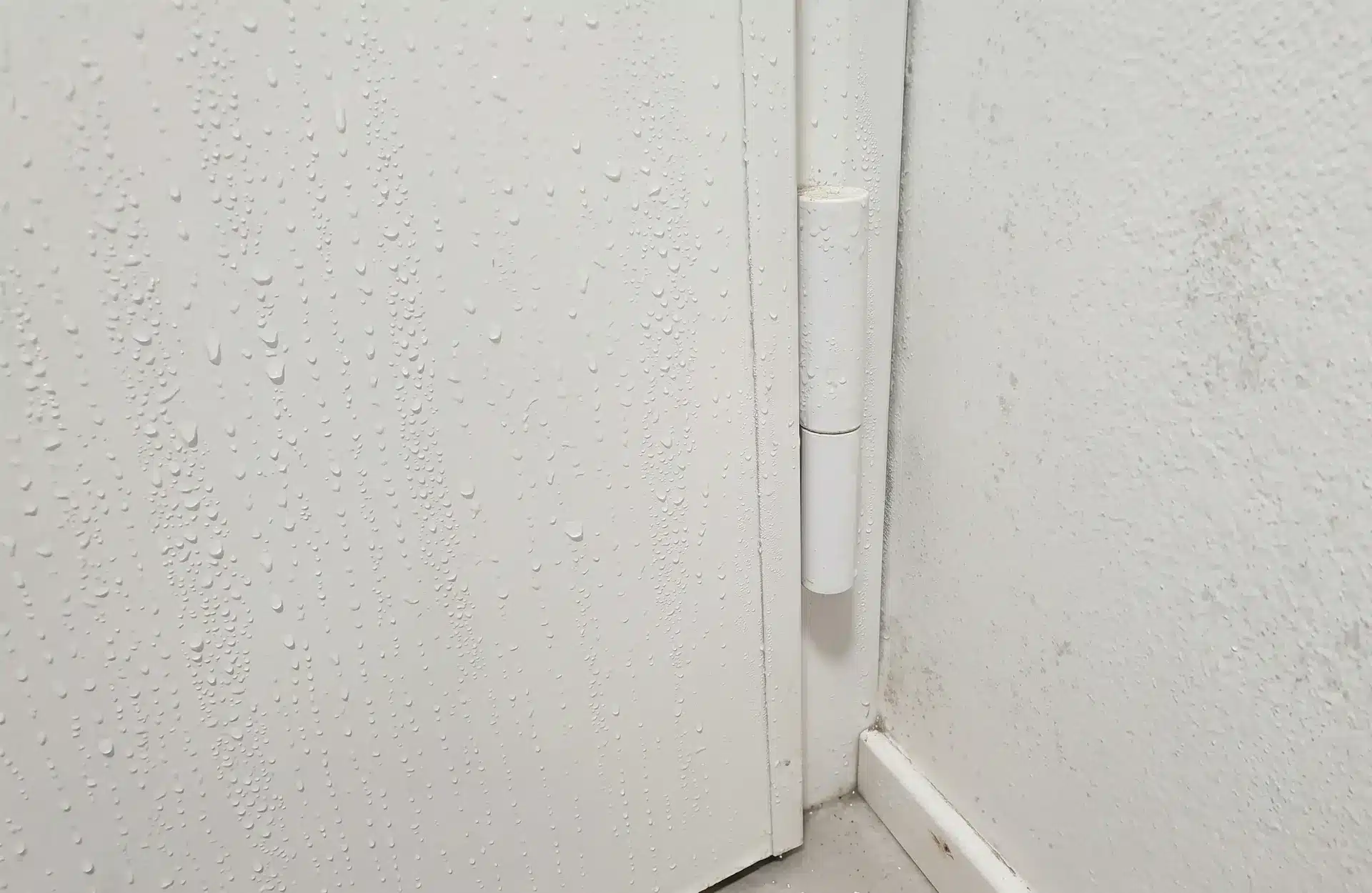
Condensation is water vapour that turns back into liquid as soon as it touches a surface that is cold enough.
It is the same thing that happens to a bottle taken out of the fridge in summer: the air around it mists up and gets wet.
At home it works the same way. The indoor air in winter is warm and full of humidity produced by cooking, showering, drying laundry and even just breathing.
When this air meets the cold frame of the armoured door, it leaves its moisture there in the form of droplets.
Behind all this there is a precise threshold, the dew point: the temperature below which the air can no longer hold its vapour and releases it.
When the surface of the frame drops below that threshold, condensation forms. It is a normal physical phenomenon.
It appears in winter and almost always on the frame, because that is the point that stays colder than the rest of the door.
Where exactly it forms on the door
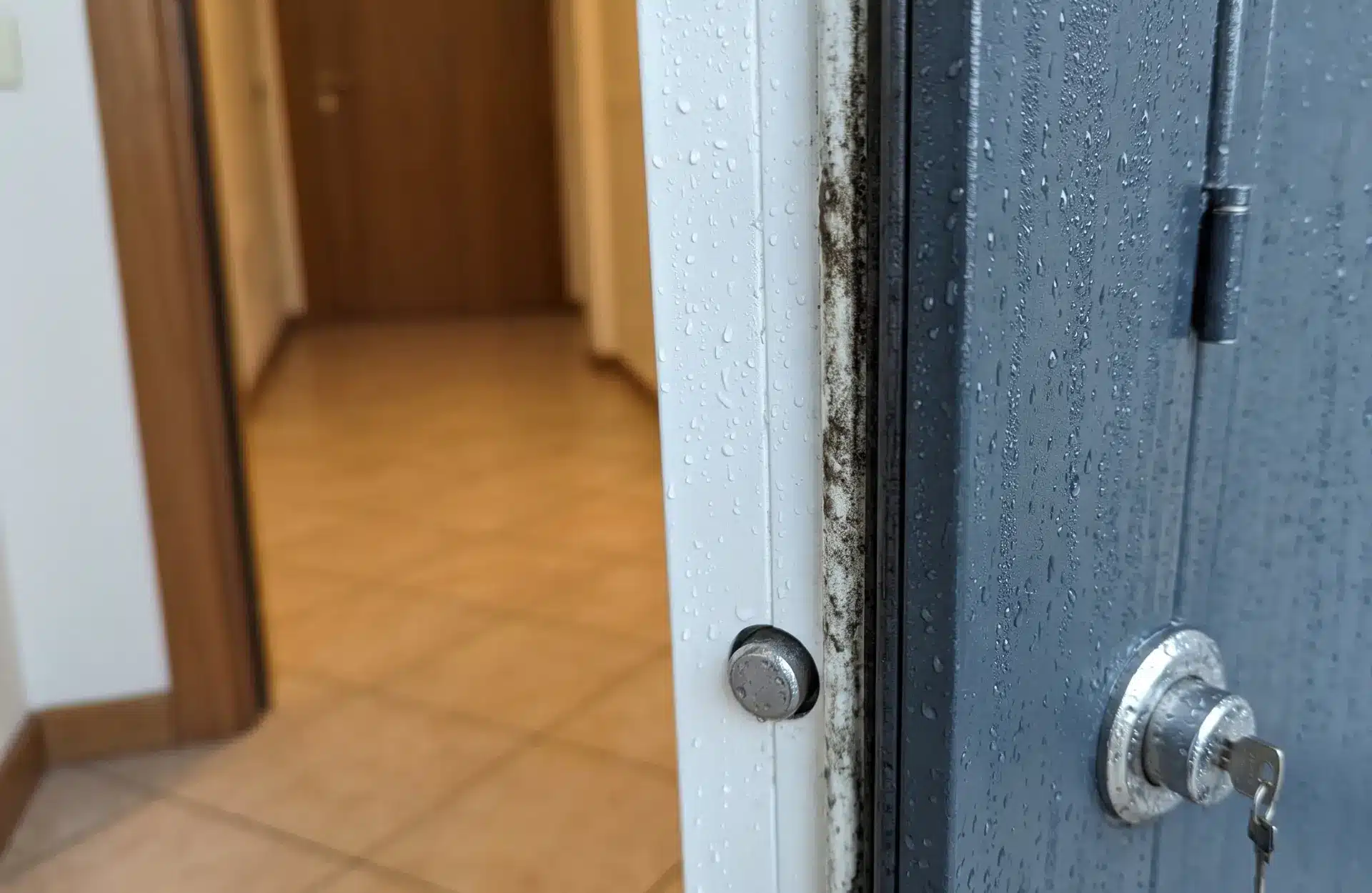
Condensation gathers on the cold spots of the door, and the frame is first on the list.
The frame and the subframe are made of steel, and steel carries the cold inside far more than the panel of the leaf does.
To understand in detail how a door is built and why the frame is its most thermally delicate point, it helps to read how an armoured door is made.
The places where you will almost always find it are these:
- the frame and the subframe, especially on the side facing outside or a cold stairwell
- the threshold on the floor, where the puddle of water often gathers
- the hinges and the corners, because the metal is more exposed there
- the joint between door and wall, if the installation let the cold through
If the condensation always appears in the same spots and always in winter, the culprit is the cold frame.
A water leak would give different signs, and we will see how to tell them apart shortly.
The three causes of condensation
Condensation comes from three factors meeting, and almost always one of them weighs more than the others in your home.
The first is the cold frame, what in technical terms is called a thermal bridge: a preferred path through which the cold from outside reaches the inner surface of the metal.
The colder that frame stays, the more easily the air in your home leaves its moisture on it. It is the point where condensation almost always starts.
The second is too much humidity in the home, produced by showering, pots on the hob, drying laundry, poor ventilation or many people in a few square metres.
It is the cause people underestimate the most. On a cold frame, with dry air the condensation stays minimal; with air saturated with vapour it takes very little to bring it out.
The third is the low indoor temperature, for example a poorly heated home or a freezing stairwell on the other side of the door.
On its own it counts for little, but it amplifies the other two.
Is it condensation, water ingress or mould that is already there?
Before you spend a penny you need to know what you are dealing with: condensation, rainwater getting in, or mould that has already settled.
These are three different problems with three different solutions.
It is condensation if the water appears in winter, on cold days, in the morning, in droplets on the frame, with no connection to the rain.
It goes away when the home is well aired and warmer.
It is water ingress if the water arrives when it rains or when there is driving rain, follows a precise direction and stays unrelated to the temperature.
In this case the problem is the watertight seal or the installation.
It is mould that is already there if around the frame you see dark or black patches that do not dry out and leave a stain even after cleaning.
Mould is the consequence of condensation ignored for too long.
A simple check: dry everything well in the evening and look in the morning. If the water has come back without it having rained, it is condensation.
Is condensation on an armoured door dangerous?
Yes, ignoring it is a mistake. Water sitting on the frame leads straight to mould.
Household moulds release spores that worsen allergies, asthma and respiratory problems, especially in children and vulnerable people.
On this point the guidance from the health authorities is clear: excess humidity in enclosed spaces encourages mould and respiratory disorders, as Italy’s National Institute of Health points out.
There is also slow, material damage: standing water swells the reveal linings, flakes the paint around the door and over time works against the frame.
Condensation neglected at the start of winter becomes a patch of mould on the wall by the end of the season.
If you act in time it stays a manageable problem. Neglected for months, it becomes mould that needs removing.
How to get rid of condensation on your front door
It is almost always solvable, by following the measures in this order: first the remedies that cost nothing, then those on the door, and only at the end replacement.
Starting with replacement without having checked humidity and installation often leads to spending money without solving anything.
Measure the condensation with a hygrometer
Buy a digital hygrometer: it costs a few euros and is the first tool to use.
Place it near the door or the coldest wall, away from radiators, and read it in the morning, when the humidity in the home is at its highest.
Here are the values to refer to in winter:
- below 45%: a safe situation, condensation is unlikely
- between 45% and 55%: a watch zone, air the home consistently
- above 55%: act now, the risk of condensation and mould is high
- above 60% for several days: an urgent situation, act straight away on humidity and ventilation
The practical goal is to keep indoor humidity around 40-50%.
Lower the humidity inside your home
Open the windows wide, not ajar, for 5 minutes, 2-3 times a day, even in winter.
If you open two windows on opposite sides and create a through draught, 2-3 minutes are enough and the home does not have time to cool down.
After showering: bathroom window open for 5-10 minutes and bathroom door closed, so the steam does not spread through the home.
While you cook: extractor hood on and a kitchen window open.
Do not dry laundry indoors. If you really must, put it in a closed room with the window open.
These are simple, everyday habits and on their own they solve a large share of real cases.
If the hygrometer stays above 55% even when you do all of this, consider a dehumidifier, aiming to bring it back below 50%.
Check the seals and the adjustment
A door that does not close properly lets cold in where it should not and cools the frame more than necessary.
Check that the seals are intact and that the door is properly adjusted: you will find how to do it in the guide on how to adjust an armoured door.
This step removes a factor that makes the condensation worse. You tackle the thermal bridge itself with the two steps that follow.
Check the frame installation
If the frame stays freezing despite everything, the problem is often how the door was installed.
A badly made joint between door and wall leaves a direct channel to the cold outside: this is where well-done thermal insulation of the armoured door comes into play, right from the installation.
It needs to be assessed and put right by a qualified installer, it is not a DIY job.
Consider a thermal-break door
When the frame is structurally cold, the only definitive solution is a door with a thermal-break frame, designed to interrupt the passage of cold from outside to inside.
It costs more and it is the only measure that closes the problem for good.
| Measure | How much it costs | When it works | Limitation |
|---|---|---|---|
| Hygrometer | A few pounds | Always, it is the starting point | It measures, it does not solve |
| Airing, extractor hood, no laundry indoors | Free | Humidity just above normal | Has to be done every day |
| Mechanical ventilation (MVHR) | Medium | Structurally high humidity | On its own it is not enough if the frame is freezing |
| Seals and adjustment | Low | Draughts, misaligned closing edge | Does not act on the thermal bridge |
| Installation joint | Medium | A frame that carries the cold inside | Needs an installer |
| Thermal-break door | High | A structurally cold frame | It is the definitive solution |
Do you want to change the door or work out which armoured door will put an end to the condensation in your home?
Get a quote: tell us where the condensation forms and what door you have, and we will prepare a concrete proposal for you.
If you would rather talk it over in person, you can book a consultation in the showroom with one of our expert advisers.
Why two identical homes get different condensation
It happens often: same building, same door, and your neighbour does not get a single drop while you dry the frame every morning.
It almost always comes down to the installation and the setting.
The same door fitted well or fitted badly behaves in opposite ways.
A first-rate installation leaves no continuity between the cold outside and the inner frame; a rushed one does.
It is the single factor that explains most of these differences between flats.
Then there is the setting: a flat that is better heated, better aired or with fewer people produces far less humidity than an identical one lived in differently.
Here there is a concrete difference with Ariete: the technicians who fit the doors are in-house and trained at the Accademia della Posa in Opera in Genoa, the first in Italy.
Installation accounts for half of the final result. An excellent door fitted badly can give more condensation than an average door fitted well.
The right door for no more condensation
If the problem is the frame, the right door is the one with a thermal-break frame: it is the only one that acts on the cause.
The thermal break is a barrier, inside the frame, that breaks the path of the cold.
The result is simple: the inner surface of the frame stays warmer, stays above the dew point and the air in your home no longer leaves its moisture on it.
Watch out for one point that few people tell you: the declared insulation value of a door is an average calculated over the whole surface, and an average can hide a mediocre frame.
To understand how to really read these figures without being fooled by the average, you will find the article on the thermal transmittance of an armoured door useful.
Ariete doors are designed for maximum thermal and acoustic insulation, frame included: no draughts, no stairwell coming into the home, no freezing frame dripping in winter.
If the door opens onto the outside or a cold stairwell, external armoured doors are the right category to look at.
Conclusions
In nearly every case condensation on an armoured door comes from the humidity in the home combined with a frame that is too cold. Only rarely does it come down to a fault in the door.
The path is always the same, in this order: measure the humidity, lower it with the free everyday habits, check the seals and the installation, and only if the frame stays structurally cold move on to a thermal-break door.
What you cannot do is ignore it: today’s standing water becomes the mould on the wall within a few months.
If you want to replace the door or work out which model puts an end to the condensation, request a quote or book a consultation in the showroom with one of our expert advisers.
Frequently asked questions
Because the warm, humid air in your home touches the cold frame and leaves water on it. In the vast majority of cases it is the sign that there is too much humidity in the home and that the frame is not well enough insulated. It forms in winter and almost always on the frame, because that is the point that stays colder than the rest of the door.
Yes, if you ignore it. Water sitting on the frame creates the perfect environment for mould, which worsens allergies and respiratory problems and leaves black stains on the wall. If you act in time it stays a manageable problem; neglected for months it becomes mould that needs removing.
In most cases you do not need to change the door. Often it is enough to lower the indoor humidity, sort out the seals and adjustment and check the installation. Replacing it with a thermal-break door is only needed when the frame is structurally cold and the other measures are not enough.
Because the same door fitted well or badly behaves in opposite ways, and because the setting changes everything. A flat that is better heated, better aired or with fewer people produces far less humidity. The installation, in particular, explains much of these differences between flats in the same building.
Almost always yes, because it acts on the cause: it keeps the inner surface of the frame warmer and above the dew point. It is still good practice not to let the humidity in your home get out of control, because a home saturated with vapour puts any surface to the test.
In winter it is best to keep it around 40-50%, checking it with a hygrometer. Between 45% and 55% you are in the watch zone; above 55% the risk of condensation and mould rises sharply. That is why the first step is to measure rather than go by feel.
Often no. Mechanical ventilation helps a great deal to keep humidity low, but if the frame stays freezing condensation can still appear on the coldest spots. It is a great ally when it goes hand in hand with a well-insulated frame.
Almost never, because it is usually not a fault in the door but the result of high indoor humidity and a poorly insulated frame. To know for sure in your case it is best to talk it over with an adviser: if instead it turned out to be an installation or sealing problem, that is a different matter.
