
Have you asked for a quote on an armoured door and found yourself faced with a spec sheet full of codes: class 3, Ud 1.3, Rw 40 dB, EN 1627, class 5A, C5… and you have no idea what they really mean?
You are not alone.
The spec sheet of an armoured door is the document that sums up security, insulation and structure in measurable values: learning to read it is the only way to understand whether what you are being sold is really worth the price.
The trouble is that most people simply look at the price at the bottom.
Yet every line of a spec sheet tells you something concrete: how much security the door gives you, how well it insulates against cold, noise and rain, and how it is built.
If you cannot read it, you risk two things: paying too much for features you do not need, or taking the salesperson’s word for it with no objective evidence.
In this guide I will explain:
- what an armoured door spec sheet really contains
- the 8 items you should always check
- how to tell whether the stated values are good for your home
- which certifications must be shown
By the end you will be able to open any armoured door spec sheet and work out in 30 seconds whether the door is a serious choice or not.
Read on.
What is an armoured door spec sheet?
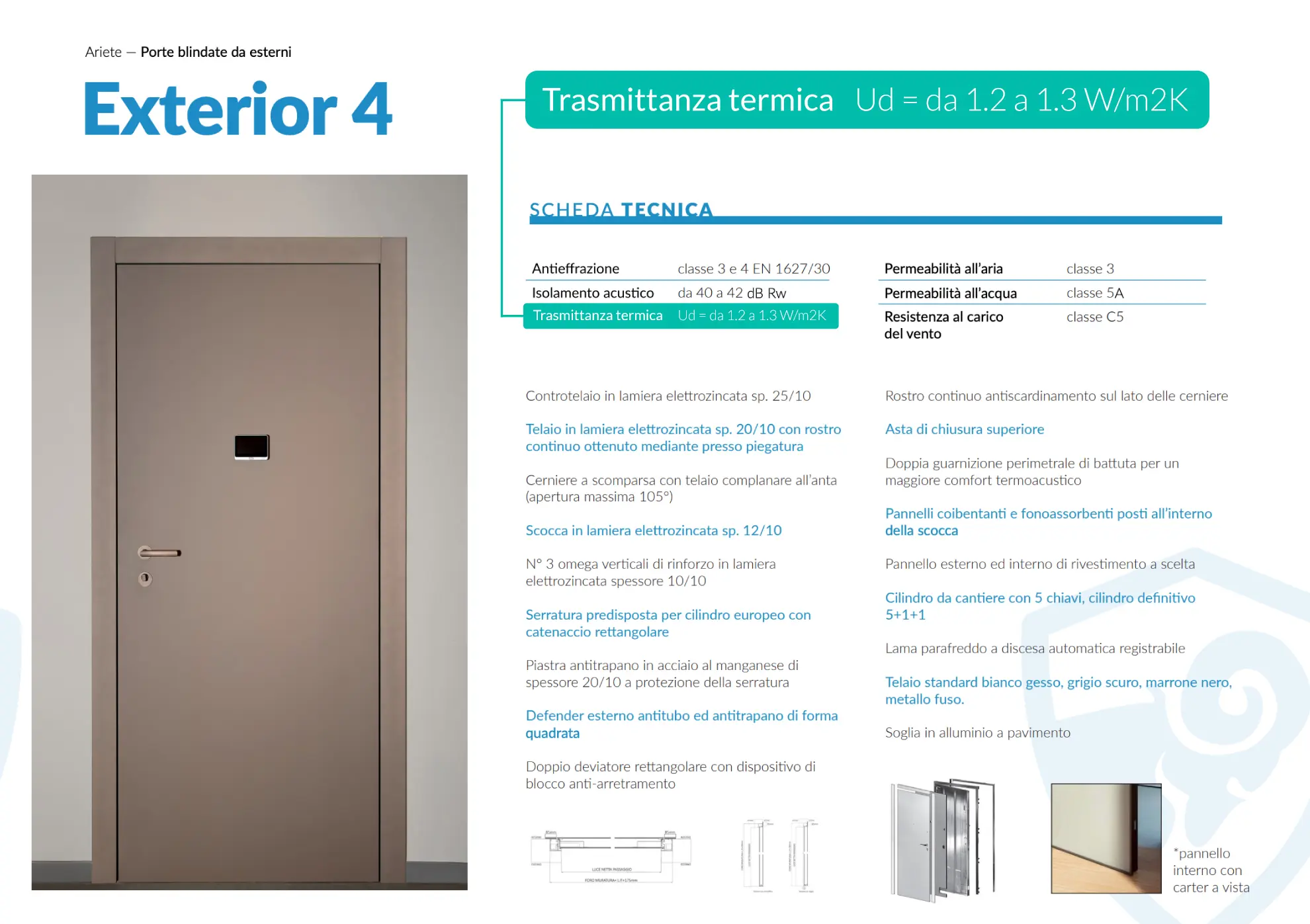
The spec sheet of an armoured door is the technical and commercial document that states, in certified values, the door’s performance and materials.
In practice it is the “identity card” of the door: it contains everything you need to compare models and manufacturers on objective grounds, not just on the salesperson’s words.
The sheet is drawn up by the manufacturer and is required for entrance doors sold in Europe, because it relies on harmonised technical standards that define how performance is measured and how it must be expressed.
A well-made sheet contains certified numerical values (burglar resistance class, thermal transmittance, sound reduction) and detailed descriptions of the components (sheet steel thicknesses, type of lock, defender material).
The spec sheets for Ariete doors are published in the product catalogue, one for each model (Interior 3, Interior 4, Exterior 3, Luce, Unica, Futura and so on).
They are available to consult before you buy, so you can compare values and specifications model by model.
In the next sections we will go through everything you need to check, one item at a time.
The 8 essential items of a spec sheet
A complete spec sheet contains 8 essential items: four are performance parameters (security, thermal insulation, acoustic insulation, weather resistance), four are structural components (locking system, structure, hinges and locking points, panels and insulation).
Before we go into detail, let me show you everything in a table you can use as a quick reference.
| Item | What it measures | Minimum acceptable value | Good value |
|---|---|---|---|
| Burglar resistance class | Resistance to break-in attempts | Class RC3 | Class RC4 |
| Thermal transmittance (Ud) | How well it insulates against heat | ≤ 1.6 W/m²K | ≤ 1.3 W/m²K |
| Sound reduction (Rw) | How well it insulates against noise | 35 dB | 40 dB and above |
| Air/water/wind permeability | Weather resistance (external) | Air 2, Wind C3 | Air 3, Water 5A, Wind C5 |
| Lock, cylinder, defender | Locking system | Euro cylinder + basic defender | Anti-scaffolding-pipe, anti-drill defender + 5+1+1 cylinder |
| Structure (frame + body) | Strength of the door body | 10/10 sheet steel | 12/10 sheet steel + reinforcement omega profile |
| Hinges and locking points | How many points hold the door to the frame | 3 fixed dog bolts | Continuous anti-lever lip + double auxiliary bolt + top rod |
| Panels, insulation, seals | Finish and thermal-acoustic sealing | Standard panel + single seal | Fire-resistant mineral wool + double seal + draught-excluder blade |
Now let us go into the detail item by item.
Burglar resistance class (EN 1627)
The burglar resistance class is the first figure you should look at: it indicates the door’s level of resistance to a break-in attempt, measured in a laboratory under the European standard EN 1627/30.
There are 6 classes in total, from 1 (minimum resistance) to 6 (maximum resistance for residential use).
For a private home the classes that really matter to you are class RC3 and class RC4.
Class RC3 means the door withstands attacks with light hand tools such as screwdrivers, pliers and small crowbars: it is the standard for flats in a block with medium risk.
Class RC4 steps up a level and also withstands heavier tools such as sledgehammers, drills and sturdy levers: it is the recommended choice for detached houses, villas or more exposed settings.
All Ariete doors are certified to class RC3 or RC4 depending on the model. For example, Interior 3 and Exterior 3 are class RC3, while Interior 4 and Exterior 4 are class RC4.
If you want to learn more about how the laboratory tests work and what the differences between one class and another are, read the dedicated article on the 6 burglar resistance classes of armoured doors.
An armoured door with no explicit class stated on its spec sheet is effectively not a certified armoured door: the reference standard is UNI EN 1627.
Thermal transmittance (Ud)
Thermal transmittance, shown by the code Ud, measures how much heat passes through the door between inside and outside: the lower the value, the better the door insulates.
The unit of measurement is W/m²K (watts per square metre Kelvin).
The values you find on industry spec sheets fall into four bands:
- above 1.8 W/m²K: low insulation, to be avoided
- between 1.4 and 1.8 W/m²K: medium insulation
- between 1.0 and 1.3 W/m²K: good insulation (this is the range Ariete doors sit in, with Ud from 1.2 to 1.3 W/m²K)
- below 1.0 W/m²K: very high insulation, typical of advanced solutions with thermal breaks and special panels
For an internal door (stairwell) a Ud of 1.3 is already an excellent result, because the door does not separate inside from outside directly.
For an external door (villa, detached house) it is more important to aim for values below 1.3 W/m²K, because the door is directly exposed to cold and heat.
The Ud value is also decisive if you want to claim the Italian Ecobonus, which requires minimum transmittance values to qualify (typically Ud below 1.3-1.6 W/m²K depending on Italy’s climate zone).
The Italian Renovation Bonus, on the other hand, does not require minimum Ud values: an armoured door qualifies in any case, regardless of its thermal performance.
For the details, read our in-depth piece on Italian tax relief for armoured doors.
To understand what transmittance is in detail and how it is calculated, read our dedicated guide to the thermal transmittance of an armoured door.
Sound reduction (Rw)
Sound reduction (Rw) measures how much the door cuts noise coming from outside, expressed in decibels (dB): the higher the value, the better the door insulates.
To give a concrete reference: for every extra 3 dB the perceived noise is halved.
On industry spec sheets the typical values fall into four bands:
- below 30 dB: poor insulation (non-armoured or low-quality doors)
- between 30 and 35 dB: medium insulation
- between 35 and 40 dB: good insulation
- above 40 dB: high insulation (Ariete doors range: from 40 to 46 dB Rw depending on the model)
In a block with a noisy stairwell, a lift nearby, loud neighbours or an entrance onto a busy road, a door with an Rw below 40 dB lets you hear practically everything.
A class RC4 Ariete door such as Interior 4 starts at 43 dB Rw, which translates into acoustic comfort that is clearly superior to the lower classes.
If soundproofing is a priority for you (you live above a venue or near a main road), find out more in our dedicated article on the soundproof armoured door.
Air permeability, water tightness and wind resistance
These three parameters measure how well the door holds up against the weather: they are essential for external doors and less relevant for internal ones, where water and wind are not an issue.
The three items you find on the sheet are:
- Air permeability (EN 12207): classes from 1 to 4. The higher the number, the better the door holds out draughts. Ariete standard: class 3.
- Water tightness (EN 12208): classes from 1A to 9A (or “NPD” if not tested, typical of internal doors). Ariete standard for external doors: class 5A.
- Resistance to wind load (EN 12210): classes from A1 to C5. Ariete standard: C5, the highest class in the residential field.
The code NPD means “No Performance Determined”. It is normal for an internal door (stairwell) to show NPD for water, because in that setting the item is not relevant.
If, on the other hand, you are buying a door for a villa or detached house, an NPD for water is a warning sign: the door has not been tested in those conditions and is probably not suitable for external exposure.
Lock, cylinder and defender
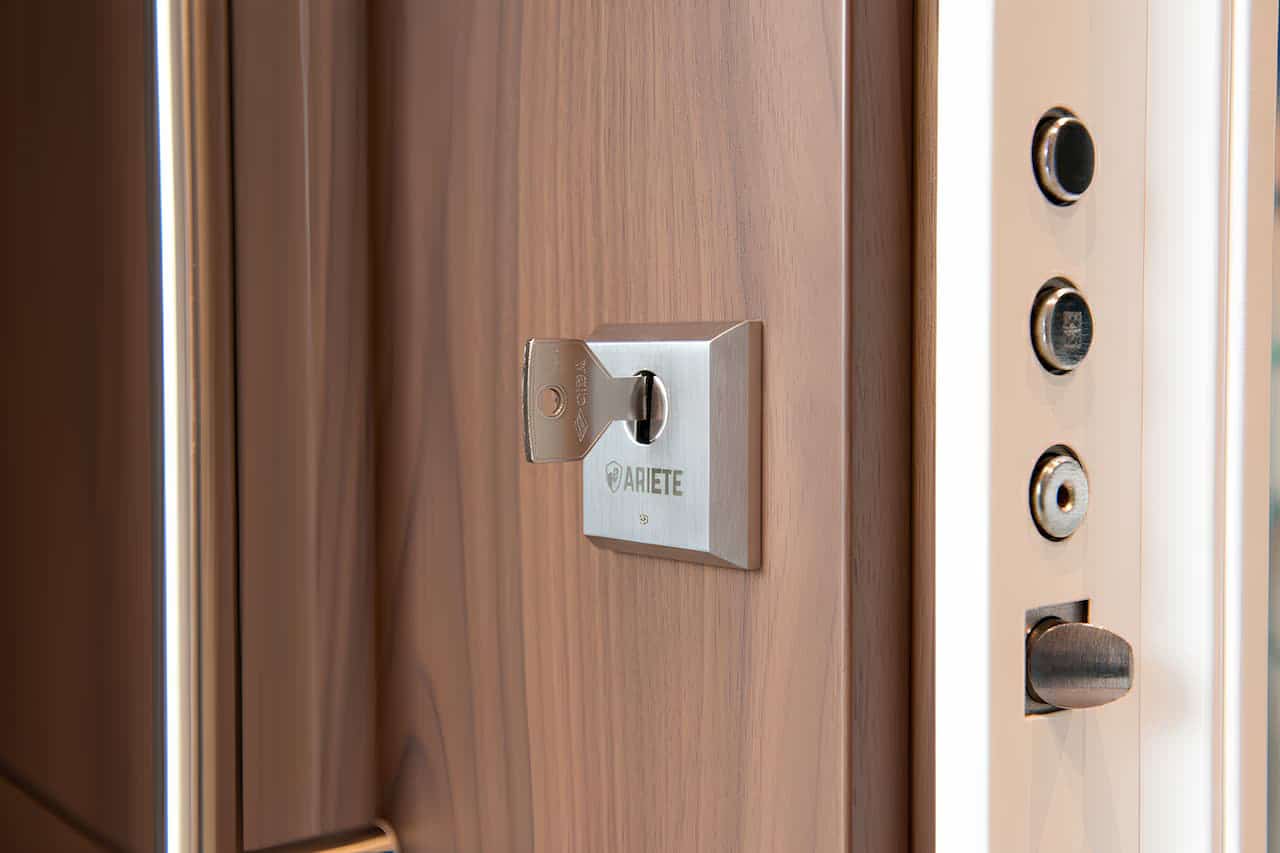
Lock, cylinder and defender are the “heart” of the security: they work as a system, and a serious spec sheet describes all three in detail, rather than just saying “door fitted with a lock”.
Here is what you should look for:
- Lock: the type (euro cylinder, double-bit, electronic) and the locking system (cylindrical bolts, rectangular deadbolt). The Ariete Interior 4 doors have a lock set up for a euro cylinder with a rectangular deadbolt, a more robust solution than the cylindrical bolts of class RC3 doors.
- Cylinder: type (standard euro, anti-bumping, recodable). Ariete supplies a temporary site cylinder with 5 keys (for works in the home) and a permanent “5+1+1” cylinder: five master keys, one emergency key that recodes the cylinder on its own and a second emergency key, all impossible to copy at a hardware shop.
- Defender: it is the external metal plate that protects the cylinder against attacks (drilling, scaffolding pipe, pulling out). The Ariete defender is square and anti-scaffolding-pipe: the square shape stops pipe wrenches from getting a grip, a technique typical of experienced burglars.
Behind the lock there is also the anti-drill plate, listed on Ariete sheets as “20/10 manganese steel”: manganese steel is particularly resistant to drilling.
To understand in detail how this distinctive component works, read our dedicated article on the armoured door defender.
Structure: subframe, frame, body and reinforcement omega profile
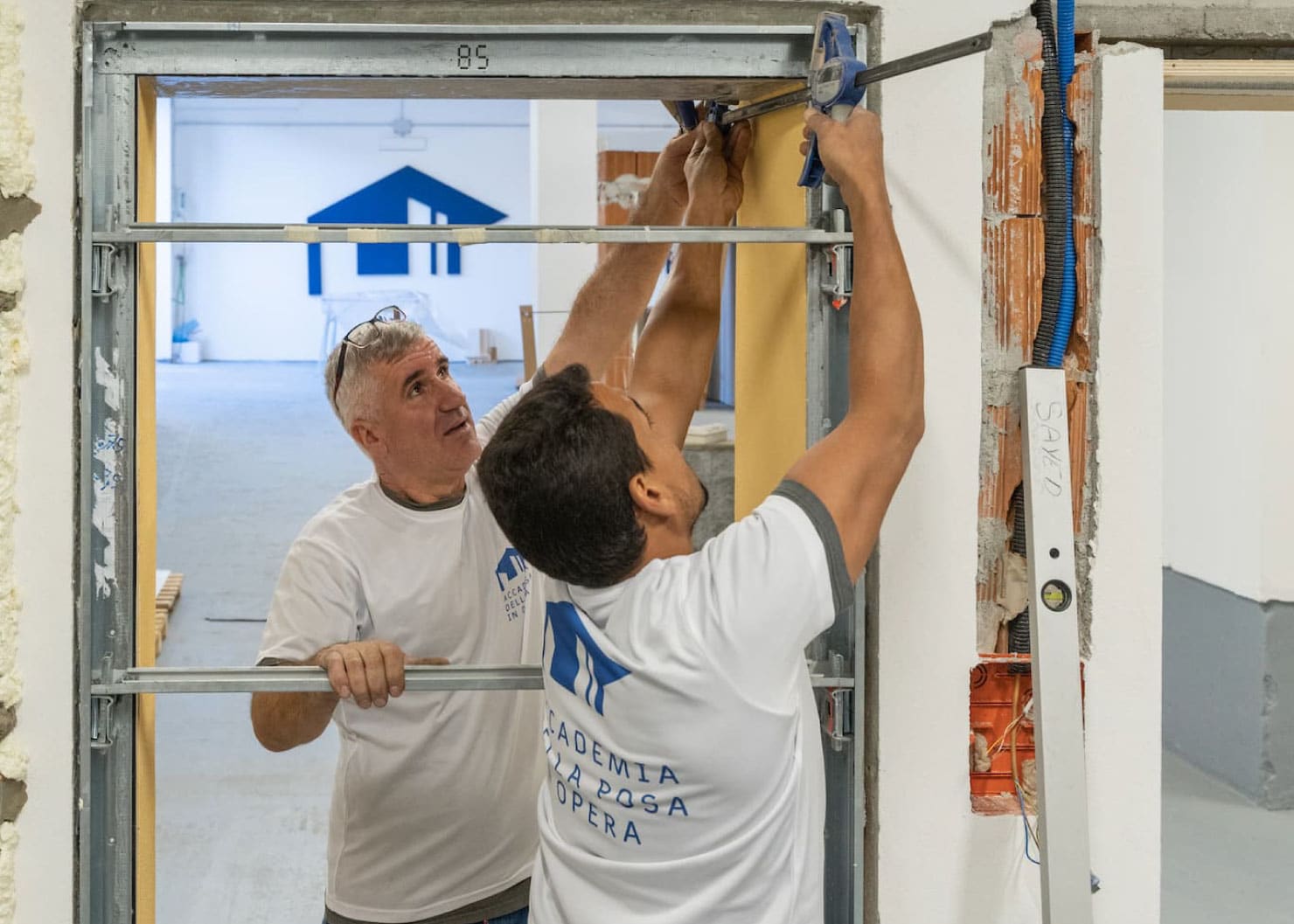
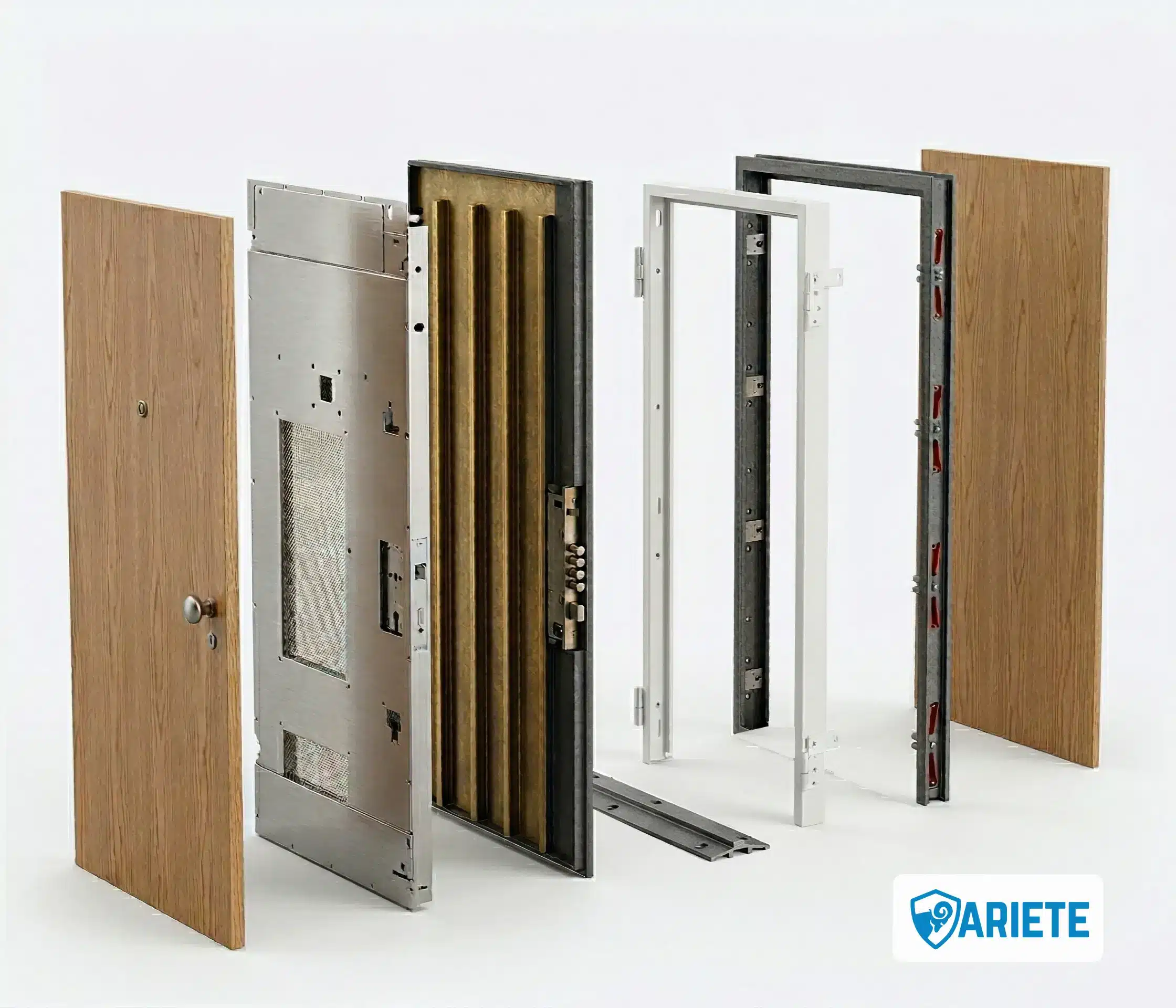
The structure is the “metalwork” of the door: the part that really makes it rigid and resistant. It is described on the sheet by the type of sheet steel, the thickness and the internal reinforcements.
The four elements you always find on spec sheets are:
- Subframe: the “false frame” embedded in the masonry to fix the door in place. Ariete thickness: 20/10 electro-galvanised sheet steel (for class RC4 concealed-hinge models it rises to 25/10).
- Frame: the fixed metal structure that frames the door. Ariete thickness: 20/10 electro-galvanised sheet steel, often with a continuous anti-prising lip formed by press-bending on class RC4 models.
- Body (or leaf): the moving body of the door. Ariete thickness: 10/10 electro-galvanised sheet steel for class RC3, 12/10 for class RC4 with concealed hinges.
- Reinforcement omega profile: steel profiles shaped like an Omega (Ω), welded inside the body to stiffen it. Ariete standard: 3 vertical omega profiles in 10/10 electro-galvanised sheet steel.
The notation “20/10”, “12/10”, “10/10” indicates the thickness in tenths of a millimetre: 20/10 is 2 mm of sheet steel, 10/10 is 1 mm. The greater the thickness, the more rigid (and heavier) the door.
A class RC4 door with a 12/10 body and a 20/10 frame with a continuous lip is structurally far more solid than a standard class RC3 door.
It is one of the details where low-cost manufacturers cut corners: thinner thicknesses mean lower material cost, but also less resistance to attack.
If you are interested in the full picture of the components of an armoured door, read our in-depth piece on how an armoured door is made.
Hinges and locking points
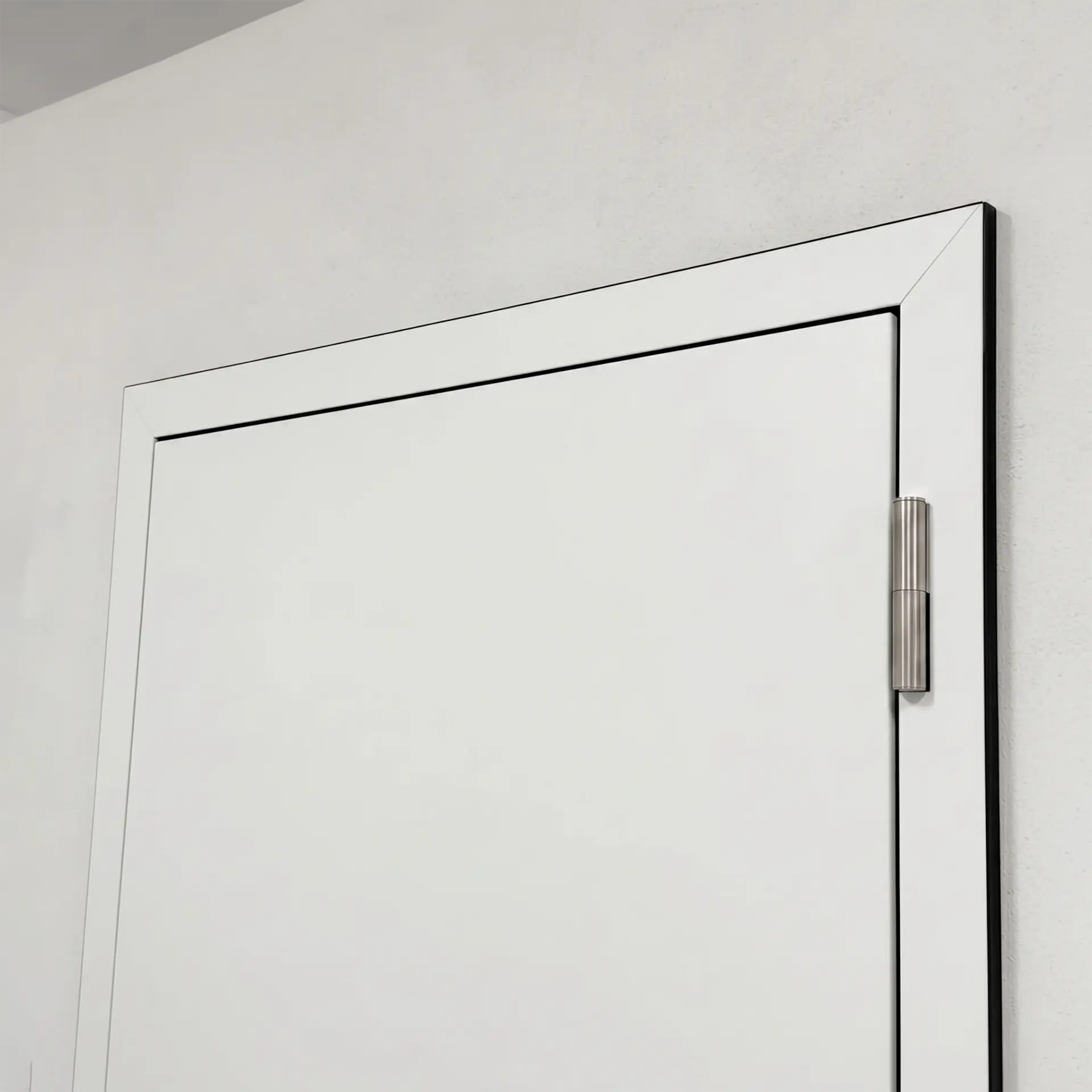
Hinges and locking points indicate how many ways the door fastens to the frame when it is closed: the more points, the harder it is to force or prise off its hinges.
On spec sheets you find:
- Hinges: usually 2 on standard doors, 3 or more on particularly heavy or oversized doors. They can be visible and adjustable or concealed with a flush frame. Concealed hinges are cleaner looking (flush-to-wall lines) and on Ariete doors they are used in the “4S” and “Concealed” versions.
- Anti-prising dog bolts: fixed prisms placed on the hinge side, which slot into the frame when the door is closed. On Ariete class RC3 models there are 3 fixed dog bolts, while on class RC4 models there is a continuous anti-lever lip (more protection).
- Auxiliary bolts: devices that move the locking points to the top and bottom of the door. Ariete standard: double rectangular auxiliary bolt with an anti-retraction blocking device.
- Top locking rod: a mechanism that locks the door at the top as well, stopping a burglar from “lifting it out”. Fitted as standard on every Ariete door.
A door with three locking points spread across top, middle and bottom (plus dog bolts and auxiliary bolts on the hinge side) is structurally much more resistant to a lever or crowbar attack than one with just a central lock.
Panels, insulation and seals
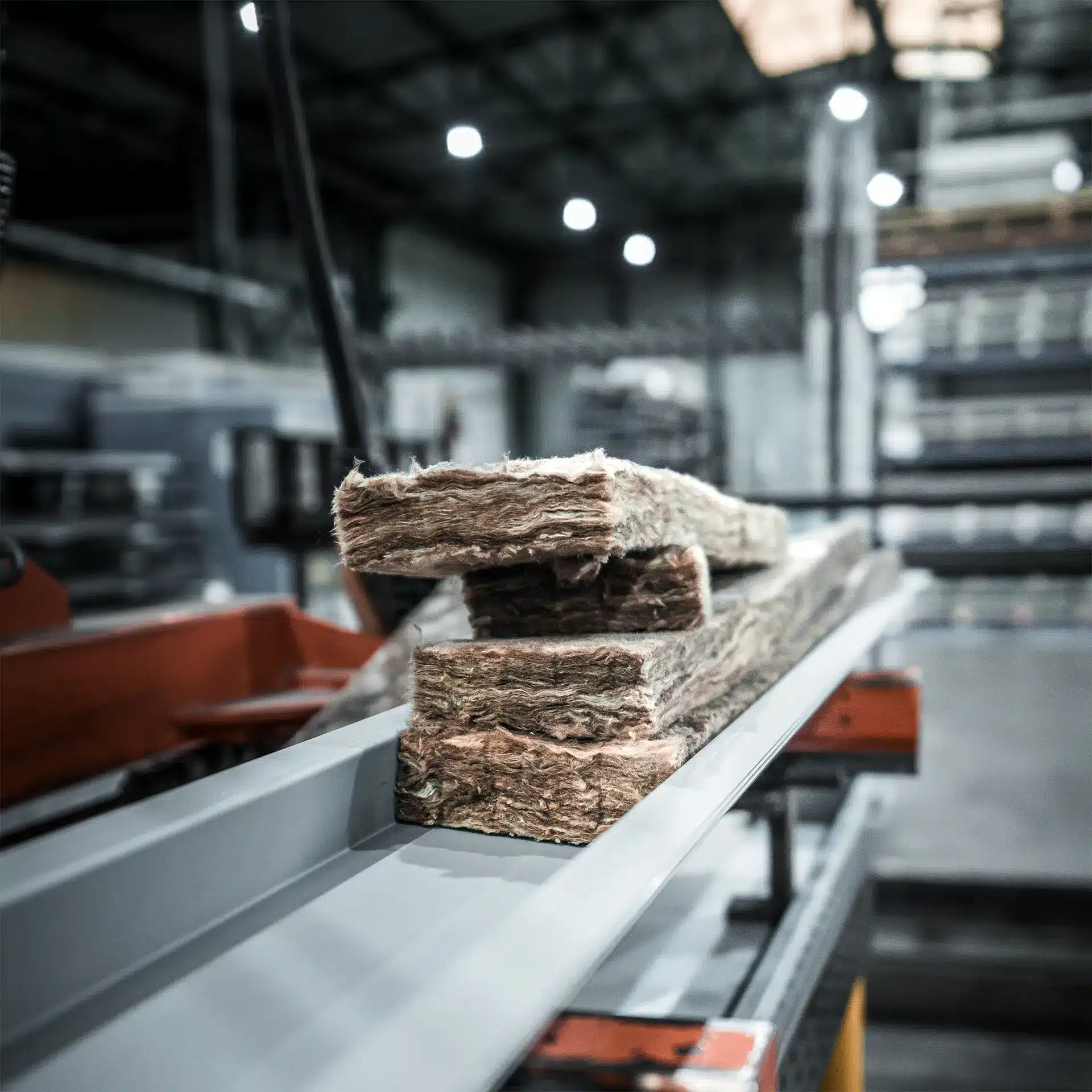
Panels, insulation and seals are the materials that fill and cover the door: they affect its external look and how well the door insulates against noise and cold.
What to look for on the sheet:
- External and internal cladding panel: it is the “face” of the door. On Ariete it can be customised for material (laminate, wood veneer, porcelain stoneware, aluminium, ceramic), colour and finish, with a thickness of 6 mm. On external doors the panel must be weather resistant.
- Internal insulation: the material that fills the gap between the steel sheets. Ariete uses fire-resistant mineral wool, which performs three functions at once: thermal insulation, acoustic insulation and fire protection.
- Double perimeter closing seal: it seals the edge of the door against the frame when it is closed. The double seal (one internal and one external) makes a big difference both for draughts and for perceived noise.
- Draught-excluder blade: a blade at the bottom that drops down automatically when the door closes, sealing the gap at floor level. Ariete standard: adjustable automatic drop-down draught-excluder blade.
- Threshold (external doors): the metal barrier at floor level, in aluminium on Ariete doors, which ensures water tightness and insulation against the cold coming in from below.
The item “fire-resistant mineral wool” is a detail worth looking for on the sheet: it performs clearly better (both thermally and acoustically) than the polyurethane or honeycomb cardboard that some low-cost manufacturers use to save money.
Want to know which armoured door is right for your home?
Every home has different needs, and the values that are “good” for a flat in a block are not the same as those needed for a detached villa. We help you read your spec sheet case by case and compare it with the one that is truly right for you.
Fill in the form with a few details about your home: we need them to prepare a serious quote for you, not a number plucked out of the air.
How to interpret the data for your needs
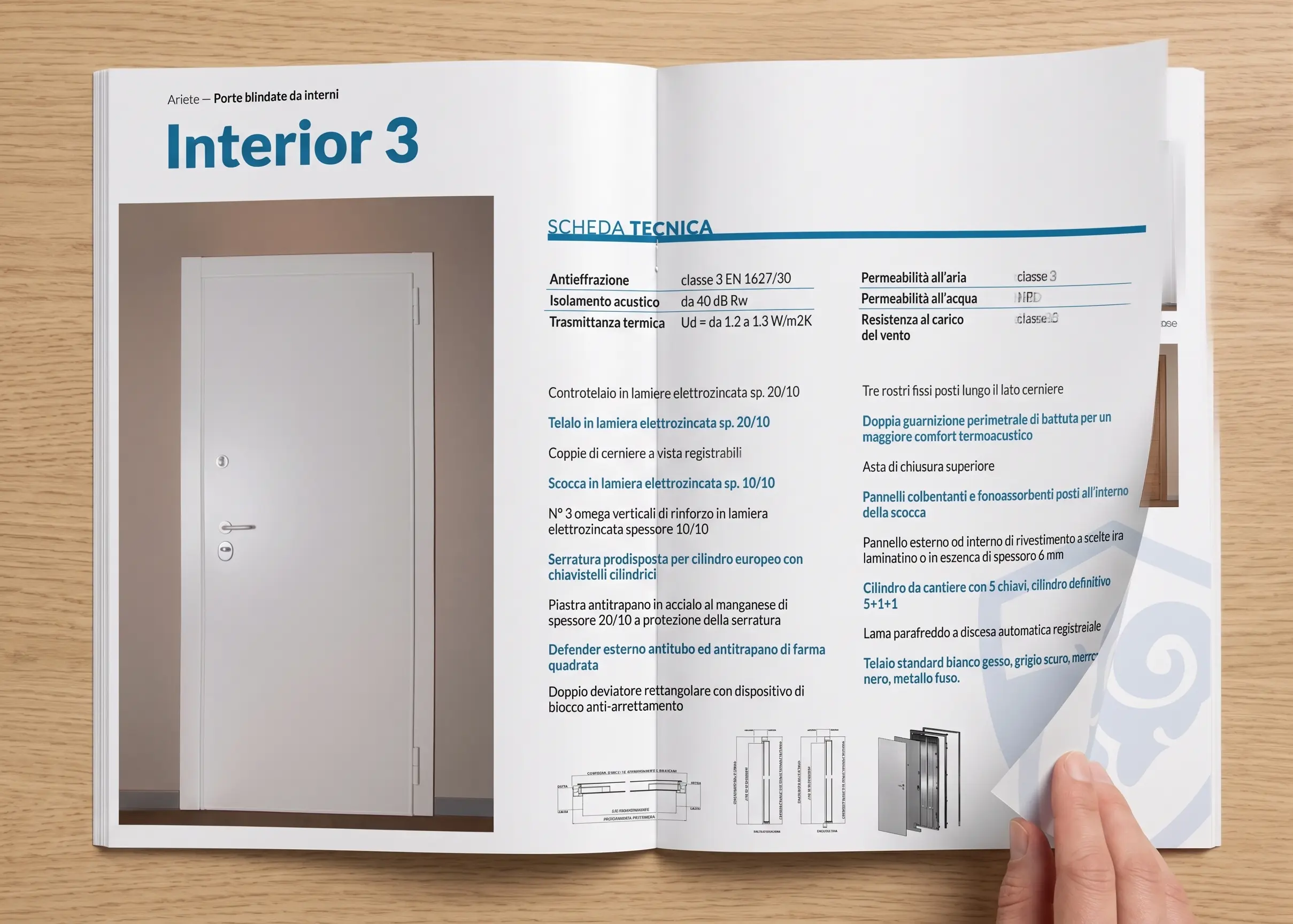
A spec sheet only reads well if you know what you are looking for: the “good” values change with the home, the climate zone and the exposure of the door.
Here is how to find your way with four typical cases.
Case 1: flat in a block
If you live in a flat with a door that opens onto the stairwell (the most common situation in Italy), the priority parameters are:
- Burglar resistance class: RC3 is enough, RC4 recommended if you live on the ground or first floor
- Sound reduction (Rw): aim for 40 dB minimum, especially if you have a lift nearby or noisy neighbours
- Thermal transmittance (Ud): 1.3 W/m²K is already an excellent value
- Water/wind permeability: of little relevance (it is normal to see NPD for water)
Case 2: villa or detached house
If the door opens directly onto the outside, the priorities are reversed:
- Burglar resistance class: RC4 essential. A villa is more exposed to prolonged attempts
- Thermal transmittance (Ud): aim below 1.3 W/m²K, ideally 1.2 W/m²K
- Water tightness: minimum class 5A
- Wind resistance: class C5
- Sound reduction: less critical, but 40 dB+ is still desirable
Case 3: entrance onto a busy or noisy road
If outside noise is your main problem (a shop below, a bus stop, constant traffic), focus on:
- Sound reduction (Rw): above 43 dB (the Ariete Interior 4 and Exterior 4 reach 43 dB as standard; specific models can touch 46 dB)
- Double perimeter seal + draught-excluder blade explicitly stated on the sheet
- Mineral-wool insulation (not polyurethane): it is the real difference in perceived dB
Case 4: cold climate zone (northern Italy, mountains)
If you live in climate zone E or F (e.g. Trentino, Aosta Valley, upper Lombardy), every tenth of transmittance counts:
- Thermal transmittance (Ud): minimum 1.2 W/m²K, ideally below 1.0 W/m²K
- Fire-resistant mineral wool + thermal threshold + draught-excluder blade indispensable
- Air permeability: class 3 minimum, to reduce the convective movements that let cold in with the door closed
To help you with the overall choice, also read our guide on how to choose an armoured door.
What values should your spec sheet have?
Answer 3 questions about your home and find out exactly which values the spec sheet of the right armoured door for you should have.
Here are the values your spec sheet should have:
| Burglar resistance class | – |
|---|---|
| Thermal transmittance (Ud) | – |
| Sound reduction (Rw) | – |
| Air / water / wind permeability | – |
| Insulation | – |
The certifications of armoured doors
The certifications stated on a spec sheet are the regulatory references that validate the values shown: without certification, the numbers on a sheet are just the manufacturer’s claims with no objective evidence.
The European standards you should see cited on the spec sheet of a serious armoured door are:
- UNI EN 1627 / EN 1630: defines the 6 burglar resistance classes (1-6) and the laboratory tests used to assign them. Reference: store.uni.com
- UNI EN ISO 10077: calculation of thermal transmittance Ud for doors and windows
- UNI EN ISO 717-1: methods for assessing acoustic insulation (the Rw value)
- UNI EN 12207: air permeability (classes 1-4)
- UNI EN 12208: water tightness (classes 1A-9A or NPD)
- UNI EN 12210: resistance to wind load (classes A1-C5)
- UNI EN 356: classification of anti-shatter laminated glass (e.g. P6B for armoured doors with glass)
The certifications are also indispensable for claiming the Italian Ecobonus, while the Italian Renovation Bonus applies regardless of the performance values.
Besides the technical standards, every armoured door sold in Italy must carry the CE marking, which declares conformity with the minimum European requirements for construction products.
Conclusions
A spec sheet is the objective snapshot of what an armoured door is worth.
Learning to read it across its 8 essential items (class, Ud, Rw, weather resistance, locking system, structure, hinges, panels) lets you compare models and manufacturers objectively, going beyond the marketing and beyond the final price.
The values should not be looked at in absolute terms but in relation to your home: a class RC3 can be perfectly fine for a flat in a block, while an exposed villa always needs a class RC4 with certified air, water and wind resistance.
Ariete armoured doors are designed and certified to the European standards, with a complete spec sheet for every model available to consult in the product catalogue.
If you want to see the sheet of a specific model or compare it with another door you are considering, we can read it through with you point by point.
Take the time to read the sheet properly.
It is an investment you will make only once, but one that shapes your security, your comfort and your energy bills for the next 20-30 years. For more information on prices, request a free quote.
Frequently asked questions
Ud stands for “thermal transmittance of the door” (the U-value for a door).
It is expressed in W/m²K and indicates how much heat passes through the door between inside and outside. The lower the value, the better the door insulates. Ariete doors have a Ud from 1.2 to 1.3 W/m²K.
Rw is the sound reduction index, expressed in decibels (dB).
It indicates how many dB the door cuts from the outside noise: a door with Rw 40 dB cuts the noise of someone outside by 40 dB. The higher the value, the quieter the door.
It depends on the door. NPD means “No Performance Determined”, that is not tested in that condition.
For an internal door (stairwell) an NPD for water is normal and not a problem, because water is not a relevant variable in that setting. For an external door, however, NPD is a warning sign: it means the door has not been tested to withstand rain and is probably not suitable for external exposure.
In theory, yes: if the armoured doors are certified to the same European standards, the stated values can be compared.
In practice, though, a class RC3 door sold in a DIY superstore is absolutely not comparable to a class RC3 door made by a specialist company.
The burglar resistance class certifies that certain tests have been passed, but it does not tell you the real quality of the structure, lock, insulation, components and durability over time.
It is also essential to check that the class is genuinely certified and not simply described as “class 3 type” or “equivalent”.
Fitting also plays a decisive role: a poorly fitted door can lose much of its performance in terms of security, thermal insulation and acoustic insulation.
P6B is the classification (under standard UNI EN 356) of anti-shatter laminated glass.
It indicates glass that withstands repeated blows from a sledgehammer or axe, certified through tests in which a steel ball is dropped from increasing heights. It is the highest class normally used for residential armoured doors with glass.
No, each model has its own sheet.
The class RC3 doors (Interior 3, Exterior 3) have different values and components from the class RC4 doors (Interior 4, Exterior 4). The performance parameters and components are stated model by model in the Ariete catalogue.
The notation “20/10” indicates the thickness in tenths of a millimetre: 20/10 is 2 mm of sheet steel.
In the same way, 12/10 = 1.2 mm, 10/10 = 1 mm. The greater the thickness of the sheet steel (of the body and frame), the more robust the door is structurally.
The sheet refers to the door model and remains valid as long as that model is produced to the same specifications.
The certifications (e.g. EN 1627) rely on laboratory tests that are repeated periodically or whenever the manufacturer changes significant components. A door fitted 10 years ago keeps its classification, but if the current model has different specifications, today’s sheet no longer matches the old one.
